
US stock futures posted losses early in the Asian market session on Thursday, January 29. Markets reacted further to the overnight Fed interest rate decision and Fed Chair Powell’s press conference.
Despite the morning pullback, Fed Chair Powell’s positive view of the economy and expectations of multiple Fed rate cuts continued to support a bullish outlook for the US index futures.
Meanwhile, US economic data, Fed chatter, and earnings will influence market sentiment later in the session.
Below, I’ll outline the key market drivers, the medium-term outlook, and the technical levels traders should watch.

Fed Chair Powell Cools Bets on an H1 2026 Rate Cut
Overnight, Fed Chair Powell downplayed the chances of an H1 2026 rate cut, despite two FOMC members dissenting from the decision to keep interest rates at 3.75%. Powell signaled a meeting-by-meeting policy stance, citing elevated inflation as a hurdle to further rate cuts.
According to the CME FedWatch Tool, expectations of a March Fed rate cut fell from 17.3% on January 27 to 13.5% on January 28. Meanwhile, the chances of a June cut eased from 65.4% to 60.8% on January 28, underscoring optimism that inflation will soften, enabling the Fed to reduce rates further.
Market expectations of multiple Fed rate cuts in 2026 remain a tailwind for US stock futures.
Dow Jones Price Forecast
Every new Dow Jones analysis as it publishes, today's technical signal and key levels, live price — on one page.
See all Dow Jones forecastsUS Economic Data and Earnings in Focus
US futures pulled back during the Asian session on January 29. The Dow Jones E-mini dropped 98 points, while the Nasdaq 100 E-mini and the S&P 500 E-mini declined 2 points and 5 points, respectively.
Microsoft (MSFT) overshadowed Meta (META) and Tesla (TSLA) after reporting Q4 earnings that showed slower cloud growth. MSFT shares dropped 6.14% in after-hours trading, pulling the Nasdaq 100 E-mini and the S&P 500 E-mini into the red. Meanwhile, Meta and Tesla rallied 6.64% and 2.16%, respectively, in after-hours trading on strong earnings results, limiting the morning losses for the Nasdaq 100 E-mini and S&P 500 E-mini.
Later on Thursday, US economic data and corporate earnings will influence sentiment. Economists expect initial jobless claims to increase from 200k (week ending January 17) to 205k (week ending January 24).
A larger-than-expected rise in claims, nearer 250k, would likely boost bets on a June Fed rate cut and support demand for risk assets. However, a lower reading is unlikely to impact risk appetite, given the Fed’s focus on inflation.
Meanwhile, the earnings calendar is likely to have more influence on US stock futures, given the optimism over Q4 earnings. Caterpillar (CAT), Mastercard (MA), Visa (V), and Apple (AAPL) are among the marquee names to release earnings results for the fourth quarter.
Strong earnings could send US index futures toward their record highs, supporting the bullish medium-term outlook.
Key Technical Levels for Dow Jones, Nasdaq 100, and S&P 500
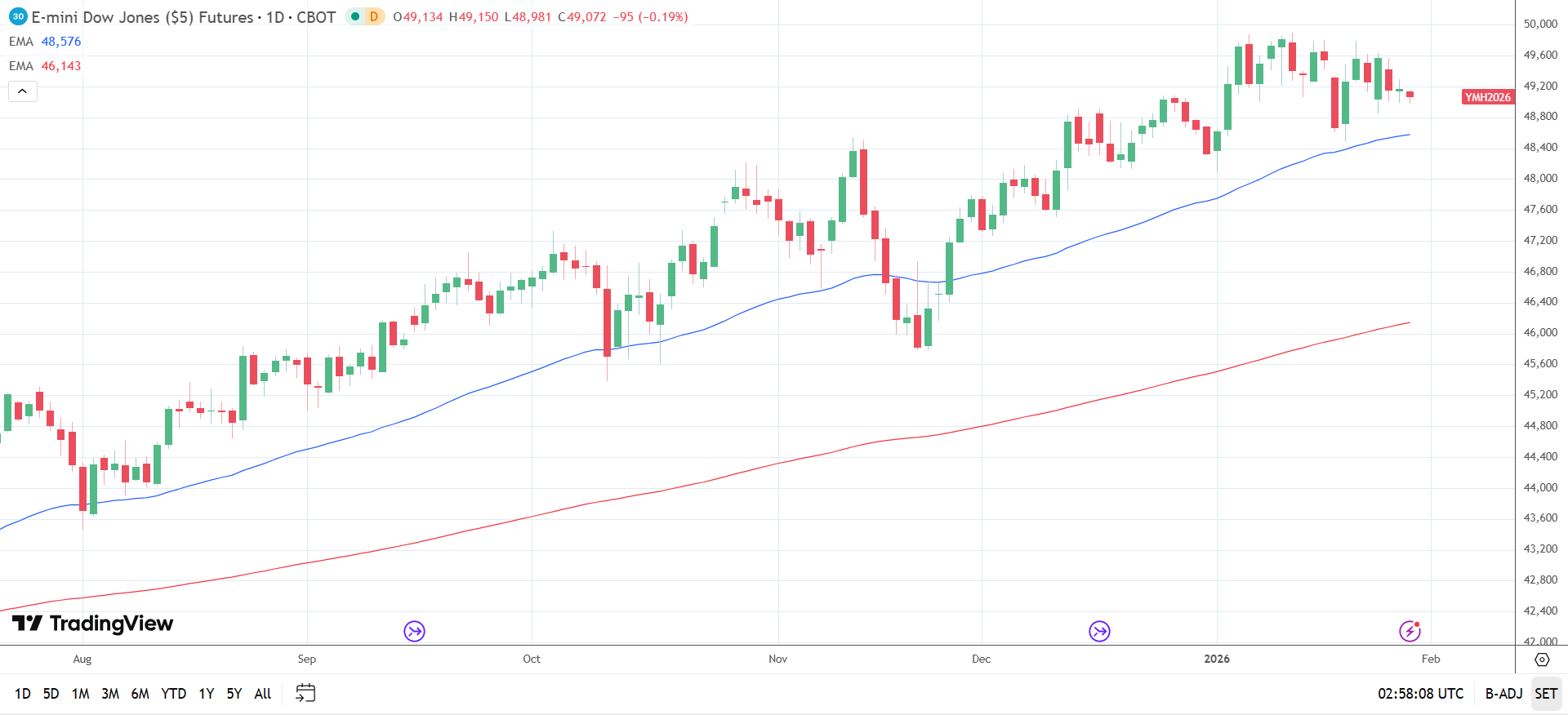
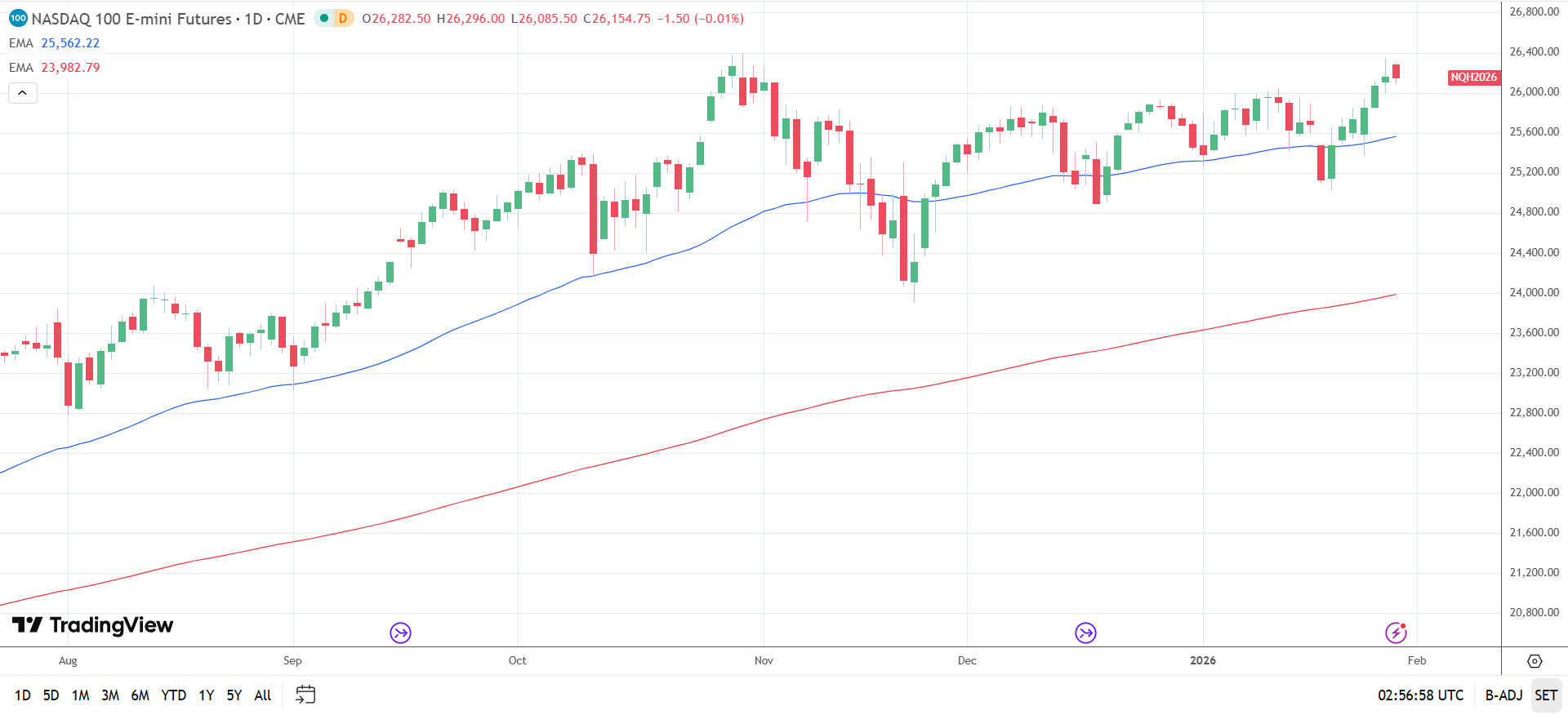
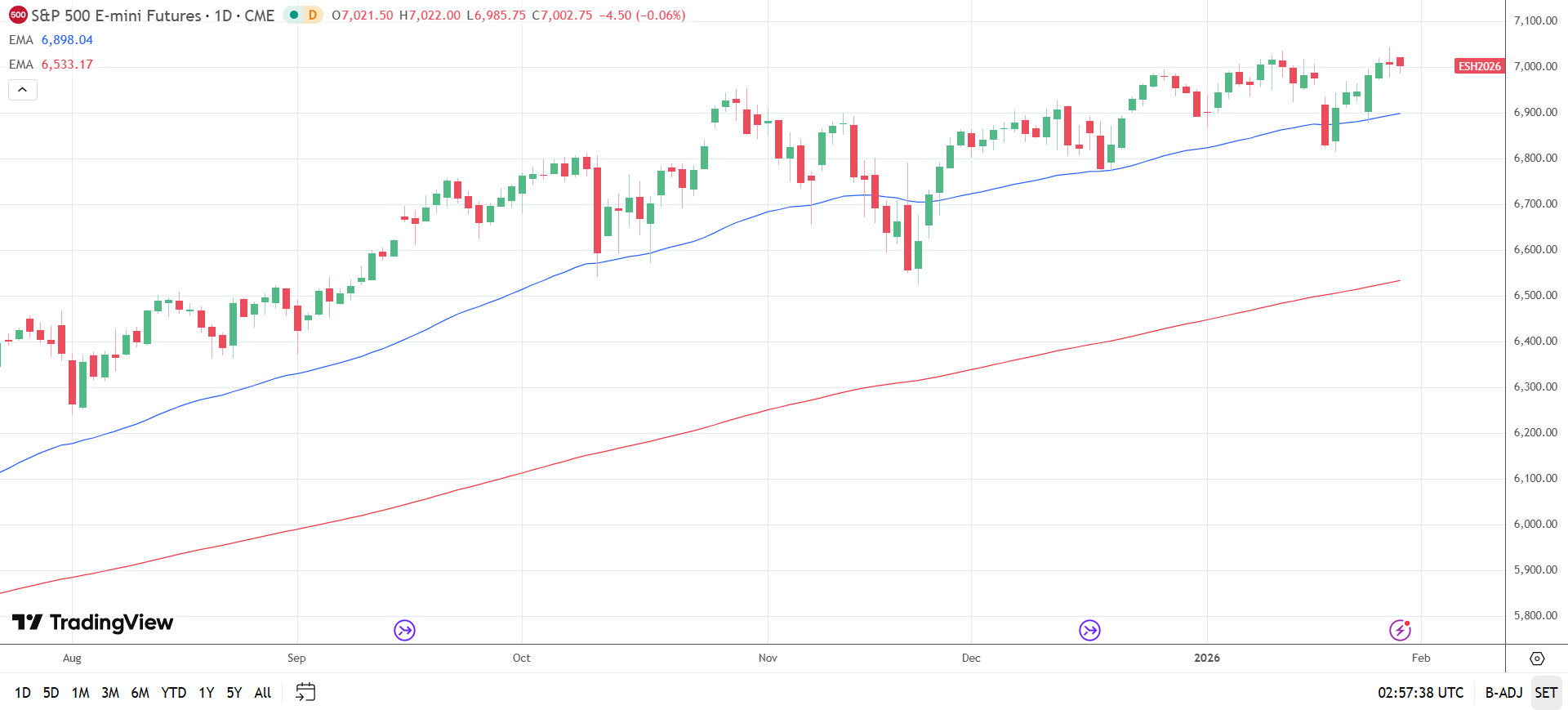
Despite the morning losses, the Dow Jones E-mini, the Nasdaq 100 E-mini, and the S&P 500 E-mini remained above their 50-day and 200-day EMAs. The EMAs signaled a bullish bias, aligning with positive fundamentals.
Near-term trends will hinge on geopolitical risks, earnings, Fed chatter, the BoJ’s policy stance, and US economic indicators. Key levels to monitor include:
Dow Jones
- Resistance: the January 13 record high of 49,901, and then 50,000.
- Support: 49,000 followed by the 50-day EMA (48,576).
Nasdaq 100
- Resistance: the October 30 record high of 26,399.
- Support: the 50-day EMA (25,562), 25,000, and then 24,500.
S&P 500
- Resistance: the January 13 high of 7,036, followed by 7,500.
- Support: the 50-day EMA (6,898) and then 6,500.
Outlook: US Economy, Rate Cut Bets, and Earnings Support Bullish Outlook
In my opinion, the short-term price outlook remains bullish. Expectations of an H1 2026 Fed rate cut and market optimism over Q4 tech earnings reaffirm the bullish outlook. These positive fundamentals align with technicals for US index futures.
However, several scenarios would derail the bullish medium-term outlook, including:
- Increasing geopolitical risks.
- The Bank of Japan declares a higher-than-expected neutral interest rate (potentially 1.5%-2.5%). A sharply narrower US-Japan rate differential may trigger an unwind of yen carry trades. Such a scenario would invalidate the short-term outlook.
- Fed chatter and US data temper expectations of multiple Fed rate cuts in 2026.
- Corporate earnings and outlooks disappoint.
Conclusion: Bullish Bias Intact
In summary, the strong US economy, a dovish Fed policy outlook, upbeat earnings, and a cautious BoJ reinforce the bullish short- and medium-term outlook for US stock futures.
However, traders should monitor BoJ rhetoric, warnings of yen intervention, and USD/JPY trends. Hawkish BoJ commentary, a dovish Fed, and more intervention threats could push USD/JPY sharply lower, potentially triggering an unwind of yen carry trades.
Despite risks of an unwind of yen carry trades, new all-time highs for US stock futures remain in play if US economic data boosts bets on a June Fed rate cut. Fed rate cuts are likely to have a more lasting effect on company earnings and equity valuations than narrowing US-Japan rate differentials on risk sentiment.
Follow our live coverage and consult the economic calendar for real-time market updates.