


Dusk Network (DUSK) is the latest privacy coin to post a major price boom post rival Zcash’s (ZEC) governance crisis.
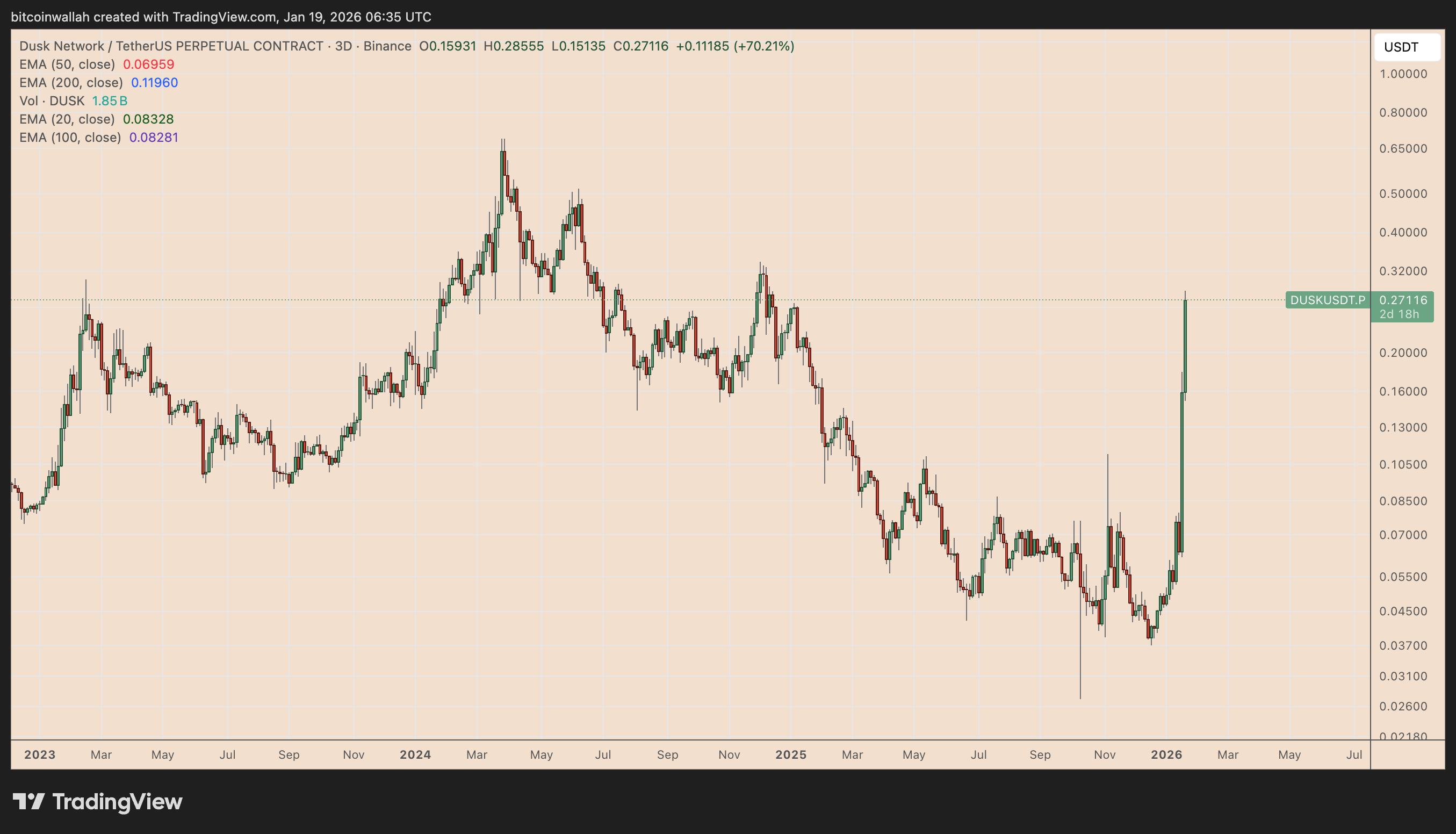
As of Jan. 19, the token was up about 545% year-to-date, hitting $0.2855 for the first time in over a month. Meanwhile, it was trading 950% higher when compared to its Oct. 10 nadir.
Can the DUSK price boom continue? Let’s examine.
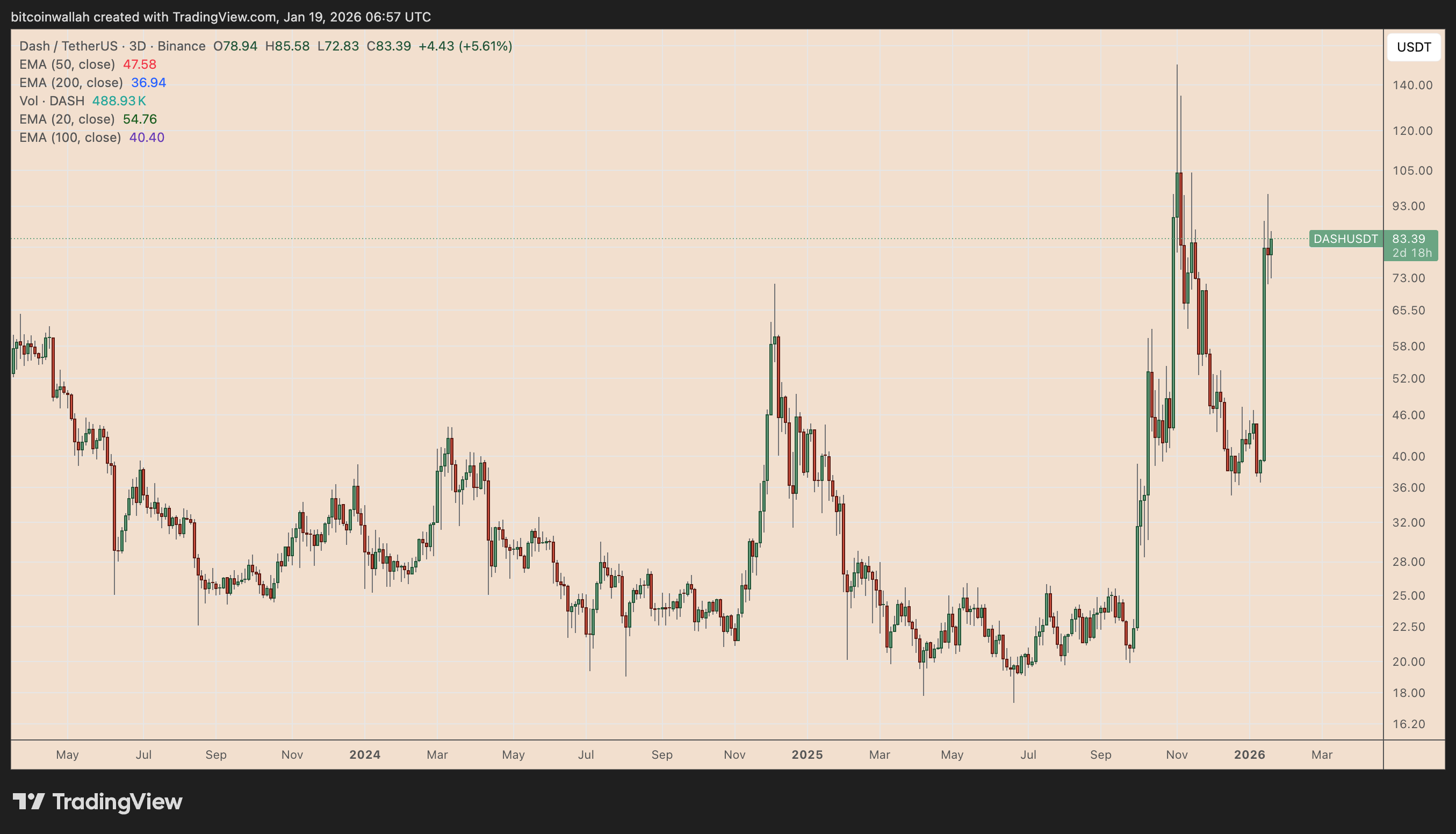
DUSK fit that screen. It markets itself as a privacy-preserving infrastructure that can still support regulated use cases, especially around tokenized securities and compliant settlement.
In a tape where “RWA” and regulated on-chain finance narratives can ignite quickly, that framing appeared to have attracted incremental demand. As a result, DUSK’s size and liquidity profile amplified the price response.
Smaller-cap tokens typically have thinner order books than majors, so a relatively modest inflow can push price through nearby resistance levels.
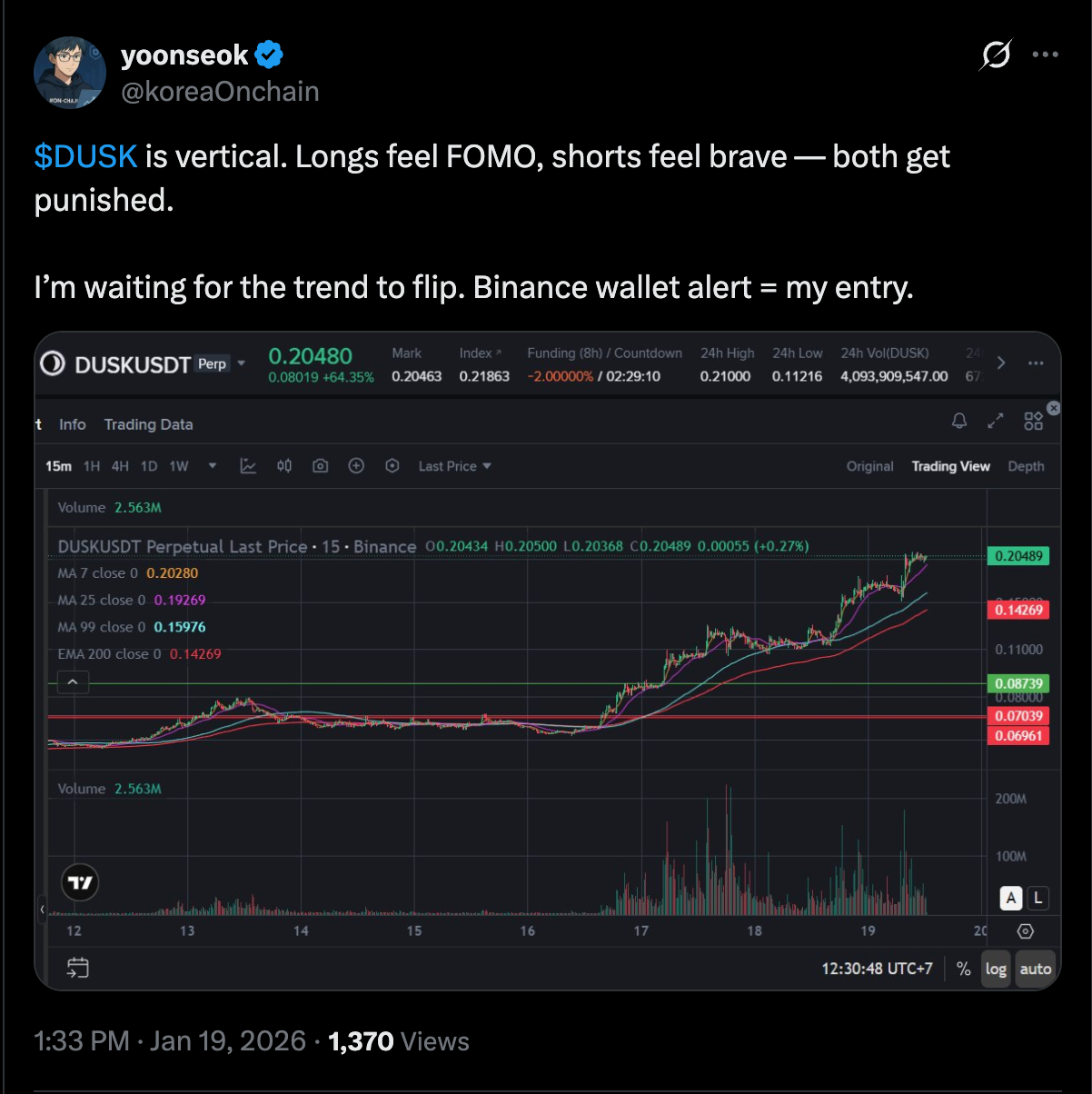
Breakouts trigger systematic buying, trend-following entries, and discretionary momentum chasing. Those flows tend to arrive in clusters, pushing price higher in a reflexive loop: rising price draws attention, attention draws volume, volume confirms the move.
DUSK Most ‘Overbought’ in History
DUSK’s relative strength index (RSI) across most-watched timeframes has risen way above the overbought threshold of 70. In simple terms, the token is now overvalued and carries significant risks for bullish traders in both spot and derivatives markets.
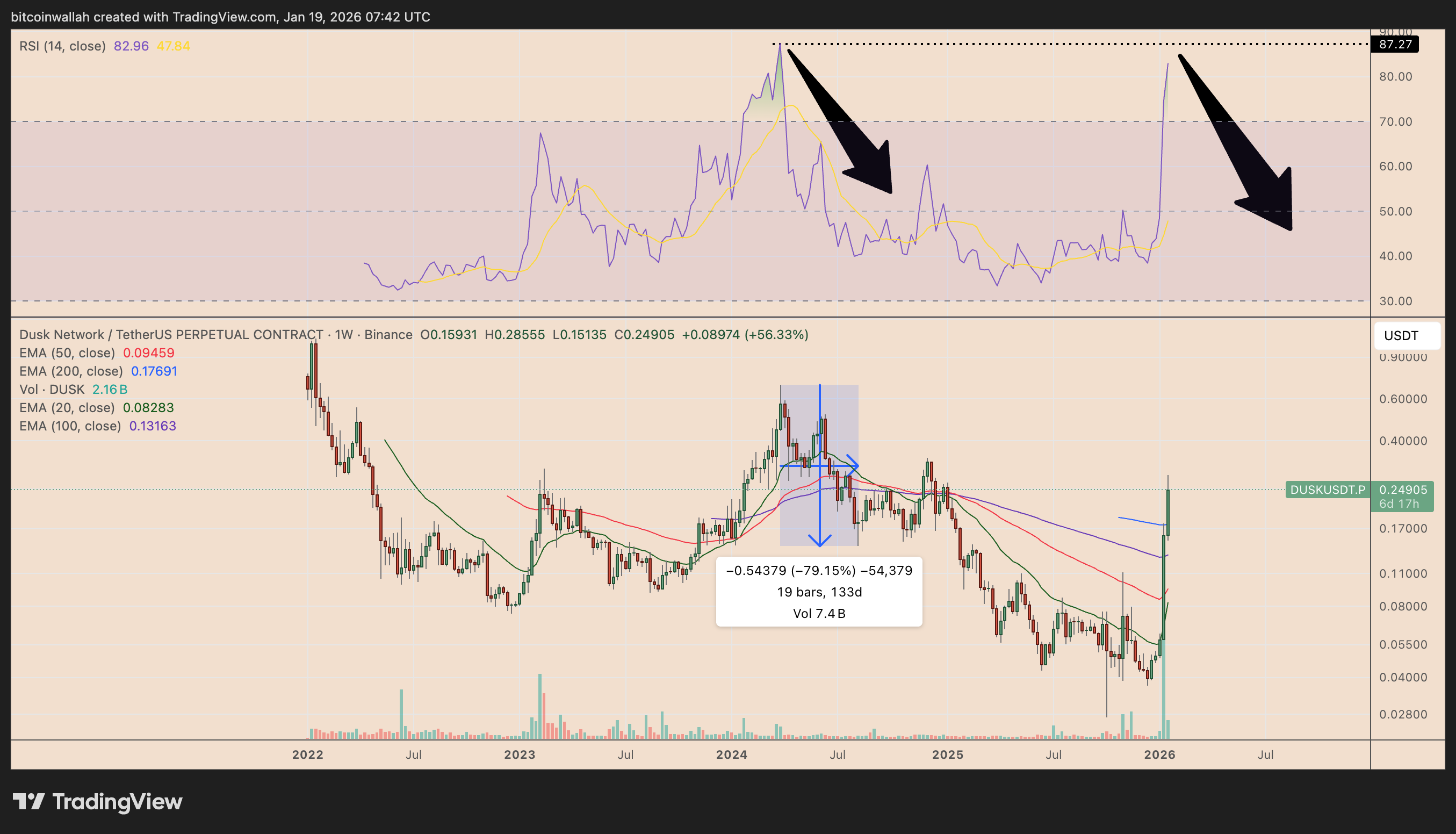
For instance, DUSK plunged by around 80% in 2024 following its RSI’s rise to 87.27, way above the 70 threshold. A similar scenario can occur in 2026, given the token’s RSI is around 82.96.
Fibonacci Levels Raise Downside Risks
DUSK’s surge has also carried it into a technical zone where prior rebounds have tended to stall, raising the risk of a fast mean-reversion move.
DUSK previously failed near the 0.236 retracement, a shallower recovery marker that signaled weak demand at the time.
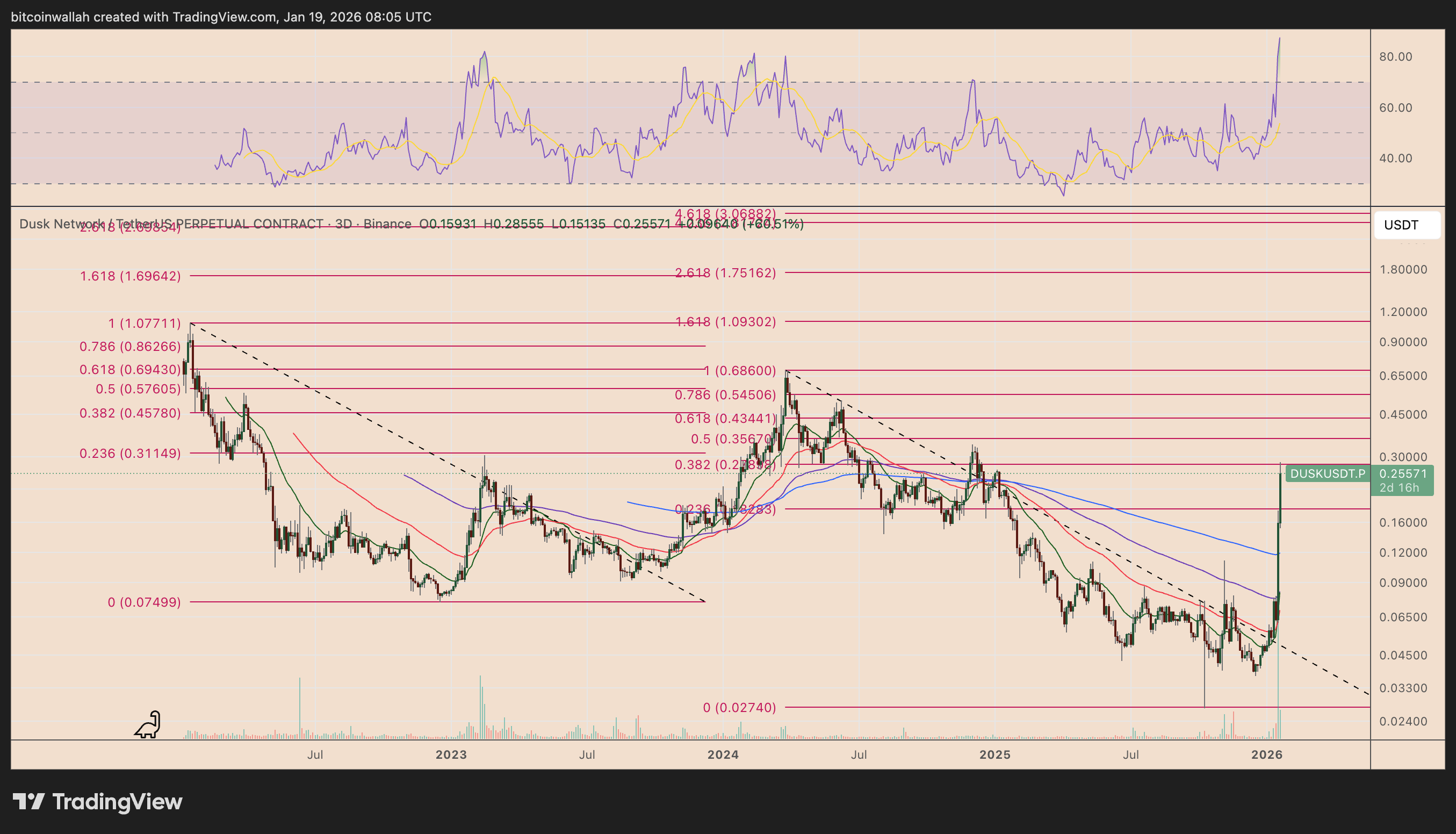
Now the token has pushed into the 0.382 zone around ~$0.219, and that level matters because a rejection here can trigger sharper downside than a 0.236 failure.
Traders typically place stop-losses just below the 0.382 band, so a slip under it can accelerate selling.
If DUSK loses the ~$0.219 area, the next technical support sits near the 0.236 retracement around ~$0.183. A deeper flush can expose the prior consolidation zones around $0.16–$0.15, with the bigger “last line” support near the recent base in the $0.12 area.
Conversely, if DUSK holds above ~$0.219 and reclaims the recent peak near $0.285–$0.286, bulls can aim for the next retracement levels at ~$0.357 (0.5 Fib) and ~$0.434 (0.618 Fib) as upside checkpoints.