
The European Central Bank faces a delicate balancing act. On the one hand, economic growth across the euro area remains fragile, confidence has been shaken by the geopolitical tensions, and hopes are high that a diplomatic resolution to the Iran war could ease some of the pressure on energy markets and households.
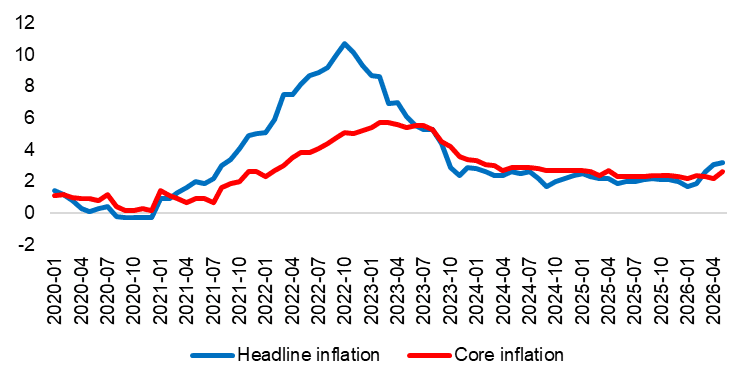
On the other hand, inflation risks are increasing, and policymakers may be increasingly concerned that inflation expectations are displaying early signs of drifting higher. In May, headline inflation rose to 3.2% year on year while yearly core inflation rose for a first time since the Iran war – reaching 2.5% (Figure 1). Consumer inflation expectations three years and five years ahead have increased modestly.
Figure 1. Euro area inflation has moved up
Euro area headline and core harmonised index of consumer prices, annual rates of change, %
Against such a backdrop, the ECB is widely anticipated to deliver a 25 basis point interest rate rise on Thursday. Such a move would be consistent with recent communications from policymakers as well as with the central bank’s determination to ensure that inflation returns sustainably to its 2% target. However, the real focus for financial markets is unlikely to be the widely anticipated rate increase. Rather, investors will be scrutinising President Christine Lagarde’s comments for clues about how the Governing Council views the balance of risks and whether policymakers believe further tightening may still be warranted later on this year.
Policymakers will not want markets to conclude that June necessarily marks the end of tightening. Instead, the ECB may keep the extent of any further tightening cycle open-ended in its comments given present geopolitical uncertainty. Even if any peace agreement were reached bringing the Iran war to a swift close inside the coming months, the ECB is probable to stress that it is still navigating an ecosystem that already sits somewhere around its adverse geopolitical scenario. Policymakers are becoming growingly attentive to signs that inflation expectations are edging up, and the ECB may use its forthcoming meeting to signal that a further rate rise remains a live possibility should those pressures become more pronounced.
Why a Peace Deal Would Not End the Inflation Debate
In many respects, the ECB’s challenge is that monetary policy operates with long and variable lags. Even if geopolitical conditions were to durably improve tomorrow, the economic consequences of recent events may nevertheless continue reverberating through the euro area economy for months or even several years. Businesses have already adjusted pricing strategies, governments have increased spending commitments, and supply chains have been forced to adapt to a more uncertain international ecosystem. Such developments may prove difficult to reverse quickly.
From the perspective of the ECB, the greater medium-run risk is still that inflation proves overly persistent and overshoots the 2% target rather than undershoots it. A peace deal would undoubtedly trim some of the immediate upside risks for inflation from energy prices and immediate downside risks for economic growth, but it would not erase the economic aftershocks of the conflict overnight. Supply-chain disruptions, shifts in pricing behaviour, higher defence spending and lingering uncertainties may continue influencing inflation dynamics well after any fragile agreement is signed. Resultantly, the ECB is likely to retain a tightening bias and to keep the door open to additional rate hike(s) beyond June should inflation expectations display signs of further upside drift.
The possibility of a peace agreement nevertheless does represent a crucial upside risk for the euro area outlook. Energy prices have historically been among the greatest economic vulnerabilities for the region, and any sustained curtailment of geopolitical risk premiums would provide relief for households and businesses alike. Lowered energy costs may support real incomes, improve corporate profitability and curtail pressure on public finances. For the ECB, any peace agreement would mean less time spent combatting geopolitical inflation and more room to focus on nurturing a flagging economy.
Yet even under such a scenario, policymakers are unlikely to declare victory over inflation. Central bankers remain acutely aware that inflation expectations can become entrenched. While there is little evidence yet of a dramatic de-anchoring of expectations, even further signs of modest slippage are likely to attract close scrutiny from Frankfurt.
EUR/USD Price Forecast
Every new EUR/USD analysis as it publishes, today's technical signal and key levels, live price — on one page.
See all EUR/USD forecastsEuro Outlook Hinges on ECB Signals and Geopolitics
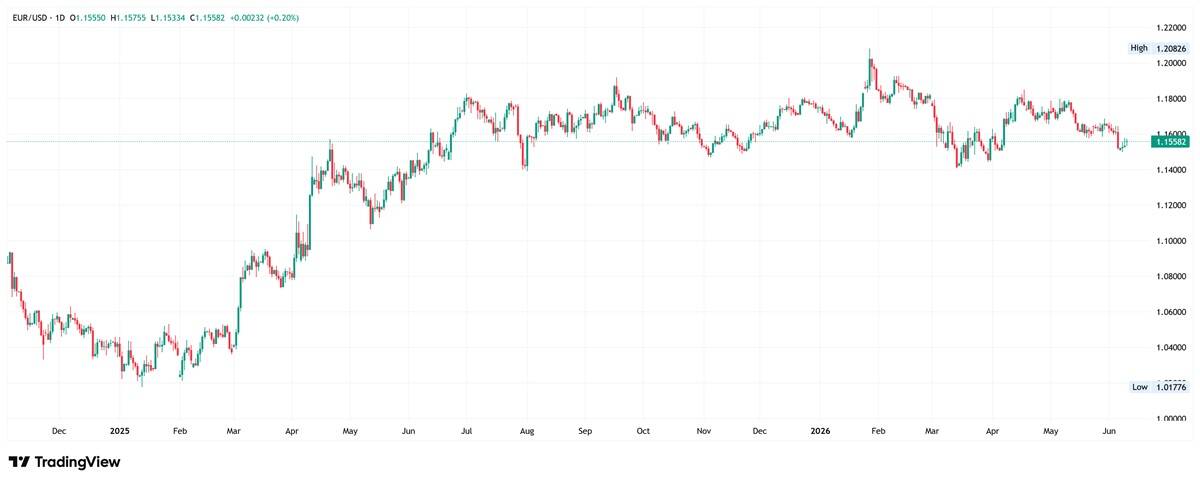
The implications for the euro exchange rate (Figure 2) are possibly significant. In the near term, a 25bp rate rise combined with signals that further tightening remains possible may provide support for the single currency – which has modestly weakened since the war.
Figure 2. Daily chart of the EUR/USD exchange rate
Over the medium run, however, the euro’s trajectory will hinge on a combination of factors such as inflation dynamics, growth performance and geopolitical developments. A credible peace agreement reducing energy prices may improve terms of trade for the region and strengthen investor confidence in the economic outlook.
For now, the most likely message from this week’s meeting is that the ECB remains vigilant. The Governing Council appears poised to preserve maximum flexibility, acknowledging the potential benefits of any more stable geopolitical ecosystem while making clear that safeguarding price stability remains its overriding priority.
In short, the central bank’s challenge is not simply bringing inflation down; it is ensuring that inflation expectations remain firmly anchored while the euro area navigates an uncertain geopolitical landscape. That balancing act is likely to define ECB policy not only this week, but for many months to come.
Dennis Y. Shen is a macroeconomist and the former Chair of the Macroeconomic Council of the European credit rating agency. He is a lecturer at the International School of Management (Germany) and serves as a Member of the Supervisory Board of Visioneers gGmbH. He is a regular contributor for the London School of Economics.