Broad Sector Sell-off Led by Tech
Major US benchmarks took a sizeable hit on Thursday – led by a sell-off in tech – and closed the session down 2.7% amid what is now termed as ‘the AI scare trade’. 343 companies in the S&P 500 reported losses, with about 160 names ending in the green.
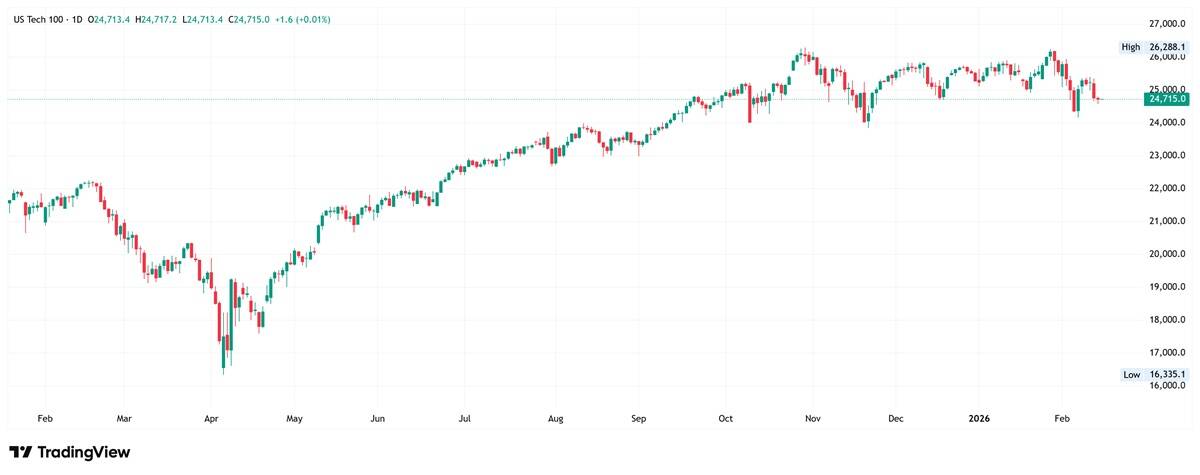
Ultimately, Thursday’s scorecard showed the tech-heavy Nasdaq 100 slid 513 points (2.0%) to 24,687, the Dow Jones fell 669 points (1.3%) to 49,451, and the S&P 500 lost just over 100 points (1.6%) to 6,832.
What’s particularly striking is how quickly the AI fear trade has metastasised across sectors. Logistics companies saw sharp declines, with publishers, financial services firms, and even commercial real estate companies also finding themselves caught in the downdraft as investors assess which business models might be vulnerable to AI disruption.
BTC offered little relief as a safe haven, falling 3.0% against the USD and currently trading around US$66,000. US Treasuries, however, caught a strong bid, sending the 10-year yield to 4.10% – a level not seen since early December last year. Risk-off flows clearly went to Bonds, as Spot Gold and Silver settled lower, with the former elbowing back under the widely watched US$5,000 barrier.
US Inflation Numbers Eyed Today
Ahead of today’s US January CPI inflation report at 1:30 pm GMT, Wednesday’s blowout January jobs report came in pretty much stronger than expected across all key metrics – albeit traders were left to digest this headline print alongside the latest revisions, which painted a sobering picture of the jobs market last year.
As shown in the LSEG economic calendar below, economists expect both YY headline and core CPI inflation measures to ease to 2.5% from 2.7% and 2.6%, respectively. The estimated range for the headline number spans between 2.8% and 2.3%; the forecast distribution is also interesting, with investors likely looking to the max/min estimates closely.
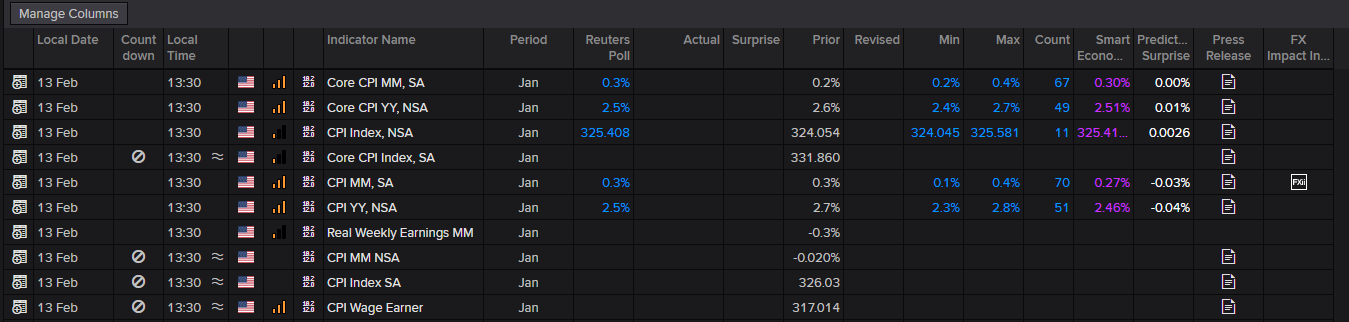
Excluding December’s in-line print of 2.7%, headline YY inflation undershot consensus in both November and October last year. If we get 2.5% or below today, it would bring inflation back to levels seen when US President Donald Trump announced his ‘Liberation Day’ tariffs in April last year, suggesting that the tariff agenda that was expected to trigger an increase in price pressures was possibly overblown. Additionally, easing inflation suggests there is room to lower the target rate without triggering a resurgence in inflation.
However, I am leaning toward a hawkish surprise today from a trading perspective – one that should benefit USD longs and weigh on Stocks.
Here’s why:
- First, economists expect cooling inflation across the YY measures; therefore, an upside surprise would catch many off guard, particularly if we hit the upper bound of the estimates noted above. Also, remember that, aside from December’s data, the numbers from November and October missed expectations, which I feel will somewhat add to a surprise beat.
- Second, a positive CPI could trigger a positioning squeeze given that the USD remains overstretched to the downside.
- Third, with US jobs numbers coming in solid for January, a decent CPI beat should create a 1-2 punch, potentially prompting another hawkish repricing of the Fed funds target rate.
My reason for not favouring a dovish scenario is that unless we see a monster miss in the data, positioning suggests limited downside. Additionally, the jobs report suggests that, at least in the near term, the Fed has no urgency to ease policy.
Bitcoin Price Forecast
Every new Bitcoin analysis as it publishes, today's technical signal and key levels, live price — on one page.
See all Bitcoin forecastsWritten by FP Markets Chief Market Analyst Aaron Hill