I want to kick off this morning’s briefing by stepping back to acknowledge the performance April delivered; it is quite extraordinary. The S&P 500 and the Nasdaq 100 rallied 10% and 16%, respectively, recording their best months since 2020. Arguably, this has unfolded against a backdrop that should weigh on stocks.

Hormuz Standoff
In the Middle East, the Strait of Hormuz remains (double) blockaded, with US President Trump sticking to his guns. He recently said he wants the blockade to continue, as he sees it as the most effective way to inflict economic pain on Iran and force the country back to the negotiating table without using military force. He also told reporters that the Iranian economy is crashing and promised that oil will drop once the war ends. Time will tell on that one.
Iran has said the US blockade must be lifted before talks can progress, but the US is not budging. Tehran is not giving anything away, and its new supreme leader, Mojtaba Khamenei, has vowed not to relinquish nuclear or missile technologies.
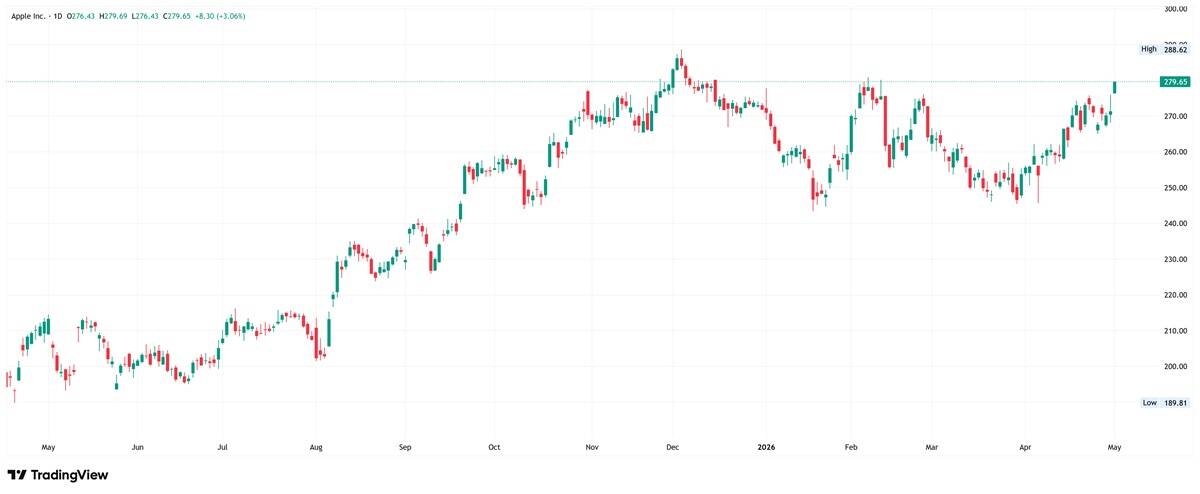
In the equities space, Apple (AAPL) delivered results that I think broadly reassured a market that needed reassurance from the top of the Magnificent 7. Gross margins came in broadly in line with estimates, up 22% to US$54.78 billion, with the company sitting atop US$45.6 billion in cash and cash equivalents – a reminder, if one were needed, of how formidable Apple’s financial position remains.
The stock rose in after-hours trading, which I view as a reasonable reaction, though I would caution against reading too much into after-hours moves given the volatility we have seen this earnings season.
ECB and BoE Are Considering Rate Hikes
Both the ECB and the BoE held rates at 2.0% and 3.75%, respectively, on Thursday, with Middle East uncertainty dominating both events. Both central banks are evidently transitioning to a hawkish stance, though I feel they are in rather different positions.
Let’s take the BoE’s 8-1 vote split. Chief Economist Huw Pill called for an immediate 25 bp hike, reflecting a change from the unanimous vote seen at the previous meeting; for me, this is considered hawkish. However, from the ECB, it was a unanimous vote, yet it was ECB President Christine Lagarde – not the MPC’s minutes – that carried the more explicit signal of a hike. So, on one side, the ECB is unified in its decision to hold right now but is clearly more open to raising rates in its communication, while the BoE has been slightly more cautious.
My overall read is that both central banks are heading in the same direction, but the ECB faces a harder communications challenge, whilst the BoE faces a more difficult economic test, with a more deeply embedded inflation problem.
If energy prices remain elevated in May, I think a June ECB hike becomes probable. For the BoE, I suspect the 8-1 split becomes 7-2, and then the question is simply one of timing.
US Data and a Light Calendar Ahead
US GDP grew at an annualised rate of 2.0% in Q1 26 (first estimate), marking a sharp acceleration from the Q4 25 reading of 0.5%, with the AI investment Supercycle unmistakably visible in the numbers. But I cannot look at this data and feel entirely comfortable. The US March PCE price index jumped 0.7%, the steepest monthly reading since 2022, while YY core PCE also increased by 3.2%, and the personal savings rate also dropped. For now, at least, the Fed is going nowhere, as reflected in the rate curve.
Today’s calendar is rather light, offering traders little fresh impetus to close out the week. Attention will now shift firmly to next week, where Tuesday’s RBA rate decision and Friday’s US NFP print will be the two events most likely to move markets. This is particularly so for the latter, given how closely the Fed will be watching for any signs that the labour market is beginning to crack under the weight of elevated energy costs.
Written by FP Markets Chief Market Analyst Aaron Hill