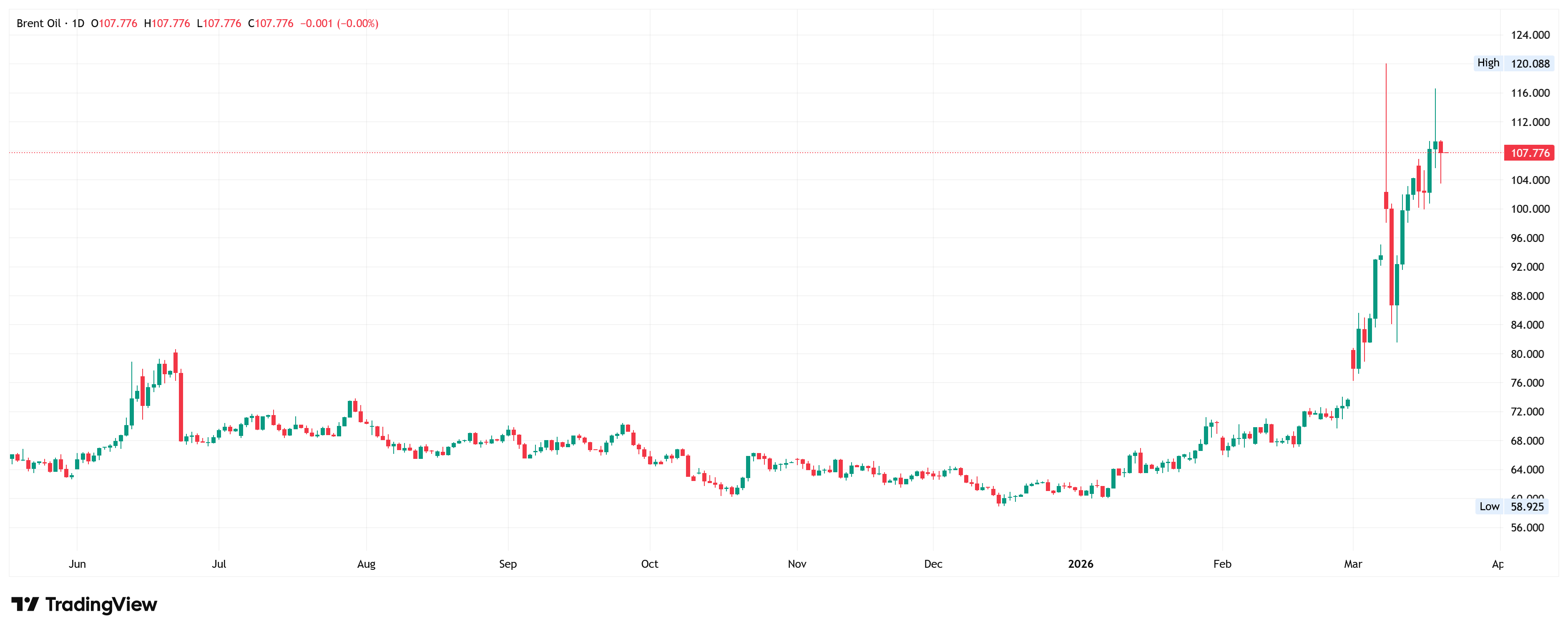
We witnessed Brent pull back to close at US$107.60 on Thursday amid comments from the US and Israel, including Trump ruling out ground troops and Prime Minister Netanyahu vowing to hold off on further strikes against Iranian energy infrastructure. Elsewhere, spot gold finished another day in the red, down 3.5%, with spot silver also posting a third consecutive day lower.
US Averages Slip; Energy Stocks Find Their Footing
In the equities space, major US benchmarks finished lower across the board, despite a rebound towards the close of the session following remarks from the US and Israel. The S&P 500 dropped 18 points (0.3%) to 6,606, featuring an almost even split in market breadth; energy stocks led the gains, while materials were the day’s biggest losers. The Nasdaq 100 declined 69 points (0.3%) to 24,355, and the Dow fell 203 points (0.4%) to 46,021, while the Russell 2000 caught a bid and ended positively, up 16 points (0.7%) to 2,494.
US Treasury yields bear-flattened, sending the front end of the curve higher amid increased inflation expectations. In FX, the USD index wrapped up the day lower by around 1.1%, while JPY, EUR, and GBP all gained as central banks held policy steady.
BoE: Rate Hikes in a Slowing Economy?
The BoE voted unanimously 9-0 to hold the bank rate at 3.75%, a surprise outcome that defied expectations of a 7-2 split and reflects how the oil price shock stemming from the Middle East conflict has reshaped MPC thinking. The dovish four (Breeden, Dhingra, Ramsden, Taylor) would have preferred to cut absent the conflict, with Taylor stressing the unanimous vote signals no directional shift. Catherine Mann shifted toward a more hawkish stance, raising the prospect of rate hikes should inflation persistence re-emerge, and markets are now pricing in roughly 63 bps of hikes by year-end, with the first cut not fully priced until June.
I am sure I do not need to delve into this too much, but hiking the BoE bank rate when output is low, inflation remains high, and the jobs market is softening is unlikely to end well for the UK economy. I believe this could be beneficial for GBP in the short term due to the rate-differential story, but the sustainability of that support entirely depends on how the energy shock develops. A resolution in the Middle East could reverse it quite quickly. Ultimately, no one knows how long the conflict will last, and the BoE is clearly keeping its options open ahead of the April meeting.
Brent Oil Price Forecast
Every new Brent Oil analysis as it publishes, today's technical signal and key levels, live price — on one page.
See all Brent Oil forecastsECB: Conflict Clouding the Outlook
The ECB followed suit and held rates steady, though I have to say, ‘steady’ may be a little too generous here for a central bank navigating an energy shock it did not see coming.
Staff projections – updated to capture the war’s latest ripple effects – now show inflation nudging back up to 2.6% this year, while growth has been trimmed to 0.9%. In other words, the eurozone faces the uncomfortable prospect of paying more for energy while producing less: a stagflationary undertone?
The Council stressed it is well-positioned to navigate the uncertainty, given that inflation had been running around target and expectations remained well anchored, but flagged that a prolonged supply disruption could push inflation further above target and growth further below the baseline. As with the BoE, the ECB is keeping its options open, reaffirming its data-dependent, meeting-by-meeting approach and explicitly declining to pre-commit to any rate path.
Thankfully, the data slate is reasonably quiet today.
That’s all from me today.
Happy trading.
Written by FP Markets Chief Market Analyst Aaron Hill