



Spot Gold Consolidates Inside Six-Day Range as Volatility Looms
Spot gold is edging higher on Monday, while consolidating inside its six-day trading range. This price action indicates investor indecision and impending volatility. Generally speaking, the tighter the coil, the greater the move. We’re just not sure of the direction yet although it’s leaning to the upside based on its position relative to the 50-day moving average.
At 14:13 GMT, XAUUSD is trading $5191.89, up $53.98 or +1.05%.
Key Support and Resistance Levels to Watch
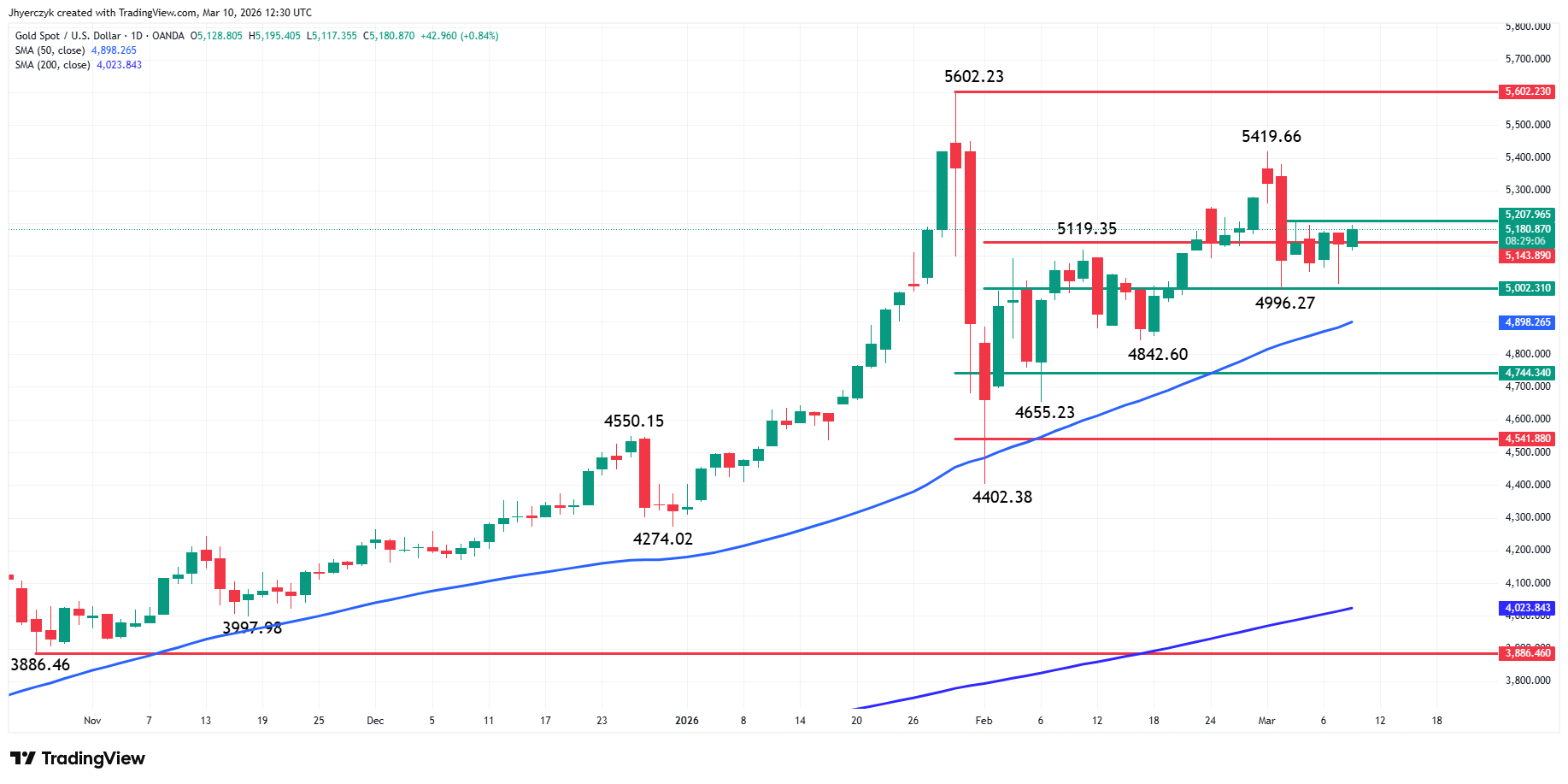
The intermediate range at $5002.31 to $5143.89 has been holding as support since March 3 when it traded down to $4996.27. The 50-day moving average support is at $4898.39.
Currently, the market is straddling a Fibonacci level at $5143.89, but facing resistance at a minor 50% level at $5207.97.
Buyers Still in Control — But Are They Passive or Aggressive?
With the 50-day MA providing support, traders are still in “buy the dip” mode. A sustained move over $5143.89 will indicate the presence of buyers. Taking out $5207.97 will indicate they are buying strength which could trigger the momentum needed to challenge last week’s top at $5419.66 over the near-term.
It’s hard to tell if the ongoing war is underpinning the market. We’re actually lower since the war began. Inflation fears and worries over the timing of the Fed’s first rate cut this year could be capping gains too.
Gold Price Forecast
Every new Gold analysis as it publishes, today's technical signal and key levels, live price — on one page.
See all Gold forecastsToday, we could find out if there are real buyers in there if the market starts taking out offers. If they don’t bite on the upside breakout potential then this will tell us the buyers are being passive, which would then put the 50-day moving average in play at $4898.39.
Why $100 Oil Is the Real Threat to Gold Prices
Fundamentally, I think all eyes are still on $100 a barrel crude oil. That is the level that can wreak havoc for the global economy, drive inflation up and force central banks to hike rates. I don’t think it will be good for gold prices if there was a prolonged move over this level. Until the volatility in oil subsides, gold could be rangebound.
Fed Rate Cut Uncertainty Keeping Gold in a Holding Pattern
The oil market goes hand-in-hand with Treasury yields, the dollar and Fed rate cuts too. Crude oil over $100 for a prolonged period of time will be inflationary. With inflation rising at a time when the U.S. labor market is weakening, the Fed is in a tough spot. Raise rates to stop inflation, but run the risk of cutting several thousands of jobs. Cut rates to support the labor market and inflation runs away.
Gold does better in a low interest rate environment. With a March cut off the board, and June starting to look the same, gold buyers have lightened up on the long side, leading to the rangebound trade. Traders want a little clarity, but that could be asking for too much with a July rate cut a 50/50 proposition at this time. But conditions could change fast if the war ends and oil prices fall back to the $60 range.
More Information in our Economic Calendar.