
Precious Metals Fundamentals: Central Banks & Structural Imbalances Set the Stage for 2026
Central banks kept right on buying gold in the first part of 2026 – a net 244 tonnes, which is a 3% increase from the year prior. This, according to the World Gold Council’s November 2026 Gold Demand Trends report. Interestingly, Poland led the pack with a whopping 31 tonnes. But it was the emerging market institutions such Uzbekistan that were really driving the diversification efforts – mainly because of all the geopolitical strains going on.
Overall, in Q1 gold demand came in at a record high of 1231 tonnes (which is the total including OTC deals), that’s a 2% increase from the year prior. And one of the things that really stood out is the huge jump in bar and coin investment – up a whopping 42% to 474 tonnes.

Silver’s Long Run Deficit
Silver is staring down the barrel of its 6th annual deficit in a row in 2026. According to the Silver Institute the deficit is going to be a staggering 46.3 million ounces – that’s 15% bigger than the one in 2025. And to put some perspective on the scale of the problem, since 2021 we’ve seen a cumulative 762 million ounces drawn out of the above ground stockpiles. As for production, mine output is looking like it’ll dip by a tiny 0.3% to 844.1 million ounces.
Industrial fabrication, which accounts for over 55% of demand, is moderating a bit – although that’s mainly due to photovoltaic thrifting (which is a sign of a wider shift towards clean energy) offset by a pick-up in electronics, EVs, and data centres. Meanwhile, investment in silver bars and coins is expected to rise – which is not going to help to ease the physical tightness in the market.
As you might expect, geopolitical risks and official sector flows are going to keep gold and silver firmly anchored in the coming months. Although energy-driven inflation and policy signals might just introduce a few near-term crosscurrents.
XAU/USD Price Analysis – Gold Rebounds at Fib 0.382 With Eyes on $4,800 Recovery

Gold is back at $4,623, making a strong comeback after finally hitting bottom at the 0.382 Fibonacci level at $4,534. That daily chart is showing a pullback in progress from the March peak near $5,233, but the price is now trying to grab hold of that 0.618 Fib level at $4,801. If you look at the chart with all the markings – it looks like the bulls are gunning for a bounce up to $4,800 before we really start to worry about a further downturn.
Gold Price Forecast
Every new Gold analysis as it publishes, today's technical signal and key levels, live price — on one page.
See all Gold forecastsBoth moving averages are still in a pretty clear uptrend – but that red MA is starting to level off, which is a sign that we might be in for a bit of a consolidation. RSI is sitting smack in the middle at 40-50 – which is exactly what you’d expect when you’re trying to rebuild momentum. A close above $4,800 would be a real game-changer for the bulls.
XAG/USD Technical Analysis – Silver Tests Rising Channel Support at $73 as RSI Recovers
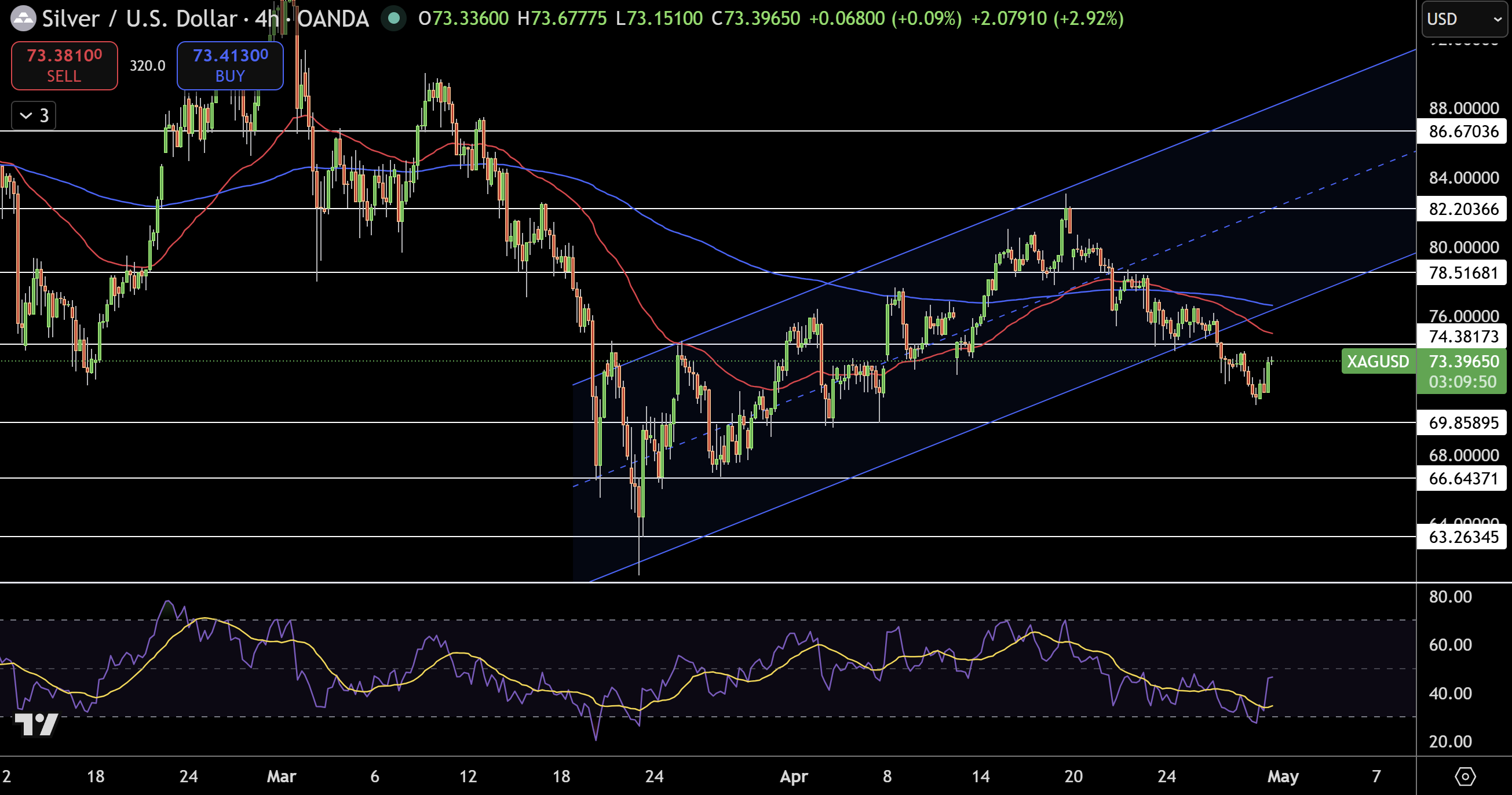
Silver is right now trading at $73.39 and is coming up against the lower end of the rising channel that’s been keeping the price in check since that mid-March low near $63. And after bouncing off that channel’s lower trendline – we’re starting to see some favourable signs for the bulls. But here’s the thing : both moving averages are actually pointing downwards – so we need to be careful.
The RSI has dropped right down to that 35-40 oversold zone and is slowly starting to turn upwards again. That’s a pretty early sign that a bounce might be on its way. The first bit of resistance is going to be at $74.38 & $76 – and then there’s a bit of a strong ceiling at $78.51.
If we can just manage to hold onto a gain above that channel base – and RSI keeps going in the right direction – we might just see a push up to $80-$82.20. But – if we do end up breaking below $69.85 – then we’ll be worried about the outlook turning bearish.