
USD/JPY drops below a crucial support level as warnings of yen intervention in the forex markets knock out buying interest in yen shorts.
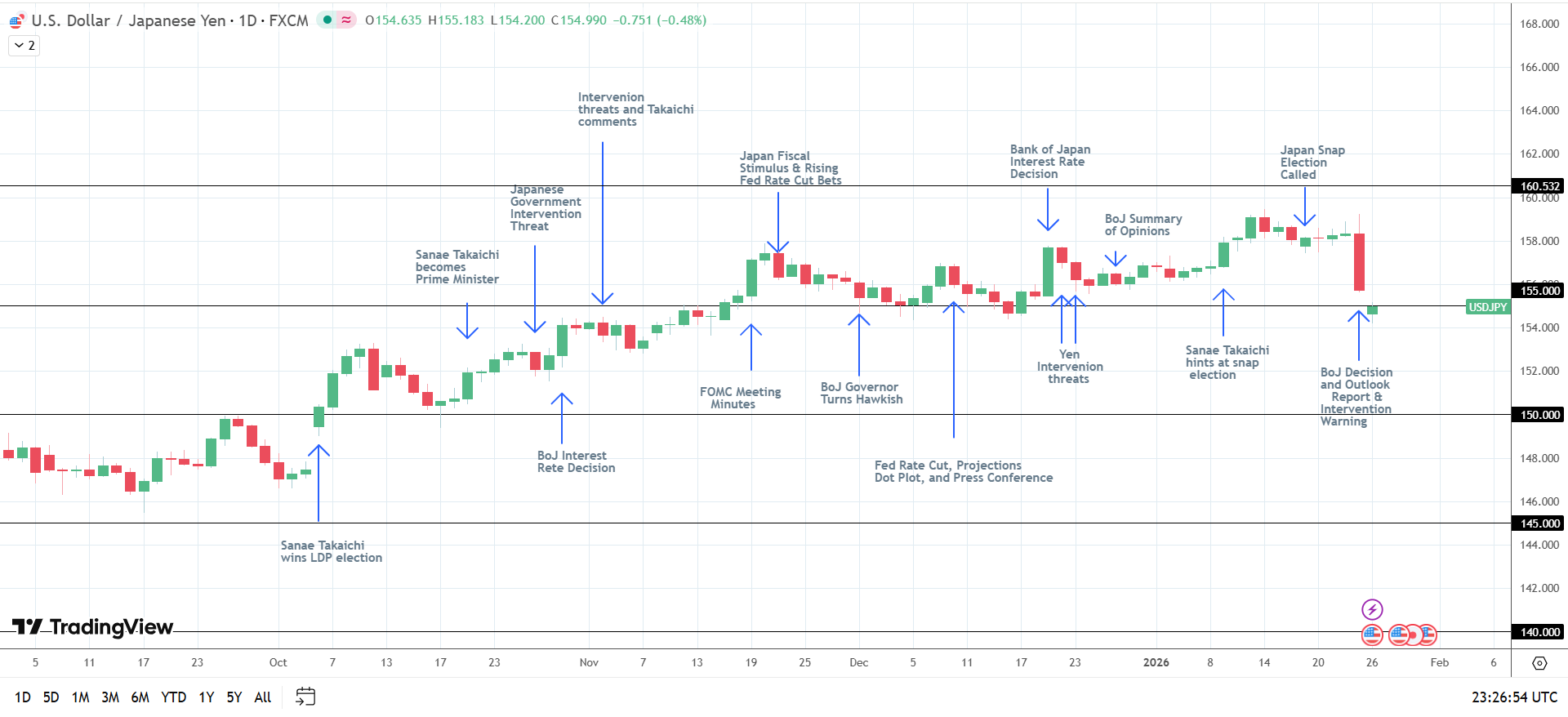
On Friday, January 23, Japanese Prime Minister Sanae Takaichi warned of action against abnormal yen movements. The warning sent USD/JPY from 159.225 to a session low of 155.6. USD/JPY fell below 155 on Monday, January 26, to 154.2, its lowest level since mid-November 2025.
Intervention threats coincided with hawkish Bank of Japan forecasts, contributing to the pair’s sharp retreat from close to 160. On January 26, Japanese and US economic indicators will influence USD/JPY trends as the prospect of a sharply narrower US-Japan rate differential becomes real, supporting the bearish short- to medium-term outlook.
Below, I’ll discuss the macro backdrop, the near-term price catalysts, and technical levels traders should closely watch.

Traders Hold Off Shorting the Yen Amid Chatter of the Fed Joining the Battle to Stabilize the Currency
Last week, warnings of intervention came from Japanese Prime Minister Takaichi rather than the Ministry of Finance. The shift in rhetoric underscored growing concerns about yen weakness pushing import prices and inflation higher, eroding households’ spending power.
USD/JPY surged from an October 3 147.460 to last week’s high of 159.454. Markets reacted to Prime Minister Takaichi winning the Liberal Democratic Party Leadership race to become Japan’s first woman prime minister.
Prime Minister Takaichi’s fiscal spending plans have spotlighted Japan’s 240% debt-to-GDP ratio, fueling fears of a major debt crisis. Last week, the Japanese Prime Minister called a snap election, aiming to strengthen her party’s position and enable her to pursue her policy goals unchallenged. News of the snap election further weakened the yen, underpinning market concerns about Prime Minister Takaichi’s policy goals and national debt levels.
USD/JPY trends since Prime Minister Takaichi took office have forced the Japanese government to warn of potential interventions. However, the threat intensified this time around, with the outcome of the Japanese election potentially sending USD/JPY above 160 if Takaichi enjoys a landslide victory.
Walter Bloomberg, with over 1 million followers on X (formerly Twitter), commented on the latest intervention threats, stating:
USD/JPY Price Forecast
Every new USD/JPY analysis as it publishes, today's technical signal and key levels, live price — on one page.
See all USD/JPY forecasts“Markets are on high alert after Japan’s Prime Minister Sanae Takaichi warned of action against “abnormal” yen moves, fueling speculation of imminent currency intervention — possibly with U.S. support. Traders reported the New York Fed contacting banks about the yen, a move often seen as a precursor to intervention. The yen rebounded sharply after sliding toward 160 per dollar, its biggest one-day gain since August. With short yen positions at decade highs and elections approaching, officials appear ready to act again, especially if the currency weakens further.”
Japanese Leading Economic Indicator in Focus
Later on Monday, Japanese economic indicators are likely to fuel speculation about an April Bank of Japan rate hike. According to the preliminary report, the Leading Economic Index (LEI) increased from 109.8 in October to 110.5 in November, suggesting a pickup in economic momentum.
An upward revision to the preliminary number would raise expectations of an April BoJ rate hike, boosting buying interest in the yen. The stronger yen would push USD/JPY lower.
Traders should pay close attention to LEI trends. A higher reading suggests improving business investment, rising employment, and higher wages. Importantly, stronger wage growth would increase households’ purchasing power, fueling spending and demand-driven inflation.
An upward trend in consumption and inflation would align with the BoJ’s upward revisions to inflation in its quarterly outlook report, supporting a more hawkish BoJ rate path.
Rising bets on BoJ rate hikes and Fed rate cuts reaffirm the bearish medium- to longer-term price projections.
US Durable Goods Orders and the Fed in Focus
While the yen gets government support, US economic data will influence the appetite for the US Dollar. Durable goods orders, the Chicago Fed National Activity Index, and the Dallas Fed Manufacturing Index will be in focus. However, durable goods order trends are likely to garner more attention, given that the Index gives insight into business and consumer spending.
Economists expect durable goods orders to rise 0.5% month-on-month in November after sliding 2.2% in October. A higher-than-expected reading would indicate a pickup in manufacturing sector activity, bolstering the US economy. However, the numbers may have limited influence on Fed rate-cut bets, given that the manufacturing sector accounts for just 20% of US GDP.
Traders should closely monitor FOMC members’ speeches, which will likely have more influence on sentiment toward an H1 2026 Fed rate cut and USD/JPY trends.
Technical Outlook: Key Levels to Watch
For USD/JPY price trends, traders should consider technicals and closely follow central bank and political headlines.
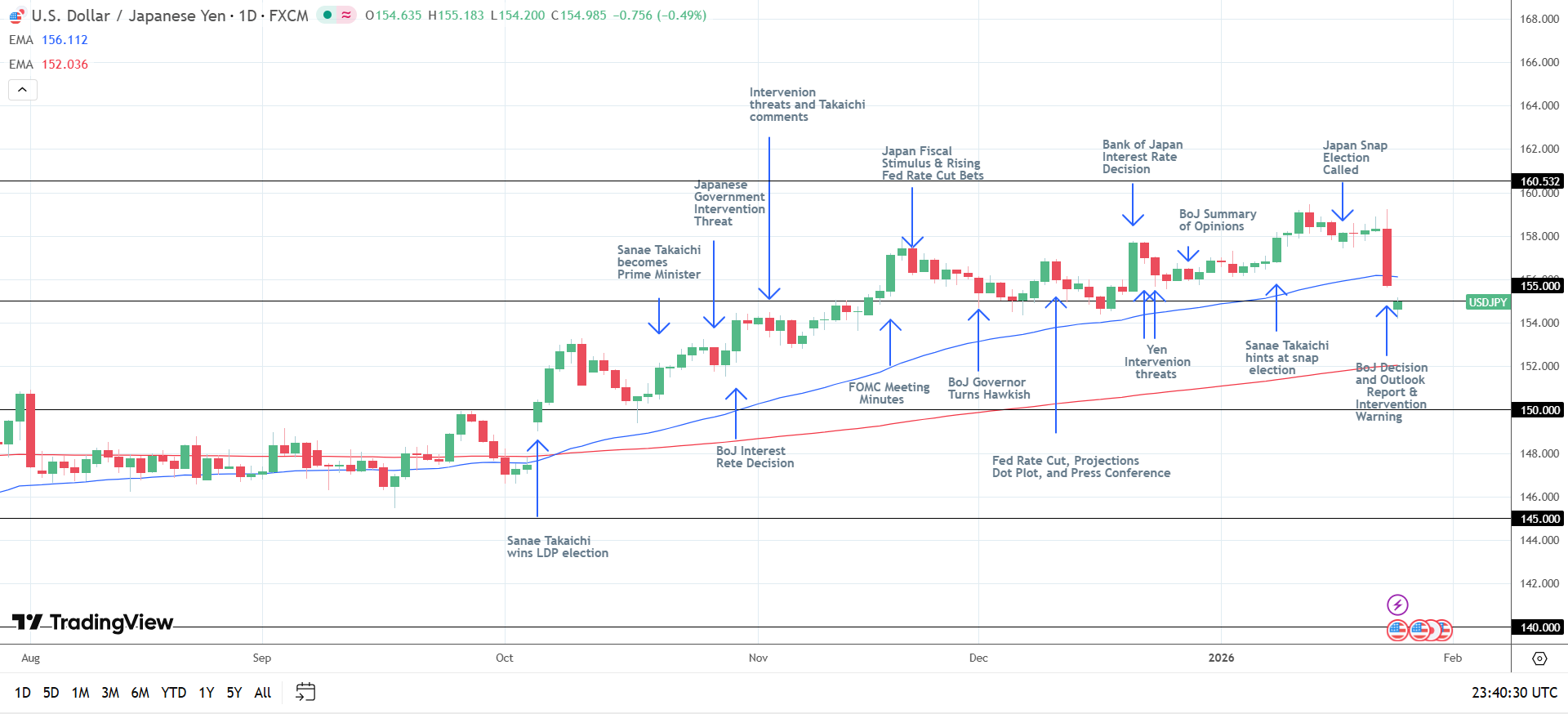
On the daily chart, USD/JPY trades below its 50-day Exponential Moving Average (EMA), but above the 200-day EMA. The EMAs signaled a near-term bearish trend reversal, aligning with the negative outlook for USD/JPY. Constructive yen fundamentals have aligned with the near-term technicals.
A sustained drop below the 155 support level would expose the 200-day EMA. If breached, 150 would be the next key support level.
Crucially, a sustained fall through the EMAs would reaffirm the bearish short- to medium-term price outlook.
Positioning and Risk Outlook
In my view, expectations of a hawkish BoJ policy outlook, warnings of yen intervention, and lingering bets on Fed rate cuts support a negative price path. However, Japan’s snap election, US economic data, and Fed chatter will be key, given recent movements in the USD/JPY pair.
Additionally, a hawkish BoJ neutral interest rate level (potentially 1.5%-2.5%) would indicate multiple BoJ rate hikes and a narrower US-Japan interest rate differential. A narrower rate differential may trigger a yen carry unwind, mirroring events in mid-2024. A yen carry trade unwind would likely send USD/JPY toward 140 over the longer term.
However, upside risks to the bearish outlook include:
- Dovish BoJ chatter and a lower neutral interest rate (potentially 1%-1.25%).
- Strong US economic data tempers H1 2026 Fed rate cut bets.
These scenarios would send USD/JPY higher. However, ongoing threats of yen intervention are likely to continue capping the upside at the 160 level.
Read the full USD/JPY forecast, including chart setups and trade ideas.
Conclusion: Politics, the BoJ, and the Fed in the Spotlight
In summary, the USD/JPY trends will hinge the BoJ’s rate path and the Fed’s policy stance. A higher neutral rate (1.5%-2.5%) would signal a hawkish BoJ rate path, strengthening the yen.
Meanwhile, Prime Minister Takaichi’s snap election will be key for the near-term USD/JPY trends, given her fiscal and monetary policy goals. Additionally, dovish Fed chatter would suggest narrower rate differentials, reaffirming the bearish medium-term outlook for USD/JPY.
A markedly stronger yen and the unwinding of yen carry trades would likely push USD/JPY toward 140 over the longer 6-12 month timeline.
For more in-depth analysis, review today’s USD/JPY trading setups in our latest reports and consult the economic calendar.