
USD/JPY sees a second decline in eight weeks as confidence in the US dollar dives.
President Trump’s tariff threat and push to acquire Greenland undermined US dollar demand, sending the US Dollar Index sharply lower. Despite Trump withdrawing his tariff threat, the US Dollar Index ended the week down 1.97% at 97.096. Crucially, the Index plunged to its lowest level since September 2025.
A hawkish Bank of Japan Governor, Kazuo Ueda, lifted demand for the yen, accelerating USD/JPY’s decline on Friday, January 23.
In a choppy week ending January 23, the USD/JPY pair climbed to a high of 159.225 before plunging to a low of 155.6. Despite a modest recovery, USD/JPY ended the week down 1.47% at 155.751.
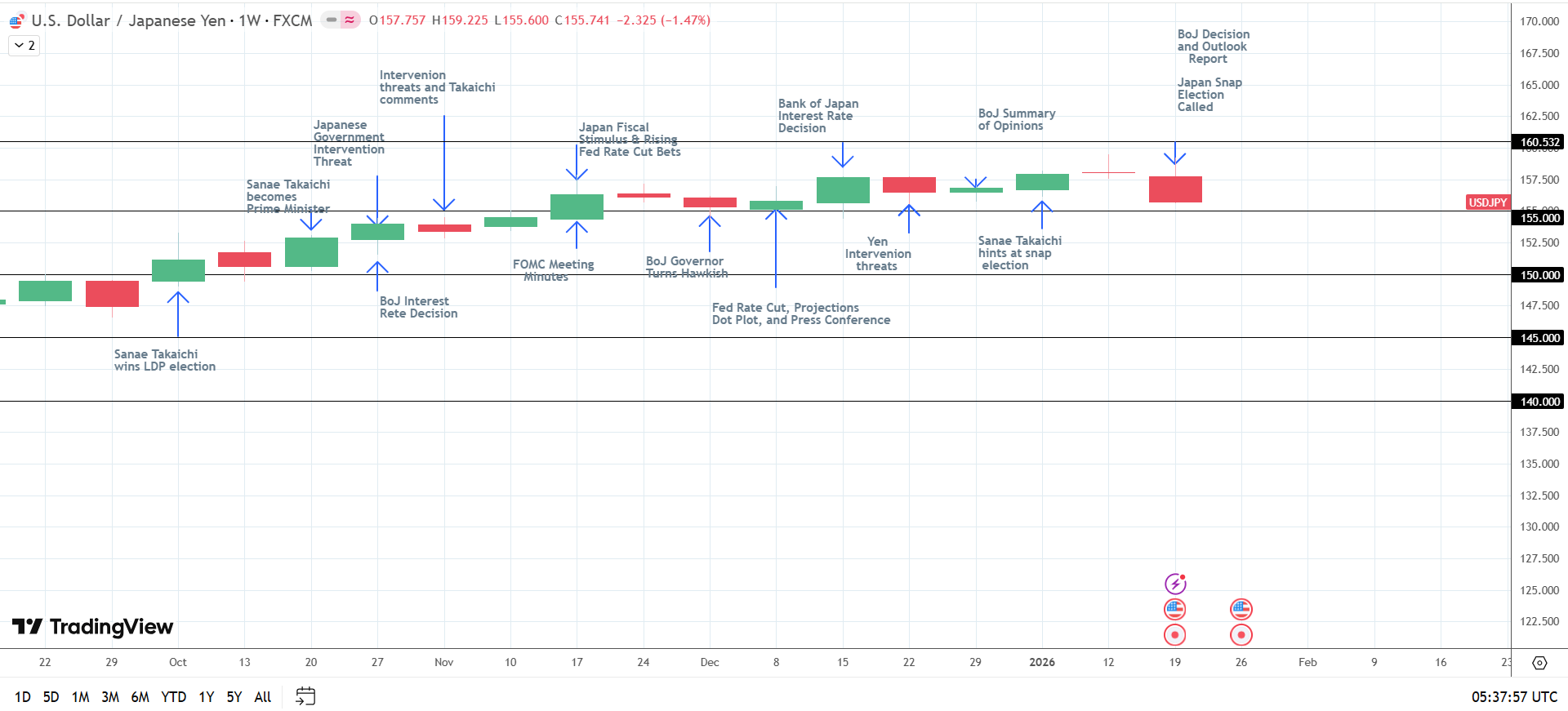
US dollar weakness and a hawkish BoJ policy outlook support a bearish short- to medium-term price outlook for USD/JPY.
Below, we examine the upcoming economic calendar, the medium-term catalysts (4-8 weeks), and the technical levels traders should watch.

Key Japanese Economic Indicators to Watch
In the week ahead, Japanese economic data will influence expectations of a BoJ rate hike. Key data includes consumer confidence, Tokyo inflation, the labor market, and retail sales.
A continued upswing in consumer confidence and steady labor market conditions would likely fuel speculation about an April BoJ rate hike. Improving consumer confidence, alongside a stable labor market, would support a pickup in consumer spending. Upward trends in consumer spending would fuel demand-driven inflation and bolster the economy.

Meanwhile, Tokyo inflation and Japanese retail sales trends will give insights into the national inflation and demand backdrop.
USD/JPY Price Forecast
Every new USD/JPY analysis as it publishes, today's technical signal and key levels, live price — on one page.
See all USD/JPY forecasts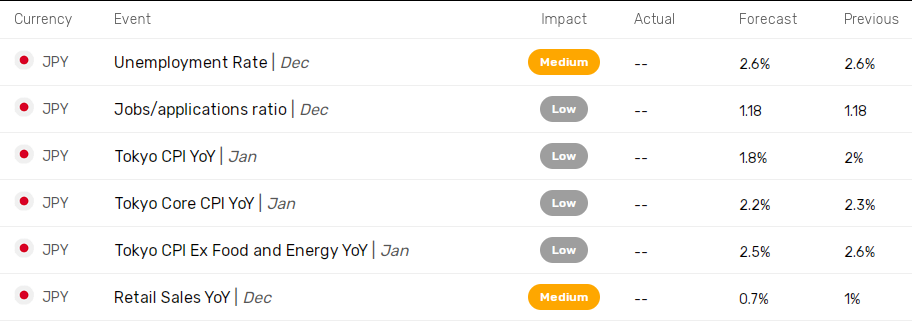
Bank of Japan Boosts Yen Demand
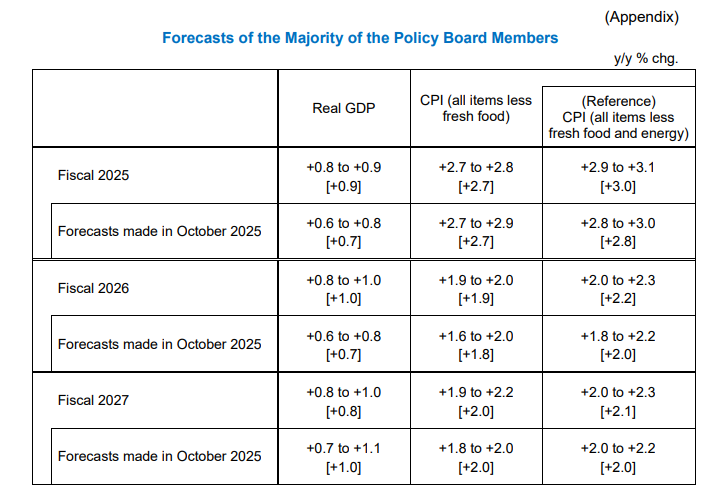
Given the BoJ’s quarterly outlook report, strong Japanese economic indicators may also raise expectations of multiple rate hikes in 2026. A hawkish BoJ rate path would boost yen demand, supporting the bullish short- to medium-term outlook for USD/JPY.
The Bank of Japan projected stronger economic growth and higher inflation in 2026, supporting a more hawkish BoJ policy stance.
Beyond the data, election-related news and BoJ rhetoric will also influence buying interest in the yen and USD/JPY trends.
Japan Elections a Threat to Bearish Outlook
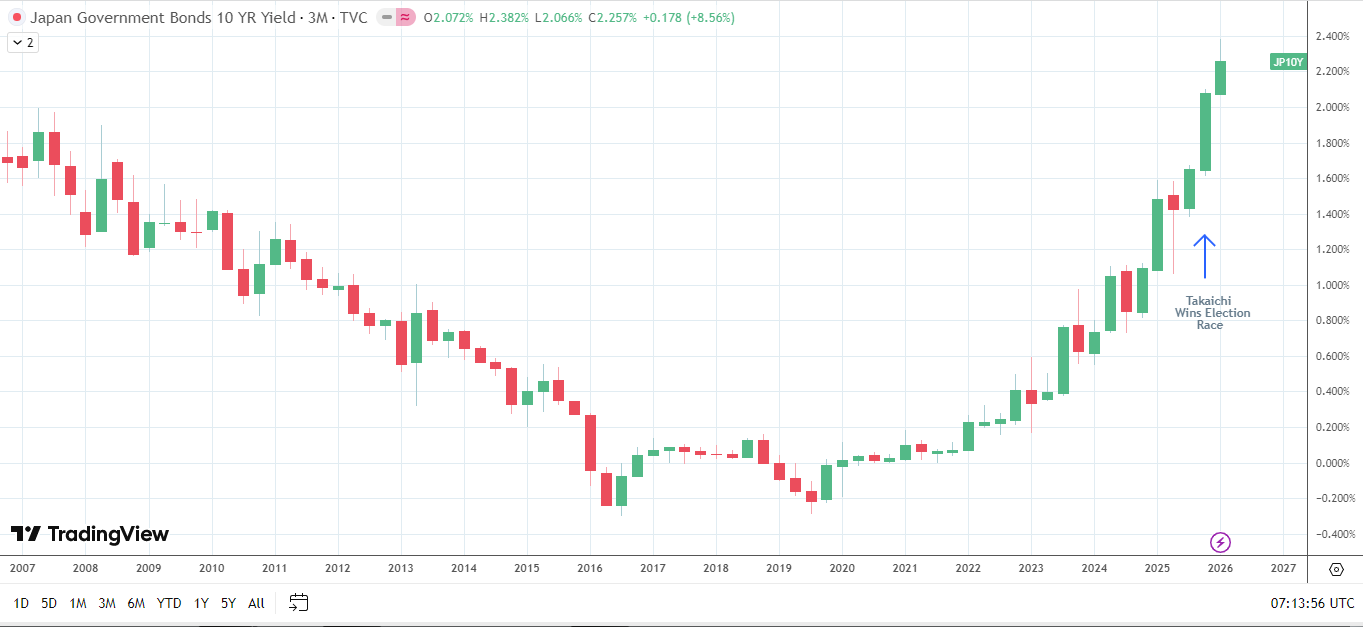
USD/JPY rallied 6.12% in the final quarter of 2025 as markets reacted to Sanae Takaichi becoming the leader of the Liberal Democratic Party and Japan’s first woman prime minister. Her push for fiscal spending fueled concerns about national debt levels, given Japan’s 240% debt-to-GDP ratio. Notably, debt jitters sent the risk premium for Japanese Government Bonds (JGBs) soaring to their highest level in decades, pressuring the yen.
10-year JGB yields and USD/JPY climbed higher in January 2026, impacted by Prime Minister Takaichi calling a snap election. A landslide victory would strengthen the LDP’s control, enabling Prime Minister Takaichi to pursue her policy goals uncontested.
While the yen has weakened over concerns about Prime Minister Takaichi’s fiscal spending and national debt levels, a hawkish BoJ policy outlook is likely to be key for USD/JPY trends.
Follow real-time updates to stay ahead of USD/JPY market developments.
US Economic Calendar: Inflation and Labor Market Data to Spotlight the Fed
As markets consider Japanese politics and the BoJ’s policy stance, US economic data and the Fed will influence buying interest in the US dollar. Key US economic indicators and events include:
- CB Consumer Confidence (Tuesday, January 27): Previous: 89.1; Forecast: 90.1
- Fed Interest Rate Decision and Press Conference (Wednesday, January 28): Previous: 3.75%; Forecast: 3.75%.
- Initial Jobless Claims (Thursday, January 29): Previous: 200k; Forecast: 205k.
- Producer Prices (Friday, January 30): Previous 0.2% month-on-month; Forecast: 0.2% MoM.
Stronger consumer confidence and a modest rise in jobless claims would signal a pickup in private consumption. Increased spending would boost economic momentum and fuel demand-driven inflation, supporting a more hawkish Fed rate path. Fading bets on an H1 2026 Fed rate cut would lift demand for the US Dollar, sending USD/JPY higher.
Producer prices will also be key, given the Fed’s dual mandate. Higher producer prices would indicate an uptick in consumer prices, tempering expectations of an H1 2026 Fed rate cut. For context, producers adjust prices higher or lower, depending on demand, passing higher prices or cost savings on to consumers.
Fed Policy Outlook Key for US Dollar Demand
The US data will influence the appetite for the US dollar. However, the Fed’s rate statement and press conference will be key for the USD/JPY pair. While economists expect the Fed to maintain interest rates on Wednesday, uncertainty lingers over the timing of a rate cut.
According to the CME FedWatch Tool, the chances of a March 2026 Fed rate cut stood at 15.4% as of January 23, down from 48.7% as of December 24. Meanwhile, the probability of a June cut stood at 60.7%, down from 82.1% as of December 24.
Changes in the chances of March and June cuts will be key for US dollar trends. A more dovish policy stance on optimism that inflation is cooling and rising bets on a March cut would reinforce the bearish medium-term outlook for USD/JPY.
Market View: Medium-Term Yen Strength
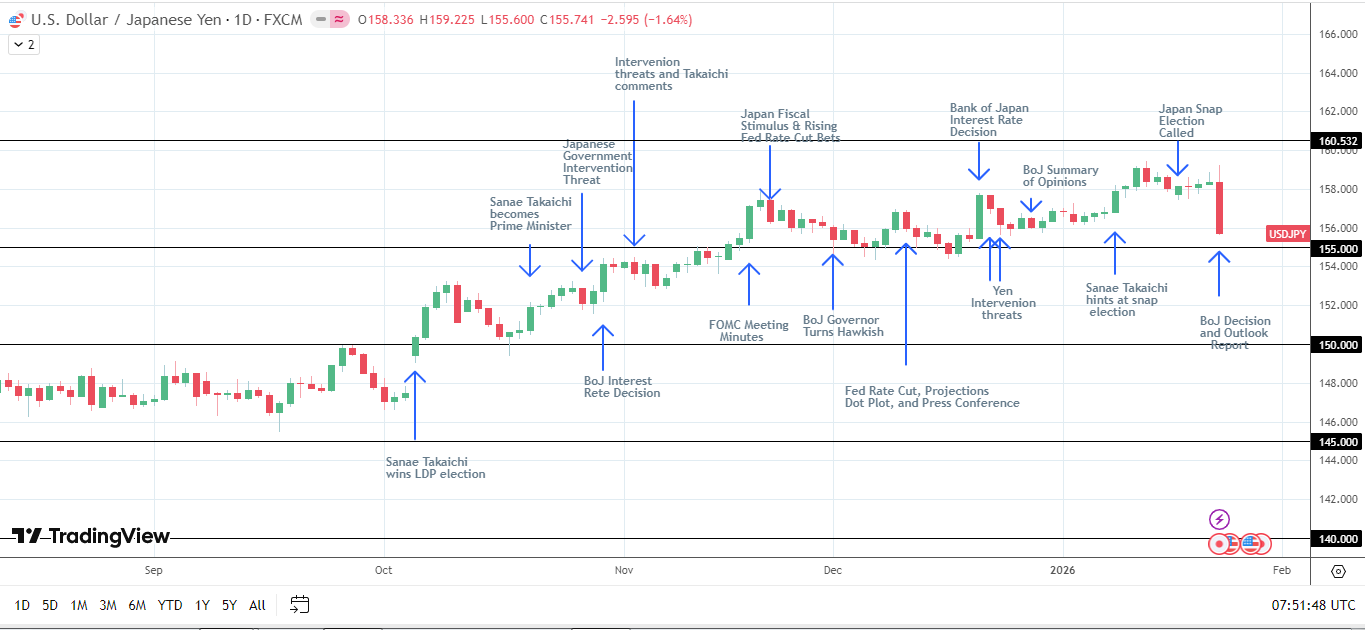
In my opinion, USD/JPY would likely fall toward 150 on the BoJ’s hawkish policy stance and bets on an H1 2026 Fed rate cut. The dovish rate path and rising bets on a BoJ rate hike affirm the bearish medium-term outlook. A break below 150 would reinforce the medium-term (4-8 weeks) to longer-term (8-16 weeks) 145-140 range.
Counter-Trend Risks: What Could Push USD/JPY Toward 160?
Upside risks include:
- Strong US inflation and labor market data.
- A hawkish Fed press conference.
- Softer Japanese economic indicators.
- Dovish BoJ rhetoric.
Despite the counter-trend risks, yen intervention threats are likely cap USD/JPY at 160. Given the upside risks, a break above the January high of 159.453 to 160 would invalidate the medium-term bearish structure.
For context, warnings of yen intervention in the forex markets have continued to hold USD/JPY below 160.
Financial Analysis
Technical Outlook: Bearish Momentum Building
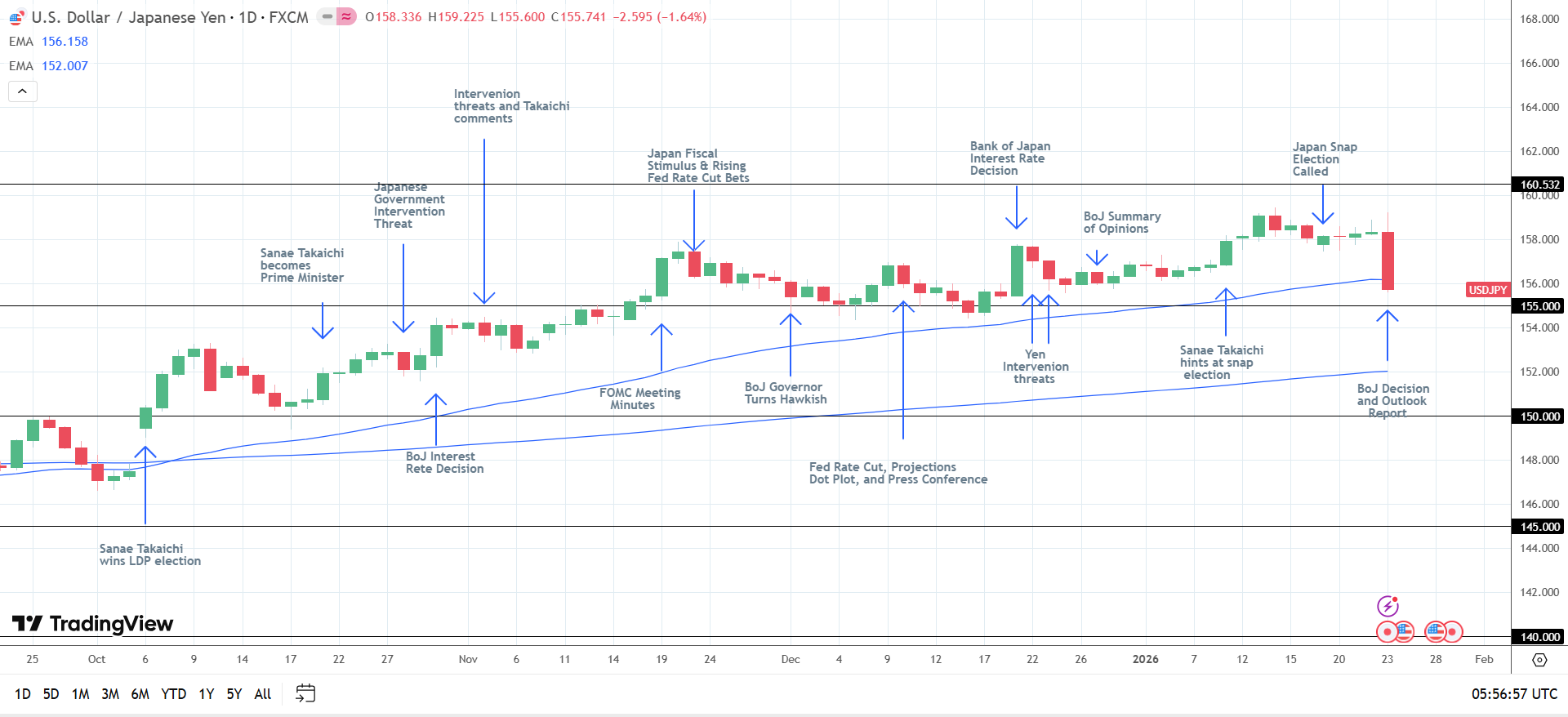
On the daily chart, USD/JPY traded below the 50-day Exponential Moving Average (EMA), while holding above the 200-day EMA. The EMAs signaled a bearish near-term but bullish longer-term bias.
Crucially, last week’s drop below the 50-day EMA indicated a near-term bearish trend reversal, supporting further USD/JPY losses. Favorable yen fundamentals are developing, aligning with the shorter-term technicals.
A break below the 155 support level would enable the bears to target the 200-day EMA. If breached, 150 would be the next key support level. Importantly, a break below the 200-day EMA would affirm a bearish trend reversal, supporting the bearish medium-term outlook.
Key Takeaways
The USD/JPY pair has fallen 0.71% in 2026, reversing the previous month’s 0.46% gain. Importantly, a hawkish BoJ rate path and dovish Fed policy stance would signal a narrowing rate differential. Narrowing rate differentials would reinforce a bearish short- to medium-term outlook for USD/JPY. Yen carry trade unwind risks also set up a bearish outlook.
Key levels will include 155, 150, and 140 on the downside, and 160 on the upside.
Consult our economic calendar for historical and upcoming data.