


Prime Minister Sanae Takaichi sends the yen into a tailspin, triggering a USD/JPY rebound. The pair briefly touched 156.279 on Tuesday, February 24, marking the highest level in two weeks.
Market bets on an April Bank of Japan rate hike faded after reports of Prime Minister Takaichi raising concerns about higher interest rates.
Meanwhile, the hawkish FOMC Minutes for the January meeting and upbeat US economic data have cooled expectations of a June Fed rate cut, boosting buying interest in the US dollar.
Despite concerns about changing sentiment toward BoJ and Fed rate paths, expectations of an eventual BoJ rate hike and Fed rate cuts continue to support the bearish medium-term outlook for USD/JPY.
Below, I’ll discuss the macro backdrop, near-term price catalysts, and technical levels traders should closely watch.
Prime Minister Takaichi Triggers a Yen Sell-Off
This week, reports emerged of Prime Minister Takaichi meeting with BoJ Governor Kazui Ueda, voicing concerns about the Bank’s intentions to raise interest rates. Prime Minister Takaichi is an advocate for loose monetary and fiscal policies. Notably, USD/JPY soared from an October 3 low of 147.056 to a January 14 high of 159.454 over concerns about fiscal spending and Takaichi’s stance on monetary policy.
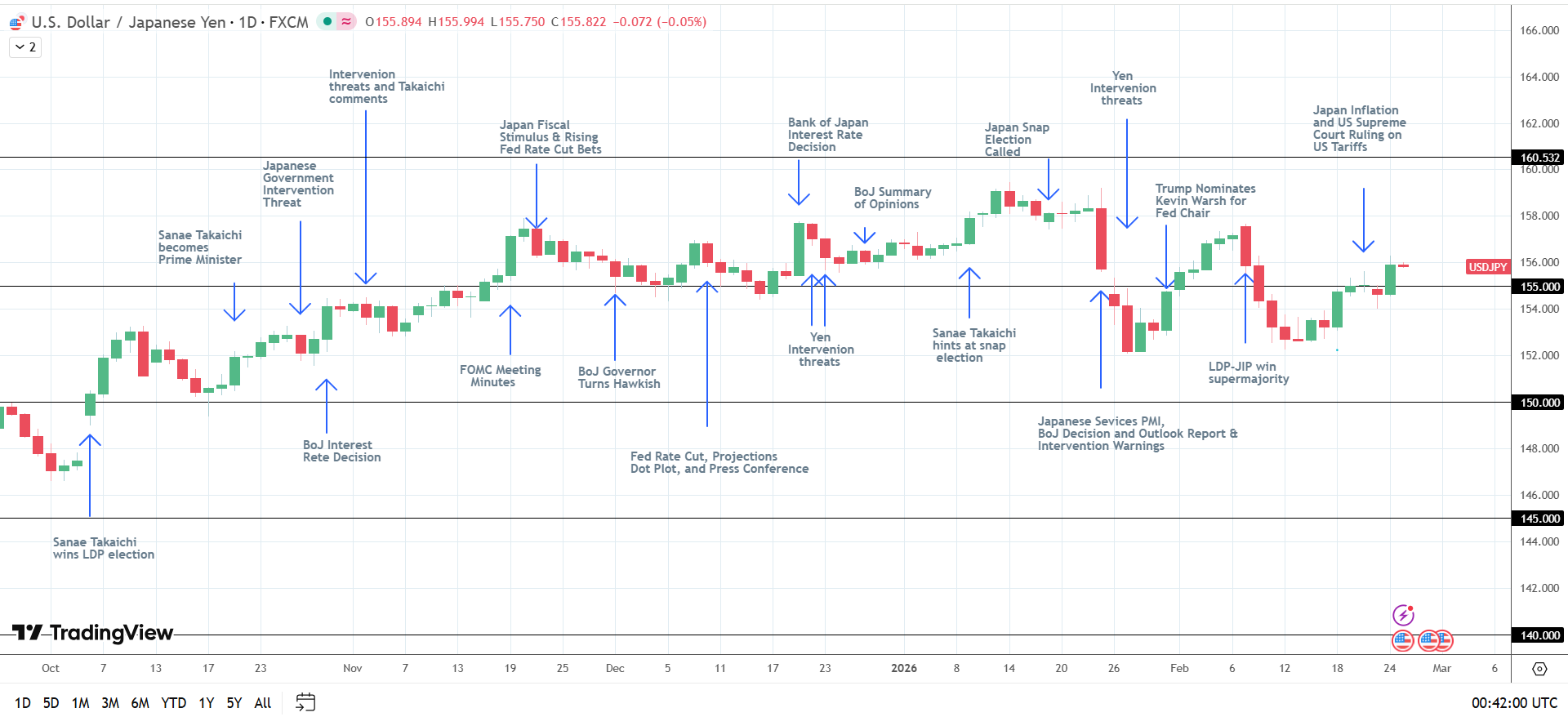
Market expectations of a delay to BoJ rate hikes come despite Japan’s so-called ‘core-core’ inflation rate holding well above the 2% target at 2.6%.
USD/JPY Price Forecast
Every new USD/JPY analysis as it publishes, today's technical signal and key levels, live price — on one page.
See all USD/JPY forecastsTariff Uncertainty Complicates the BoJ Rate Path
However, the USD/JPY pair’s rebound can also be attributed to last week’s US Supreme Court ruling. The US Supreme Court ruled that President Trump’s rollout of tariffs under the International Emergency Economic Powers Act (IEEPA) was illegal. President Trump immediately announced a sweeping 10% tariff under a different Presidential authority and then increased it to 15%. The latest tariff developments have created uncertainty that may influence the BoJ’s monetary policy stance.
For context, the BoJ stated that US tariff risk had abated, supporting tighter monetary policy. Previously, policymakers had called for patience to assess any impact of US tariffs on Japan’s economy.
Tariff risks and Prime Minister Takaichi’s stance on monetary policy suggest the BoJ will remain in a policy holding pattern until the summer.
According to the latest Reuters poll, 43 of 74 economists expect the BoJ to raise interest rates to 1% by the end of June. Notably, only 20% of economists predicted an April hike, 36% a June hike, and 34% tighter monetary policy in July.
Given tariff uncertainty and Prime Minister Takaichi’s monetary policy stance, the outlook for USD/JPY is cautiously bullish. However, intervention warnings are likely to cap the pair’s upside near 160.
Nevertheless, the medium-term outlook remains bearish, with expectations of a summer BoJ rate hike and Fed rate cut supporting a USD/JPY downtrend.
President Trump’s State of the Union Speech and the Fed in Focus
While market bets on a BoJ rate hike fade, President Trump’s State of the Union Speech will draw market attention. Trump’s references to tariff policies would likely influence US dollar demand and USD/JPY trends, given the Supreme Court ruling.
Threats of more aggressive tariff policies would likely send USD/JPY higher, given the BoJ’s concerns about the effect of US tariffs on the Japanese economy.
Later on Wednesday, traders should also monitor FOMC members’ speeches. Their views on inflation, the labor market, and the timing of rate cuts are likely to move the dial.
Recent US economic data, including labor market and consumer confidence figures, have cooled bets on a June Fed rate cut, strengthening the greenback.
According to the CME FedWatch Tool, the probability of a June cut fell from 63.4% on February 17 to 49.6% on February 24. Softer expectations of a June cut support the cautiously bullish outlook for USD/JPY.
Technical Outlook: Key Levels to Watch
For USD/JPY price trends, traders should closely monitor technical indicators, key economic data, government policies, and central bank chatter.
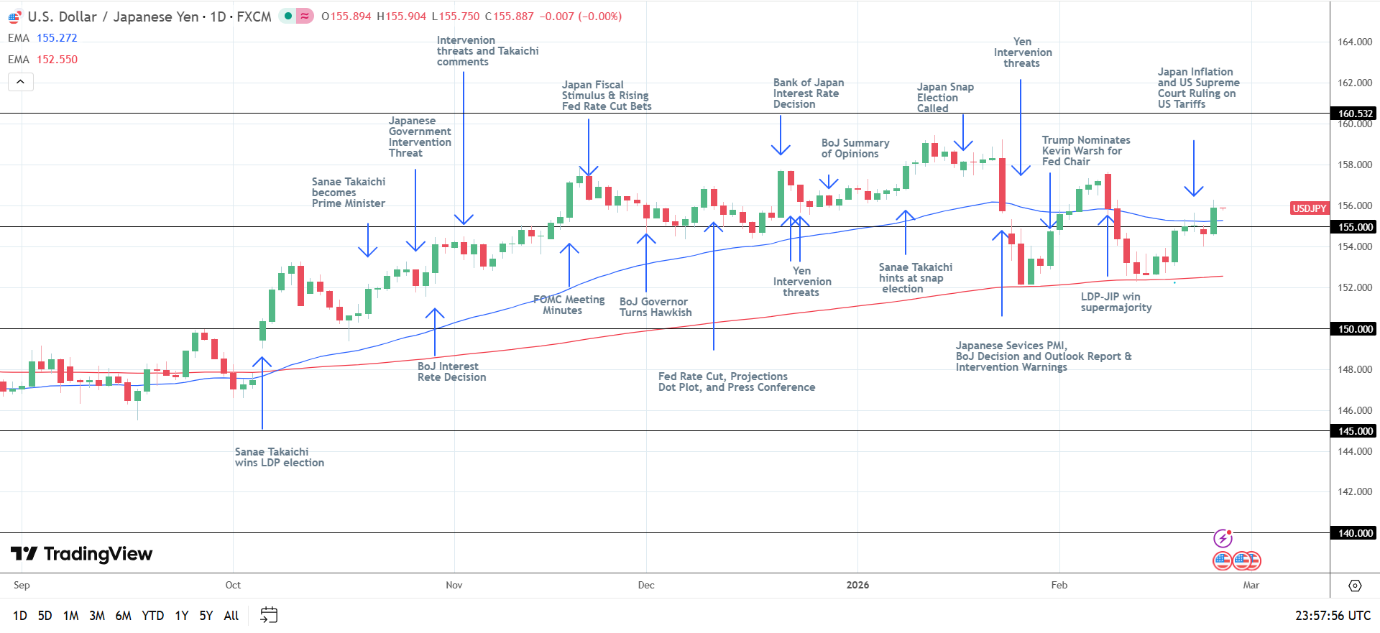
On the daily chart, USD/JPY trades above its 50-day and 200-day Exponential Moving Averages (EMAs). The EMA positions indicate a bullish bias. However, more favorable yen fundamentals offset the bullish technical outlook, supporting a bearish medium-term outlook.
A break below the 50-day EMA would bring 153 into play. If breached, the 200-day EMA would be the next key technical support level. A sustained fall through the 200-day EMA would pave the way toward the 150 support level.
Furthermore, a sustained drop below the EMAs would signal a bearish trend reversal. Significantly, a bearish trend reversal would affirm the negative medium- to longer-term price outlook.
Positioning and Risk Outlook
In my view, expectations of a BoJ rate hike and Fed rate cuts support a negative price outlook. However, upside risks to the bearish outlook include:
- Dovish BoJ rhetoric and a lower neutral interest rate band (dovish: potentially 1%-1.25%), indicating fewer rate hikes.
- Strong US economic data cool bets on an H1 2026 Fed rate cut.
These events would drive USD/JPY higher. However, yen intervention threats are likely to cap the upside near 160.
Read the full USD/JPY forecast, including chart setups and trade ideas.
Conclusion: The BoJ, Trump’s Tariff Policies, and the Fed in Focus
In summary, USD/JPY trends remain hinged on the BoJ’s policy stance, incoming economic indicators, the Fed rate path, and government policies.
Given the BoJ’s path toward monetary policy normalization, a hawkish BoJ neutral rate band (1.5%-2.5%), indicating multiple BoJ rate hikes, would strengthen the yen over the medium term. Furthermore, multiple Fed rate cuts would also narrow US-Japan rate differentials in favor of the yen. Narrowing rate differentials would reaffirm the bearish medium-term outlook for USD/JPY.
Looking beyond the short- to medium term (1-3 months). A stronger yen and yen carry trade unwinds would likely send USD/JPY toward 140 over 6-12 months.
For more in-depth analysis, review today’s USD/JPY trading setups in our latest reports and consult the economic calendar.