US tariff policies and AI disruption jitters trigger a crypto market rout, sending XRP to a three-week low.
Renewed concerns about the potential impact of AI advancements on tech companies triggered a flight to safety on Monday, February 23. The Nasdaq Composite Index closed the session down 1.13%.
There was also a delayed market reaction to Friday’s US Supreme Court ruling on President Trump’s tariffs. However, President Trump’s response to the ruling and new tariffs added to the negative sentiment.
These events overshadowed crypto-related legislative developments and XRP-spot ETF inflows. Bitcoin’s correlation with risk assets and heavy BTC-spot ETF outflows have weighed on buying interest in crypto assets, leaving XRP under selling pressure.
Despite the pullback, the favorable fundamentals support a bullish medium-term (4-8 weeks) outlook for XRP, with a price target of $2.0.
Below, I will explore the key drivers behind recent price trends, the medium-term outlook, and the technical levels traders should watch.

AI Disruption Fears Hit Risk Assets
AI-related developments took center stage on February 23 as fresh reports of AI disruption spooked investors. Advancements in AI have raised concerns over the future earnings outlook for US companies, leaving the Nasdaq Composite Index in negative territory year-to-date.
IBM plunged 11.8% after Anthropic announced that Claude Code can optimize COBOL, currently a key profit source for IBM. The threat of AI code displacing existing software has also fueled speculation that AI displacement risk could push borrowing costs higher for AI-exposed companies. Typically, tech stocks have high CAPEX. Higher borrowing costs and AI displacement could materially weaken profits and stock valuations.
Bitcoin tracked US indexes into negative territory, leaving XRP and the broader crypto market deep in the red. Notably, BTC ended the session down 4.39%. Monday’s price action underscored the continued influence of BTC price action on the broader crypto market.
The US BTC-spot ETF market has seen $2.6 billion in net outflows year-to-date (YTD), while the US XRP-spot ETF market has reported $64.13 million in net inflows YTD. Despite the resilient institutional demand for XRP, the token has fallen 26.4% YTD, tracking BTC’s 26.0% drop.
Bitcoin Price Forecast
Every new Bitcoin analysis as it publishes, today's technical signal and key levels, live price — on one page.
See all Bitcoin forecasts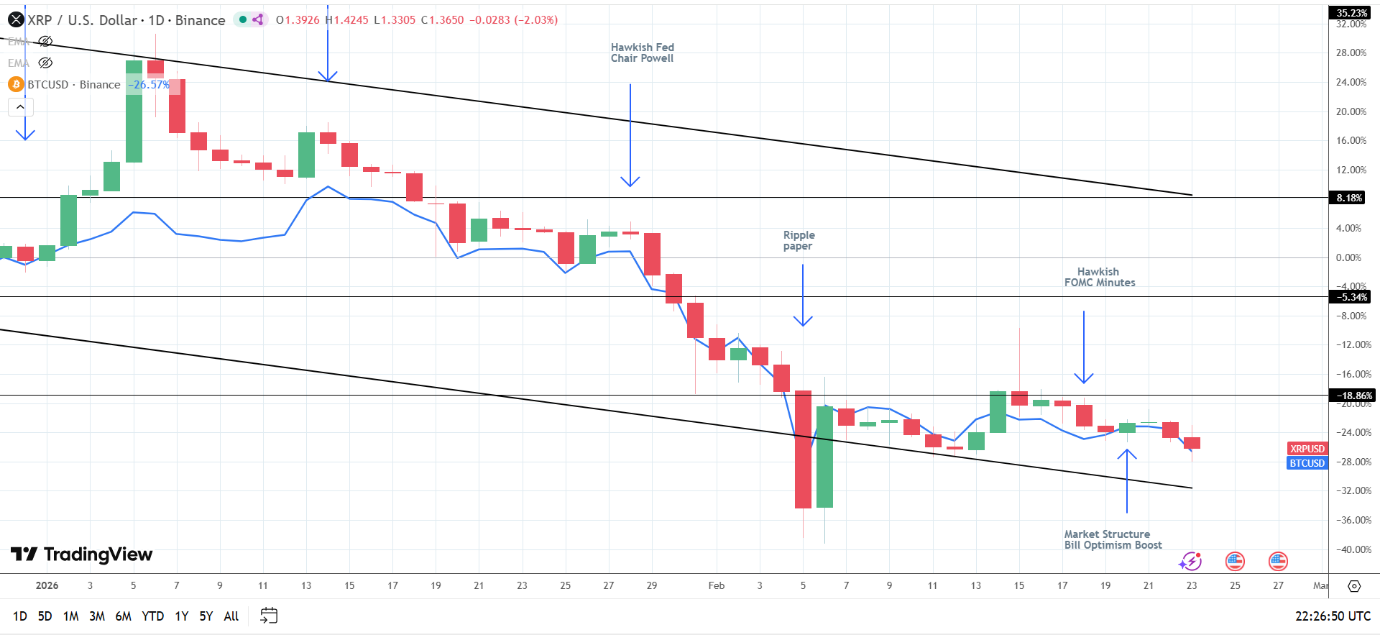
President Trump Announces Post Supreme Court Ruling Tariffs
Last week, the US Supreme Court ruled that the International Emergency Economic Powers Act (IEEPA) did not grant President Trump the authority to impose tariffs. Since the February 20 ruling, President Trump reacted by imposing a sweeping 10% tariff on all trading partners under different authority before raising it to 15%.
Trump also threatened countries aiming to leverage the ruling, warning:
“Any Country that wants to “play games” with the ridiculous supreme court decision, especially those that have “Ripped Off” the U.S.A. for years, and even decades, will be met with a much higher Tariff, and worse, than that which they just recently agreed to. BUYER BEWARE!!!”
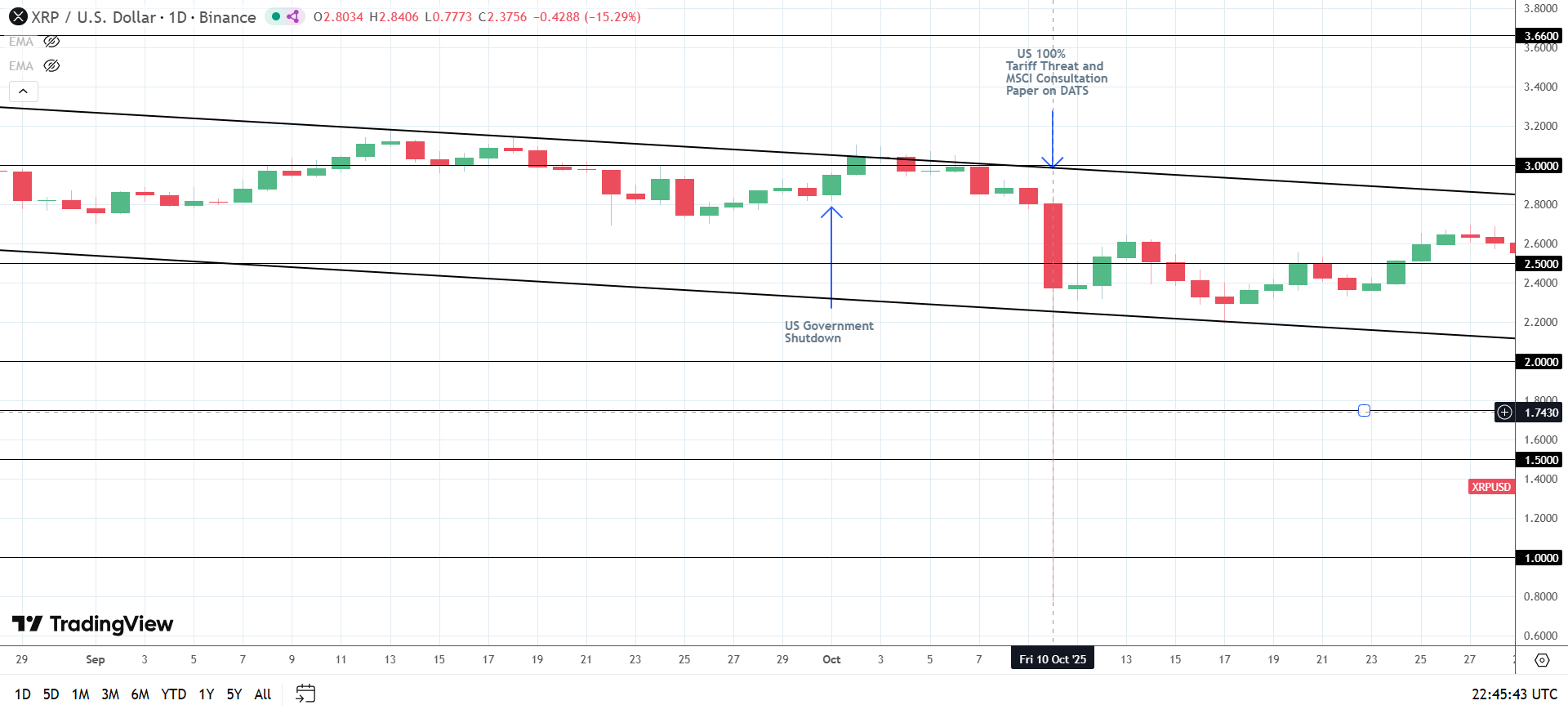
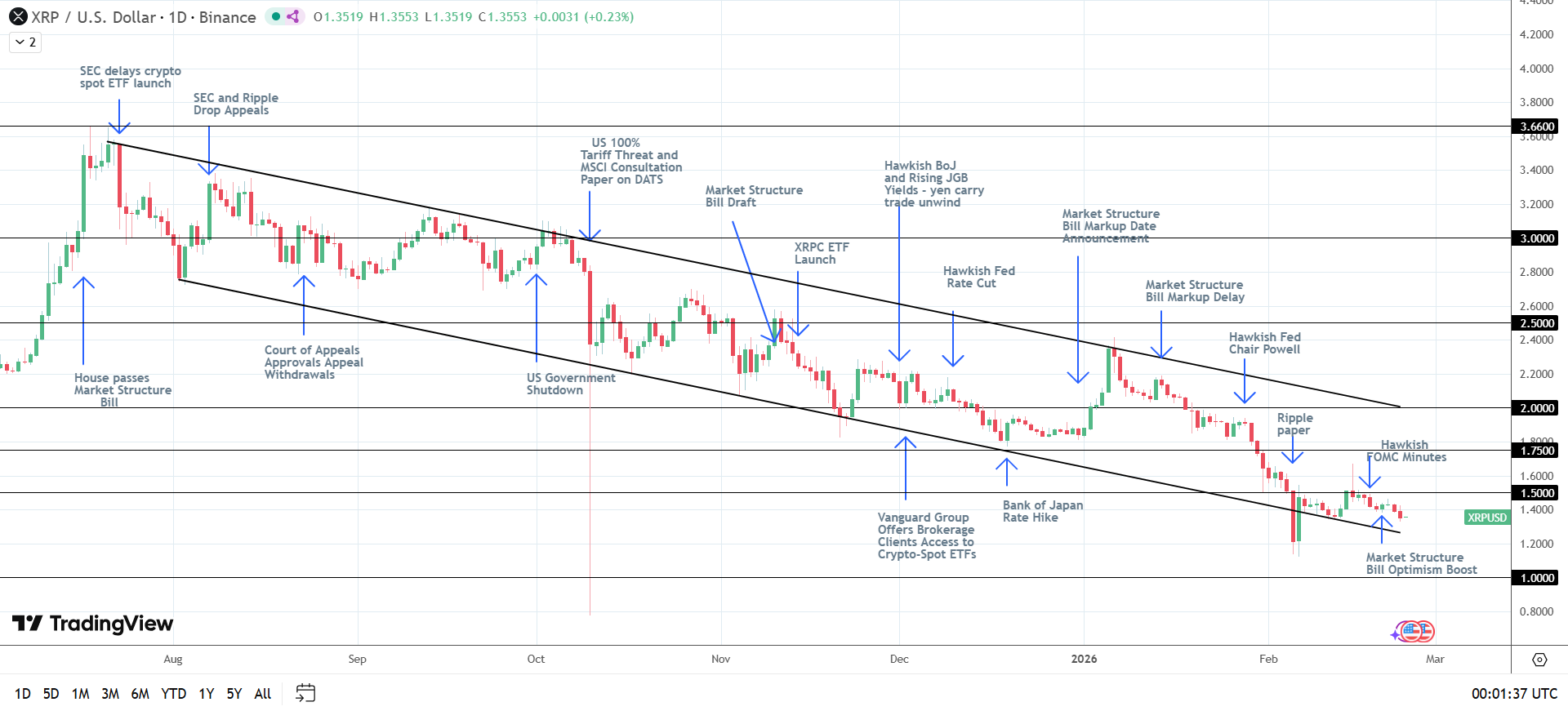
XRP and the broader crypto market remain sensitive to US tariff policies. On October 10, Trump threatened a 100% tariff on Chinese shipments, triggering a flash-crash. XRP plunged from $2.8406 to a low of $0.7773 before closing the session down 15.29% at $2.3756.
XRP Price Forecast: Short-, Medium-, and Long-Term Targets
XRP has dropped 26.4% year-to-date, affirming a cautiously bearish short-term outlook (1-4 weeks), with a target price of $1.0.
However, robust demand for XRP-spot ETFs, optimism that the US Senate will pass the Market Structure Bill, and increased XRP utility reaffirm the bullish medium- to long-term price projections:
- Medium-term (4-8 weeks): $2.0.
- Longer-term (8-12 weeks): $3.0.
Key Downside Risks to the Bullish Medium-Term Outlook
Several scenarios could unravel the constructive medium-term bias. These include:
- A full-blown US-Iran conflict.
- US economic indicators dampen expectations of an H1 2026 Fed rate cut.
- Delays and/or partisan opposition to the Market Structure Bill.
- Extended periods of XRP-spot ETF net outflows.
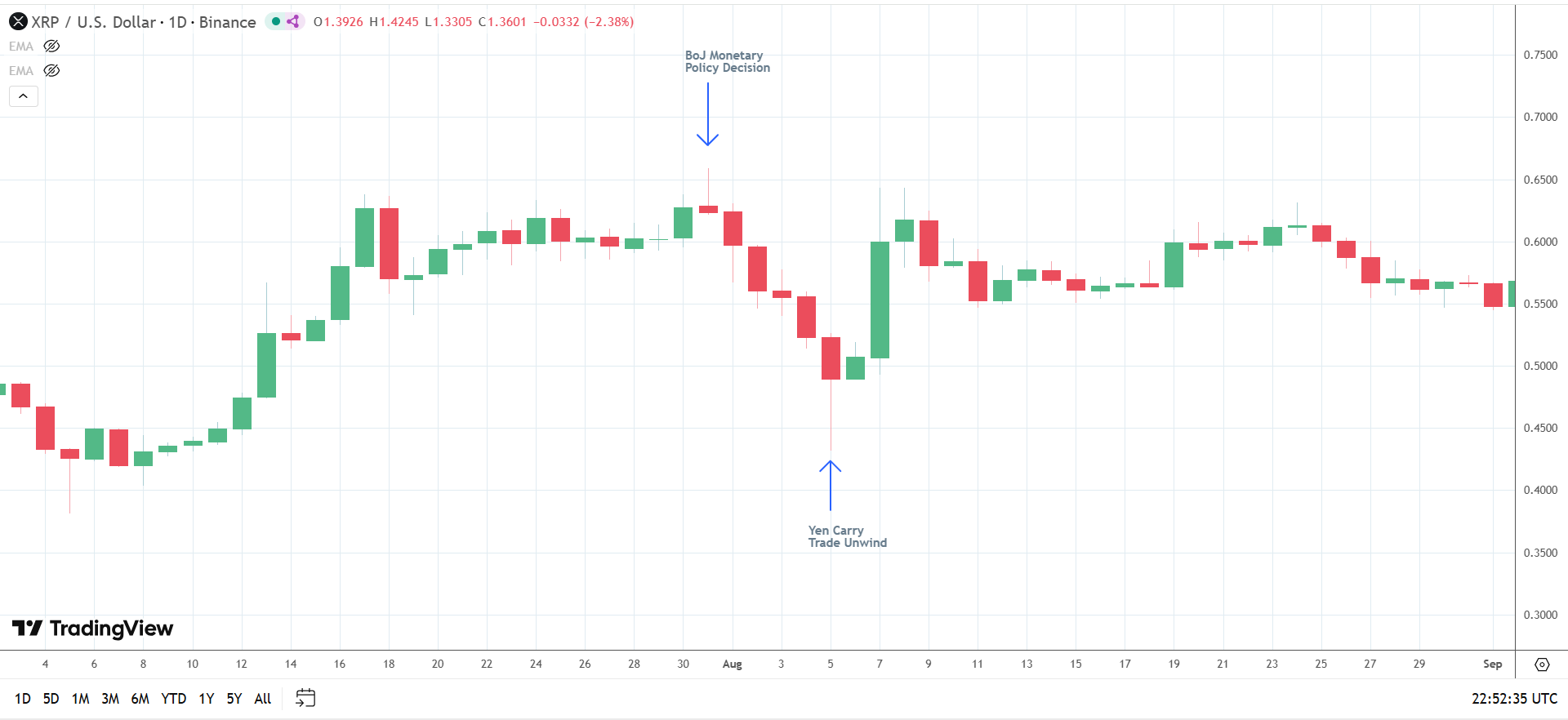
Additionally, traders should monitor Bank of Japan chatter and USD/JPY trends, given the impact of the mid-2024 yen carry trade unwind on XRP. A more hawkish-than-expected BoJ monetary policy decision sent USD/JPY crashing from 153.889 to 139.576, triggering a yen carry trade unwind, drying up market liquidity. XRP tumbled from a July 31, 2024, high of $0.6591 to an August 5, 2024, low of $0.4320 before reclaiming $0.60.
A hawkish Bank of Japan, with a higher neutral interest rate (potentially 1.5%-2.5%), would indicate multiple BoJ rate hikes. Multiple rate hikes would narrow US-Japan rate differentials in favor of the yen. Narrowing rate differentials could trigger another yen carry trade unwind. For context, the BoJ previously announced a wide neutral rate band of 1%-2.5% but stated it would declare a tighter range at a later date.
These scenarios would weigh on XRP, push the token toward $1.0, and reinforce the cautiously bearish short-term outlook.
Technical Analysis: Levels to Watch
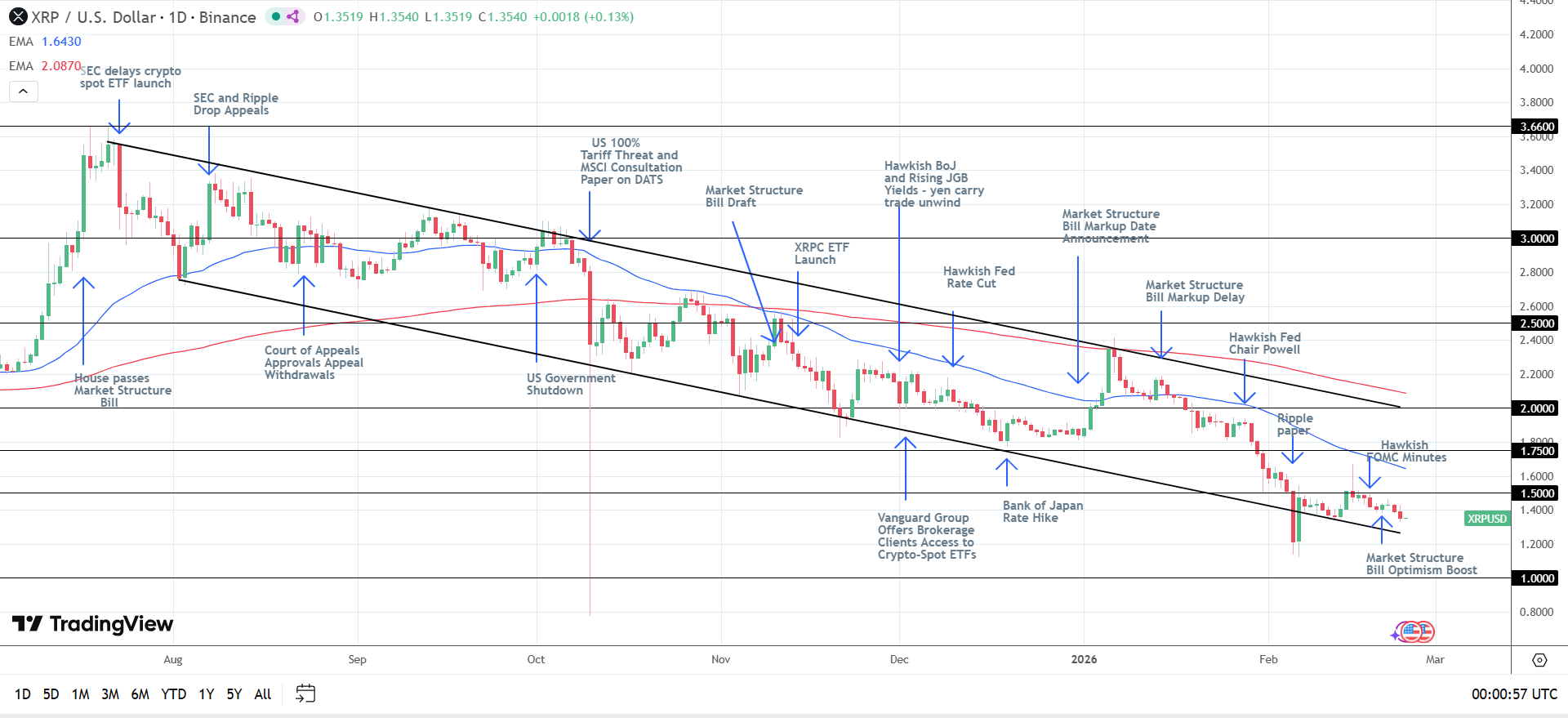
XRP fell 2.95% on Monday, February 23, following the previous day’s 2.57% loss, closing at $1.3522. The token faced less severe losses than the broader crypto market cap, which slid 3.80%.
The reversal left XRP trading well below its 50-day and 200-day EMAs. The EMA positions signaled a bearish bias. The 50-day EMA pulled further back from the 200-day EMA, suggesting increased near-term selling pressure. However, several positive fundamentals continue to counter bearish technicals, supporting the bullish medium-term outlook. Despite these favorable fundamentals, short-term technicals remain bearish.
Key technical levels to watch include:
- Support levels: $1.0, and then $0.7773.
- 50-day EMA resistance: $1.6550.
- 200-day EMA resistance: $2.0944.
- Resistance levels: $1.5, $2.0, $2.5, and $3.0.
On the daily chart, a break above $1.50 would bring the 50-day EMA into play. A sustained move through the 50-day EMA would signal a near-term bullish trend reversal. A bullish trend reversal would enable the bulls to target the 200-day EMA.
A sustained move through the EMAs would affirm a bullish trend reversal and reinforce the medium- to longer-term price targets.
Fundamental Events Driving Near-Term Price Action
Near-term price drivers include:
- XRP-spot ETF flows.
- US economic data and the Fed policy stance.
- Crypto-related legislative developments – the stablecoin yield stalemate.
- The Bank of Japan’s neutral rate and rate path.
- Increased geopolitical tensions in the Middle East.
Bearish Structure Intact: $1.0 Remains Key Support
Following Monday’s drop, XRP has fallen 17.7% in February, affirming the existing bearish trend. A break below the lower trendline would expose the February 6 low of $1.1227. If breached, $1.0 would be the next key support level. A sustained fall through $1.0 would reaffirm the cautiously bearish short-term outlook and further validate the bearish structure.
However, reclaiming $1.5 would pave the way toward $2.0 and the upper trendline. A sustained move through the upper trendline would invalidate the bearish structure and signal a bullish trend reversal, reaffirming the constructive medium-term bias.
- Short-term (1-4 weeks): $1.0.
- Medium-term (4-8 weeks): $2.0.
- Longer-term (8-12 weeks): target of $3.0.
XRP Outlook: Geopolitics, Crypto Legislation, and ETF Flows in Focus
Looking ahead, developments in the Middle East will influence market risk appetite. A US-Iran conflict would likely overshadow crypto-related regulatory developments.
Nevertheless, further passage of the Market Structure Bill on Capitol Hill would reaffirm the bullish medium- to longer-term outlook for XRP.
However, central bank chatter, US economic indicators, Trump’s tariff policies, and XRP-spot ETF flows will also influence XRP’s price outlook.
A more dovish Fed and a BoJ neutral rate potentially in the 1%-1.25% range would boost sentiment. Strong investor appetite for US XRP-spot ETFs and crypto-friendly regulatory developments would fuel demand for XRP.
In summary, these factors would support a medium-term (4–8 weeks) move to $2.0. The US Senate passing the Market Structure Bill would reaffirm the longer-term (8-12 weeks) price target of $3.0.
Beyond 12 weeks, these scenarios may send XRP to its all-time high of $3.66 (Binance). A breakout above $3.66 would reinforce a 6- to 12-month price target of $5.