



Tokyo headline and core inflation beat forecasts, strengthening the yen and sending USD/JPY below 156. Meanwhile, Japanese retail sales figures signaled a sharp pickup in domestic demand, reviving bets on a June BoJ rate hike.
This week, Japanese Prime Minister Sanae Takaichi poured cold water on April BoJ rate hike bets, sending USD/JPY to a 12-day high of 156.823 on February 26.
On Friday, February 27, Japanese economic indicators supported a more hawkish BoJ rate path.
Later on Friday, US producer prices are likely to influence the Fed rate path and demand for the US dollar.
Despite shifting sentiment toward BoJ and Fed policy stances, bets on an eventual BoJ rate hike and Fed rate cuts continue to support the bearish medium-term outlook for USD/JPY.
Below, I’ll discuss the macro backdrop, near-term price catalysts, and technical levels traders should closely watch.
Tokyo Headline Inflation and Retail Sales Strengthen the Yen
Tokyo’s headline inflation rose from 1.5% in January to 1.6% in February, signaling a pickup in national inflation. Economists had expected a reading of 1.5%. Core inflation slipped from 2.0% in January to 1.8% in February, while so-called core-core inflation fell from 2.0% to 1.8%. Economists had forecasted 1.7% and 1.9%, respectively.
The hotter-than-expected headline and core inflation rates boosted demand for the yen, sending USD/JPY from 156.043 to a low of 155.865. However, the softer-than-expected ‘core-core’ inflation rate, sitting well below the BoJ’s 2% target, will likely be a drag for the yen.
Tokyo’s softer core-core inflation suggested a further easing in national core-core inflation. Japan’s ‘core-core’ inflation rate fell from 2.9% in November to 2.6% in December, holding well above the 2% target. However, a continued downtrend in core-core inflation could challenge the BoJ’s inflation outlook and cool bets on a BoJ rate hike.
Meanwhile, Japanese retail sales figures indicated a pickup in consumption, supporting the BoJ’s upward revision to 2026 CPI forecasts. Retail sales increased 1.8% year-on-year in January, rebounding from a 0.9% fall in December. An upswing in consumer spending would likely fuel demand-driven inflation, supporting a more hawkish BoJ policy stance. Notably, USD/JPY extended its losses, falling to a low of 155.832 after the data.
The sharp rebound in retail sales also signaled a pickup in economic momentum, another prerequisite for a BoJ hike. For context, private consumption increased 0.1% quarter-on-quarter in Q4 after rising 0.2% in Q3.
Crucially, the medium-term outlook remains bearish for USD/JPY, with the retail sales figures bolstering bets on a summer BoJ rate hike.
USD/JPY Price Forecast
Every new USD/JPY analysis as it publishes, today's technical signal and key levels, live price — on one page.
See all USD/JPY forecasts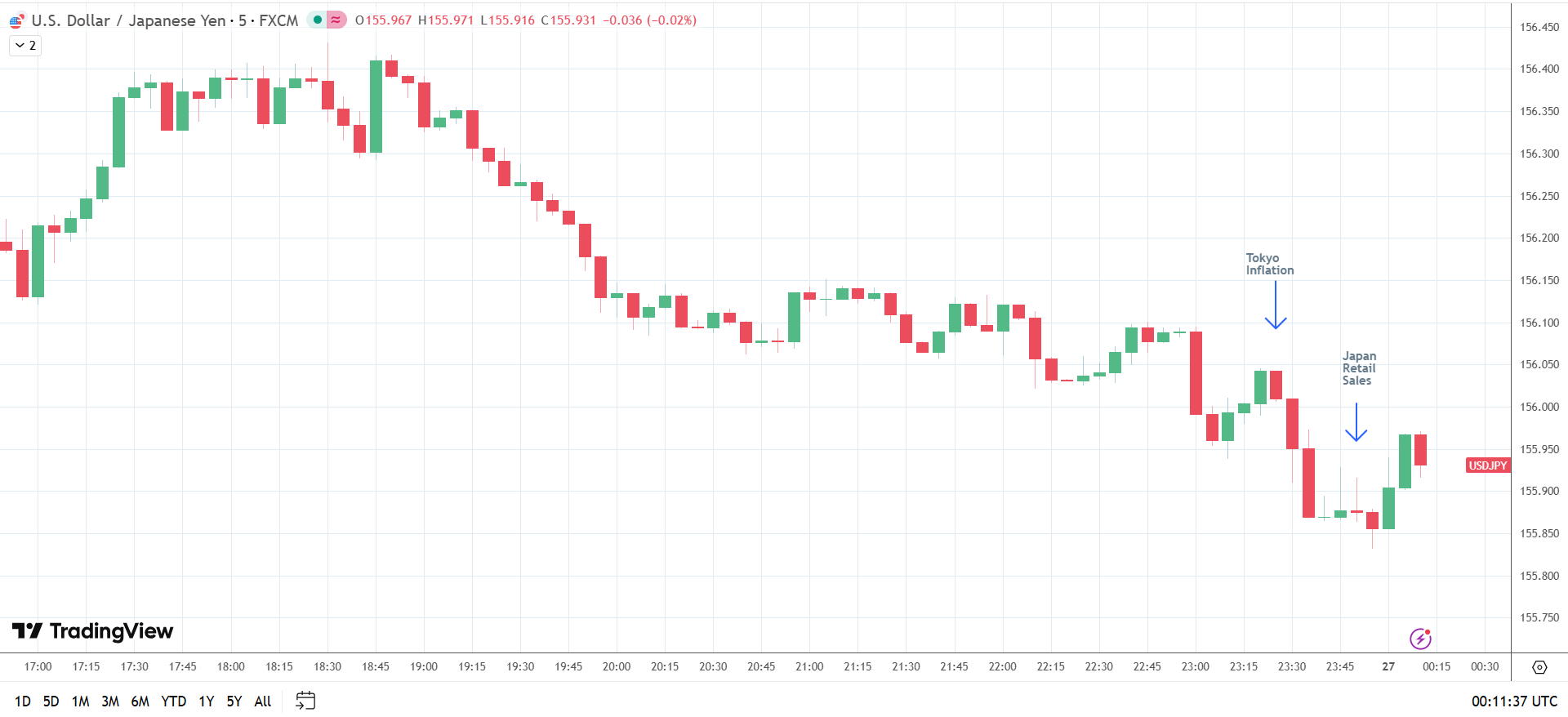
US Producer Prices to Spotlight the Fed
While market bets on a BoJ rate hike linger, US inflation data will influence sentiment toward the Fed rate path. Economists forecast producer prices will rise 2.6% year-on-year in January, down from 3.0% in December. Furthermore, economists expect core producer prices to increase 3.0% YoY in January, down from 3.3% in December.
Weaker producer prices would suggest a softer inflation outlook, supporting a June Fed rate cut. Rising bets on a June cut would weaken the US dollar and affirm the bearish outlook for USD/JPY.
Recent US economic indicators have tempered bets on a June rate cut, sending USD/JPY to 156. However, weaker-than-expected producer prices would likely trigger a US dollar sell-off on rising expectations of a Fed policy adjustment.
According to the CME FedWatch Tool, the probability of a June cut fell from 58.6% on February 19 to 47.8% on February 26.
Technical Outlook: Key Levels to Watch
For USD/JPY price trends, traders should consider technical indicators, key economic indicators, government policies, and central bank rhetoric.
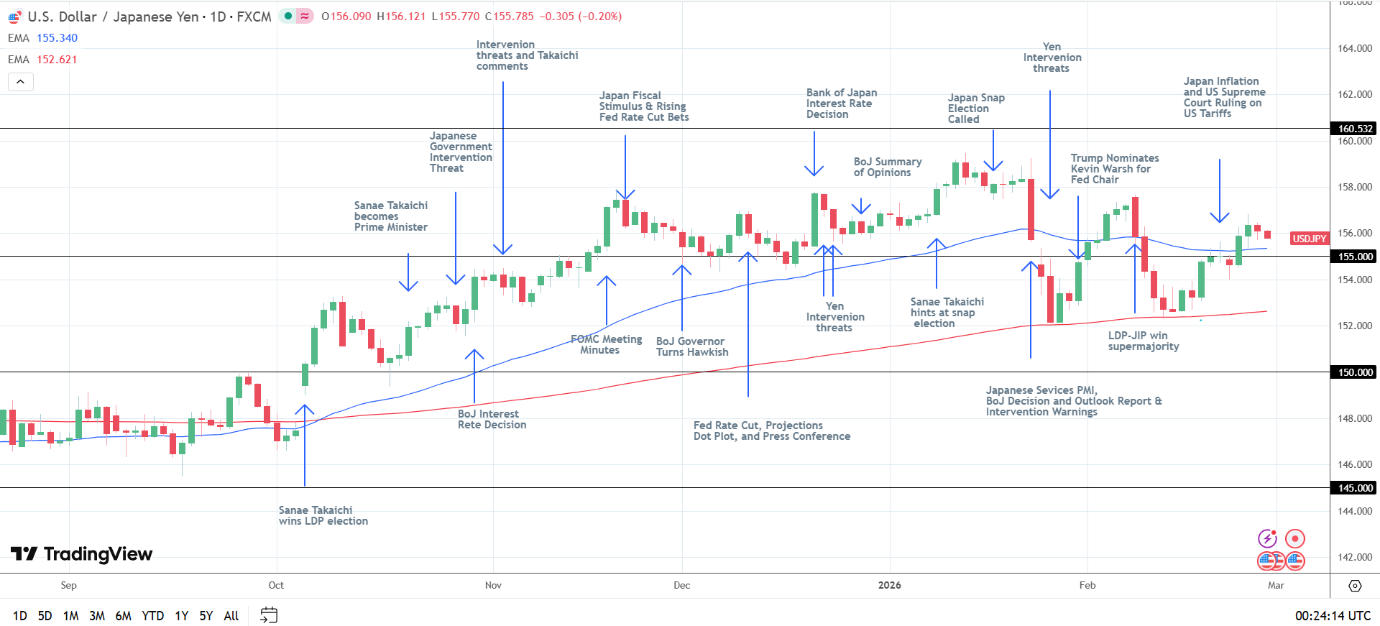
On the daily chart, USD/JPY remains above its 50-day and 200-day Exponential Moving Averages (EMAs). The EMA positions signal a bullish bias. However, favorable yen fundamentals counter the bullish technical outlook, supporting a bearish medium-term outlook.
A drop below the 50-day EMA would expose 153. If breached, the 200-day EMA would be the next key technical support level. A sustained fall through the 200-day EMA would open the door to testing the 150 support level.
Significantly, a sustained fall through the EMAs would indicate a bearish trend reversal and reaffirm the negative medium- to longer-term price outlook.
Positioning and Risk Outlook
In my view, ongoing bets on a BoJ rate hike and Fed rate cuts support a negative price outlook. However, upside risks to the bearish outlook include:
- Dovish BoJ chatter and a lower neutral interest rate band (dovish: potentially 1%-1.25%), suggesting fewer rate hikes to achieve policy normalization.
- Upbeat US economic indicators temper bets on an H1 2026 Fed rate cut.
These scenarios would drive USD/JPY higher. However, yen intervention threats are likely to cap the upside near 160.
Read the full USD/JPY forecast, including chart setups and trade ideas.
Conclusion: The BoJ, US Inflation, and the Fed in Focus
In summary, USD/JPY trends hinge on the BoJ’s policy stance, incoming economic data, the Fed rate path, and government policies.
Given the BoJ’s plans for monetary policy normalization, a hawkish BoJ neutral rate band (1.5%-2.5%), signaling multiple BoJ rate hikes, would fuel buying interest in the yen over the medium term. Furthermore, multiple Fed rate cuts would also narrow US-Japan rate differentials in favor of the yen. Narrowing rate differentials would reinforce the bearish medium-term outlook for USD/JPY.
Looking beyond the short- to medium term (1-3 months), a stronger yen and yen carry trade unwinds would likely push USD/JPY toward 140 over 6-12 months.
For more in-depth analysis, review today’s USD/JPY trading setups in our latest reports and consult the economic calendar.