


For months, capital has crowded into artificial intelligence, equities and rate-cut speculation. Yet beneath the surface, a far bigger story has been building across Energy and Metals. Supply chains are tightening. Geopolitical risk is rising. Inflation pressure is returning. AI is creating a structural power-demand shock. And inventories across key raw materials are being drawn down at precisely the wrong time.
Now price action is confirming the thesis.
WTI Crude Futures have surged more than 9% above $94 per barrel, while Brent has climbed past $97 after reports that Tehran suspended communications with Washington and moved closer to fully closing the Strait of Hormuz.
Natural Gas jumped more than 15% last week and closed the month with a gain of roughly 25%. Copper futures have broken above $6.40 per pound, closing higher than any month in history and pushing into uncharted territory.
This may be the quietest Commodity bull market ever – but it is becoming impossible to ignore.
“The market is beginning to realize Commodities are not just the hedge,” says Lars Hansen, Head of Research at The Gold & Silver Club. “They are becoming the trade. Energy security, AI demand, inflation risk and supply disruption are all converging at once.”
Oil Is the Shock Trade Markets Are Still Underpricing
The most urgent pressure point remains Oil.
Chevron Chief executive Mike Wirth has warned that the next 60 days could be worse than the last 90 for global Oil supply, with market buffers and shock absorbers being steadily drawn down. That warning matters because the world’s ability to absorb disruption has already been drastically reduced.
WTI above $94 and Brent beyond $97 suggest geopolitical risk is moving from headlines into barrels, shipping routes and physical supply chains. The danger is that traders continue to treat disruption as temporary, when the physical market may take months to normalize.
ExxonMobil Senior Vice-President Neil Chapman has also highlighted the risk of extremely low inventory levels, suggesting that once markets reach those conditions, $150 to $160 Oil becomes a realistic upside target.
ADNOC Group CEO Sultan Al-Jaber has warned that even if a deal were signed immediately, flows through the Strait of Hormuz would not fully recover overnight. Returning to 80% of pre-conflict flows could take at least four months, while full normalization may not arrive until the first or second quarter of 2027.
“A signed deal does not restore supply,” Hansen says. “Only time restores supply. That is why Oil markets could remain tighter for longer than traders currently expect.”
Brent Oil Price Forecast
Every new Brent Oil analysis as it publishes, today's technical signal and key levels, live price — on one page.
See all Brent Oil forecastsNatural Gas Is Becoming the Hidden AI Trade
Natural Gas may be the most underappreciated opportunity in the entire AI boom.
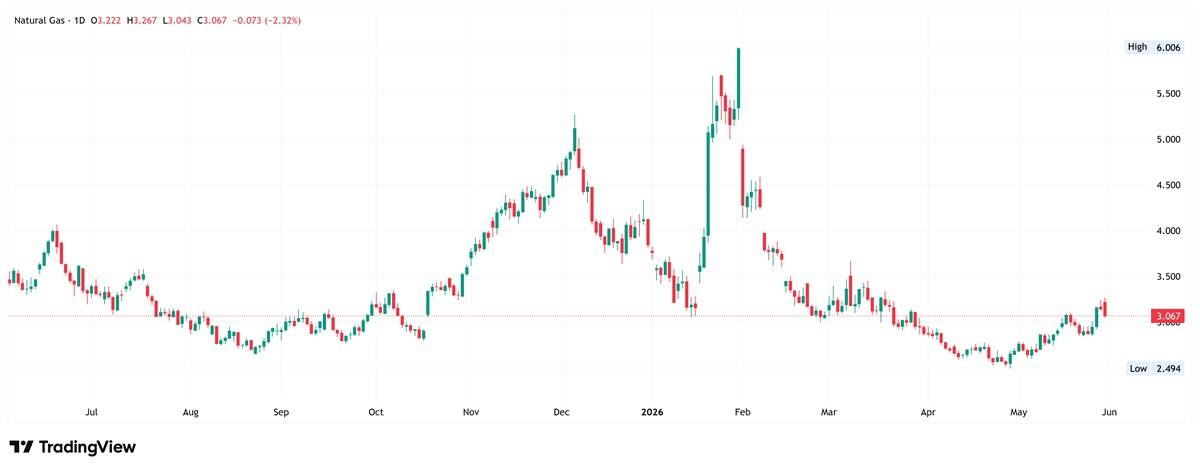
The first phase rewarded chipmakers, cloud platforms and data-centre operators. The next phase may reward the fuel required to keep the machines running.
AI cannot scale without reliable electricity. Data centres need constant power. Grid connections are becoming a bottleneck. Renewables remain essential, but intermittency means dispatchable Energy remains critical. That places Natural Gas at the heart of the AI infrastructure buildout.
“AI is creating a power-demand shock that technology stocks cannot solve by themselves,” Hansen says. “The market has priced the intelligence layer. It has not fully priced the Energy layer that keeps the entire system alive.”
Copper Is Breaking Into Uncharted Territory
Copper is now delivering one of the most important signals in global markets.
Prices have broken above $6.40 per pound, closed higher than any month in history and entered price discovery. This is no longer just a traditional industrial-growth trade. Copper is becoming the wiring of the AI economy, the grid economy and the electrification economy.
Data centres, transformers, cooling systems, power networks, defence infrastructure and clean-energy projects all require enormous metal intensity. That demand is arriving while mine supply remains constrained and inventories are historically tight.
The bigger picture is even more powerful. The last time Commodities traded near current technical levels, they went on to double. In 2004, the sector crossed a multi-decade resistance line and rallied 72% over the following four years. That level has only been touched three times in 50 years. Today, Commodities are testing it again.
“Copper is not just participating in the breakout,” Hansen says. “It may be leading it.”
Aluminum is also tightening, with falling inventories, Middle East supply disruption and extreme backwardation pointing to growing concerns over physical availability.
The Commodity Repricing May Be Just Beginning
June is not just another trading month. It could be the point when traders realize the biggest opportunity of 2026 is not hiding in crowded technology names, but in the hard assets powering the next phase of the global economy.
Oil is the geopolitical shock trade. Natural Gas is the AI power trade. Copper is the infrastructure trade. Aluminum is the scarcity trade. Precious Metals are the inflation trade.
Together, they form one of the strongest Commodity setups in years.
The question is no longer whether Commodities present a bullish case.
The real question is whether traders are positioned before the June breakout becomes impossible to ignore.