Natural Gas Holds Bid on LNG Fears and Heat
August Nymex natural gas is trading at $3.263 at 19:29 GMT on Tuesday, up 1.8 cents or 0.55%. European LNG disruption fears and a hot weather pattern stretching through mid-July are keeping the bid alive. Production near record levels and comfortable storage are limiting the upside, but the market is holding above the 50-day moving average and the buyers are not giving it back.
Daily August Natural Gas Technical Analysis
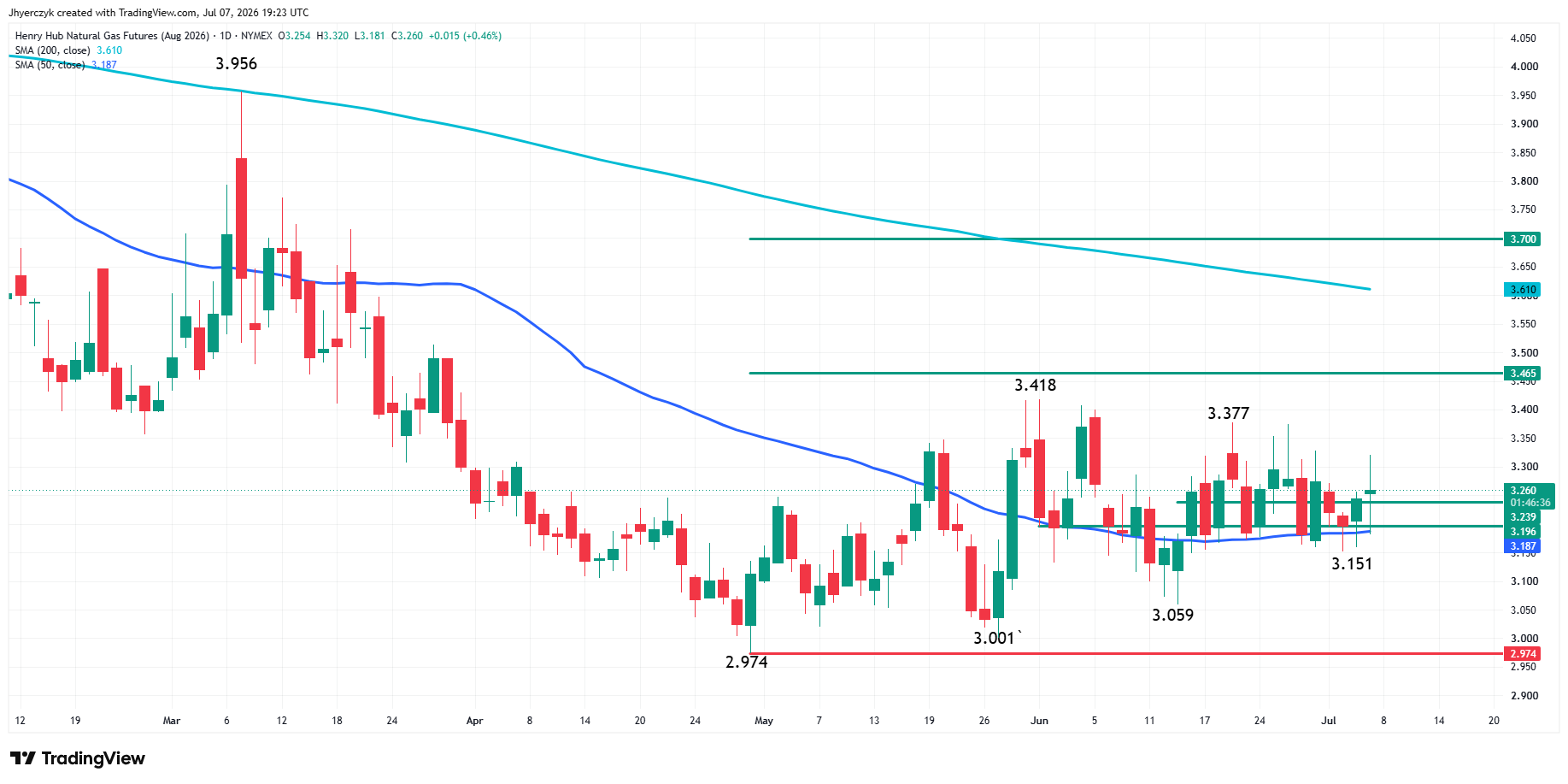
August natural gas futures are trading in a position to finish higher on Tuesday and well above the 50-day moving average at $3.187, which is the key support and guidance. While this move was enough to re-establish the support, the rally through the pair of 50% levels at $3.196 and $3.239 indicates that upside momentum is increasing.
The daily chart also indicates that buyers have a clear shot at main tops coming in at $3.377 and $3.418. Taking out these levels will reaffirm the uptrend, but headwinds still linger at the intermediate 50% level at $3.465. Not only is this support, but it’s also the trigger point for an acceleration to the upside with the 200-day moving average at $3.611 and the long-term pivot at $3.700 the next major targets.
Make sure you define your trading objectives. If you’re looking for short-term entertainment then stick with the August or September futures contracts. They will primarily be driven by short-term weather changes. If you’re looking for a long-term move with no worries about monthly rollovers, then trade the December to March futures contracts.
The scenario for a bullish long-term move involves hot weather and increasing LNG demand depleting the U.S. gas in storage. This would lead to much lower supplies at the start of the winter heating season. At least that’s my plan.
Natural Gas Price Forecast
Every new Natural Gas analysis as it publishes, today's technical signal and key levels, live price — on one page.
See all Natural Gas forecastsEurope’s Storage Gap Puts U.S. LNG in Play
European natural gas prices hit a three-week high on Tuesday after the attack on a Qatari LNG carrier in the Strait of Hormuz reopened the question of how reliably Persian Gulf cargoes can reach European buyers. European storage facilities were only about 50% full as of July 4 against a five-year seasonal average of 65%. That deficit is wide enough that any interruption to Middle Eastern LNG sends European utilities looking for U.S. cargoes to fill the gap before winter.
Ras Laffan is the reason the Hormuz attack hit European pricing as hard as it did. Qatar said earlier this year that attacks damaged roughly 17% of the facility’s LNG export capacity. Repairs are expected to take three to five years. The facility handles about 20% of global liquefied natural gas supply and the damage predates Tuesday’s incident. One Qatari tanker getting hit near the Strait is a headline. A 17% capacity reduction at the world’s largest LNG hub lasting half a decade is the story European buyers were already trading before Tuesday morning.
LNG feedgas deliveries to U.S. export terminals totaled 18.1 billion cubic feet per day on Tuesday, down 7.6% from the prior week. European utilities are trying to replace Qatari cargoes while rebuilding storage from 50% to something defensible before winter. That means bidding for U.S. gas. That pulls molecules off the domestic market and onto tankers, and the storage surplus that is keeping the bears comfortable right now starts shrinking.
Heat Through Mid-July Is Doing the Work
The demand side of this market is getting exactly what the bulls need. NatGasWeather is forecasting the southern two-thirds of the U.S. to stay hot to very hot through July 13, with highs running in the 90s to 100 degrees. Desert locations across the Southwest are expected to reach 111 to 115 degrees. The northern states get a break with highs in the 70s and 80s, but the air conditioning load across the rest of the country is doing the heavy lifting for gas-fired generation.
National natural gas demand is projected high over the next seven days and the pattern holds through much of the 15-day outlook. Weather models have some disagreements further out, but the overall lean stays bullish for power-sector gas consumption through the summer cooling peak. Every day the heat holds is a day the storage cushion gets thinner.
Output Growth Won’t Let the Bulls Run
Production keeps climbing and the forecast revisions keep going in the same direction. BloombergNEF estimated lower-48 dry gas production at 110.2 billion cubic feet per day on Tuesday, up 1.7% from a year ago. The Energy Information Administration raised its 2026 production forecast to 111.2 Bcf per day from its June estimate of 111.0. The increases are small but they are persistent and they all point the same way.
Lower-48 demand came in at 75.3 billion cubic feet per day, down 4.0% from the same period last year. Production running higher while demand runs lower is the equation that keeps every rally on a short leash.
Last week’s Energy Information Administration storage report showed an 87 Bcf injection for the week ended June 26. The market expected 84 Bcf. The five-year average build for that week was 64 Bcf. Inventories are 1.0% below year-ago levels but sit 6.4% above the five-year seasonal average. The injections are running above the pace the bulls need to see for a sustained argument.
The El Niño risk is sitting in the background. A powerful event this fall and winter would push warmer-than-normal temperatures across the Northern Hemisphere and cut heating demand later in the year. Tuesday’s session is trading the July heat, not the winter strip, but the forward curve is aware of it.
What to Watch
The European storage gap and the Ras Laffan damage are not going away this week or this month. The heat pattern through mid-July is burning gas on the demand side. Those two forces are running into production near record highs and a storage surplus that is still 6.4% above the five-year average. August Nymex natural gas needs both the weather and the European LNG pull working together long enough to close that storage gap. One without the other and the bears still have the numbers.
Sellers are waiting at the main tops at $3.377 and $3.418. Clear both and the trigger is $3.465 for an acceleration into the 200-day at $3.611.
More Information in our Economic Calendar.