


Natural Gas Edges Higher as Middle East War Threatens Global Supply
U.S. natural gas futures are edging higher on Monday after gapping up Sunday night, following a surge in crude oil futures. Although not to the same extent as crude, natural gas supply is being threatened by the war in the Middle East. The Strait of Hormuz remains shutdown to tanker traffic, raising concerns over shortages in Europe and Asia.
At 12:10 GMT, April Natural Gas futures are trading $3.341, up $0.155 or +4.87%.
Europe Is in Trouble
While the U.S. remains amply supplied, Europe is in trouble. European natural gas prices surged again on Monday, trading at nearly twice the price it was on February 27, the day before the attacks on Iran began. According to reports, benchmark European prices rose above 60 Euros per megawatt hour versus 32 Euros before the attack on Iran.
Prices in Europe are dragging U.S. prices higher because the Europeans may be forced to turn to the United States to meet LNG supply needs. The longer the Strait of Hormuz remains closed the stronger the impact on global supplies.
Shoulder Season Restocking Is Now at Risk
Europe is moving from winter to spring, but if you’ve watched the natural gas market long enough, you’d know that companies treat the spring and fall shoulder seasons as the key time periods to restock gas reserves for next winter. In Asia, the need is to top off storage before the summer heat arrives.
No End Game in Sight
As we start the second week of the war, there is no end game in sight and in my opinion, conditions are worsening. The problem is spreading and consumers and businesses are likely to start feeling financial pressures. Power plants, airlines and even inflation forecasts are being impacted.
Natural Gas Price Forecast
Every new Natural Gas analysis as it publishes, today's technical signal and key levels, live price — on one page.
See all Natural Gas forecastsAll Eyes on the Strait of Hormuz
So far, I’m seeing a controlled trade but trading conditions could change quickly if risk premiums start to rise. All eyes are going to be on the Strait of Hormuz this week and whether Washington can keep its promise to keep it open to oil and gas transportation.
Unfortunately, opening up the Strait is only one piece of the complex puzzle. Qatar’s energy minister Saad al-Kaabi said that even with a swift end to the war, restoring his country’s delivery schedules could take “weeks to months.”
Key Technical Levels to Watch
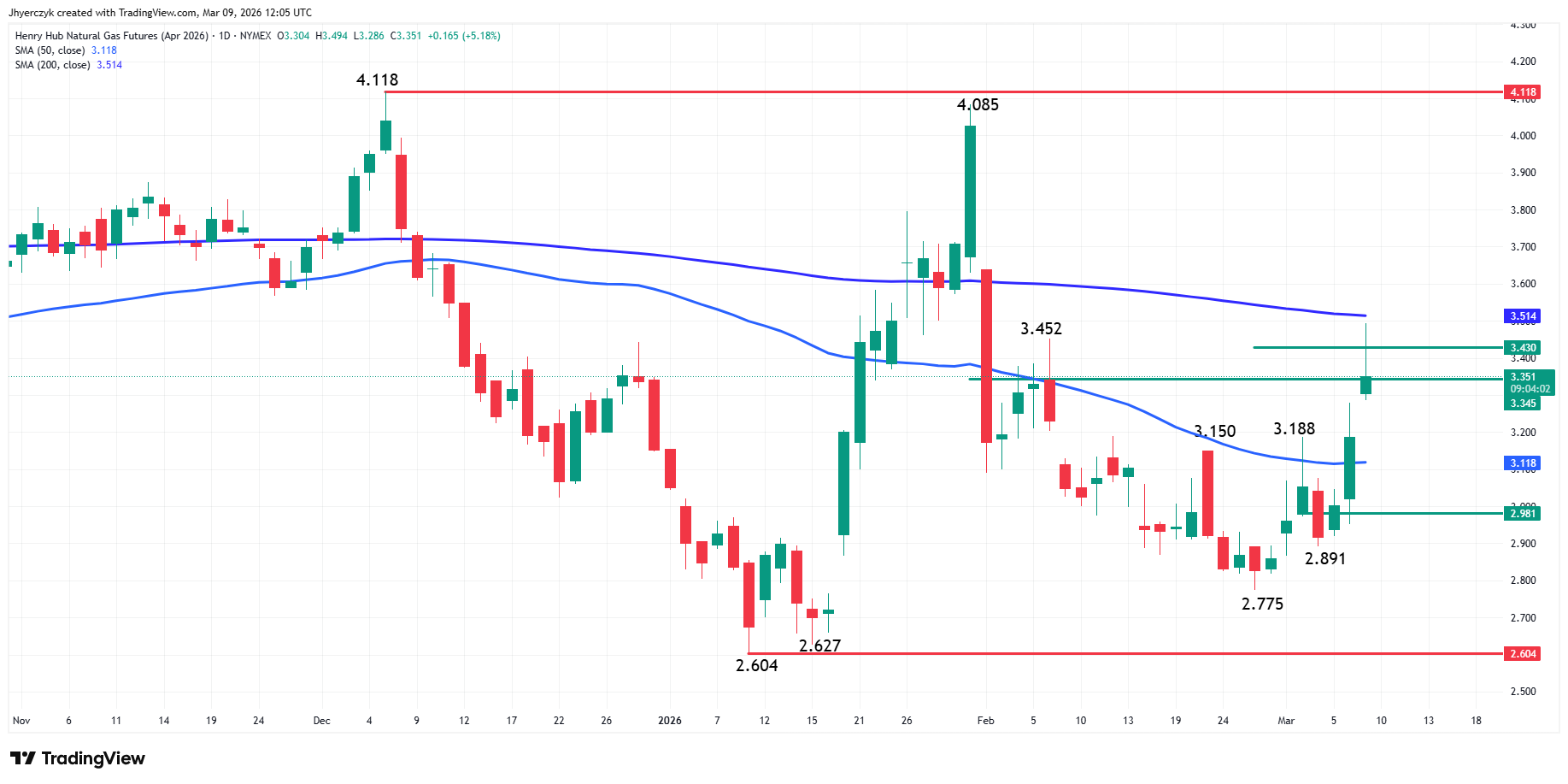
Technically, with April Natural Gas prices firmly above the 50-day moving average support at $3.119, our focus is going to be on the 200-day moving average at $3.514, overcoming this technical barrier with conviction could trigger a massive short-covering rally, fueled by speculators with potential targets coming in at $4.085 and $4.118.
Traders are currently monitoring the price action around a pivot at $3.345. How they react to this level today will determine if prices fall back to the 50-day MA, or if there is an attempt to breakout over the 200-day MA.
More Information in our Economic Calendar.


