


Heat and LNG Are Pushing Gas the Same Direction
July Natural Gas is trading $3.264, up $0.031 or 0.96% at 14:10 GMT Monday, holding above the 50-day moving average and building on the progression of higher lows that has defined the chart since late spring. Two forces are converging at the same time and the market is starting to price it in. Heat is expanding across the eastern half of the country while LNG feedgas demand sits near historic levels.
For most of the spring the bears had the easier argument. Production stayed strong, storage builds came in on schedule, and every rally got sold. That setup is under pressure now. The demand side is moving and the timing could not be worse for anyone still leaning short.
Daily July Natural Gas Futures Technical Analysis
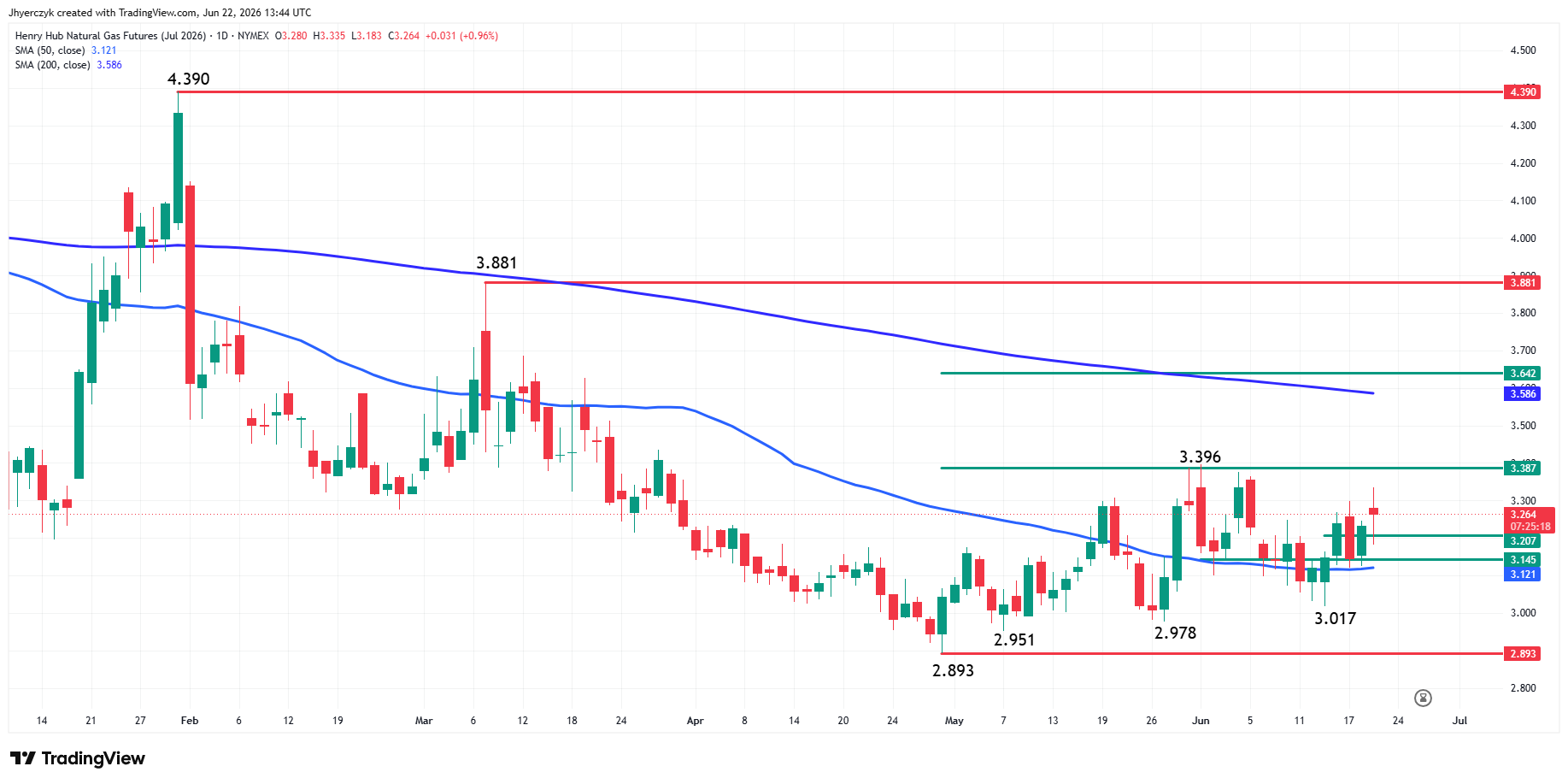
July natural gas futures are edging higher on Monday. The price action suggests investors are anticipating a bullish catalyst with the market sitting on the strong side of the 50-day moving average at $3.120 and closing in on the 200-day moving average at $3.586.
Besides the potentially bullish move over the 50-day, the trend is also being well-supported by the series of higher bottoms at $3.017, $2.978 and $2.951.
The main range is $2.893 to $3.396. Its 50% level at $3.145 is also support. It forms a price cluster with the 50-day MA.
On the upside, the first resistance is the intermediate 50% level at $3.387. The second is the swing top at $3.396. This is a potential trigger point for an acceleration to the upside. The target for this breakout will be the 200-day MA and the long-term 50% level at $3.642.
With a summer rally, we’re not anticipating a long-term event. They tend to have quick spikes that end with a fresh round of selling pressure. This doubles the importance of the $3.586 to $3.642 area.
Building a support base over the 50-day MA at $3.121 will be supportive, but it’s going to take a bullish catalyst to trigger a breakout over $3.396, the trigger point for a potential move into $3.586.
Natural Gas Price Forecast
Every new Natural Gas analysis as it publishes, today's technical signal and key levels, live price — on one page.
See all Natural Gas forecastsDaily December Natural Gas Futures Technical Analysis
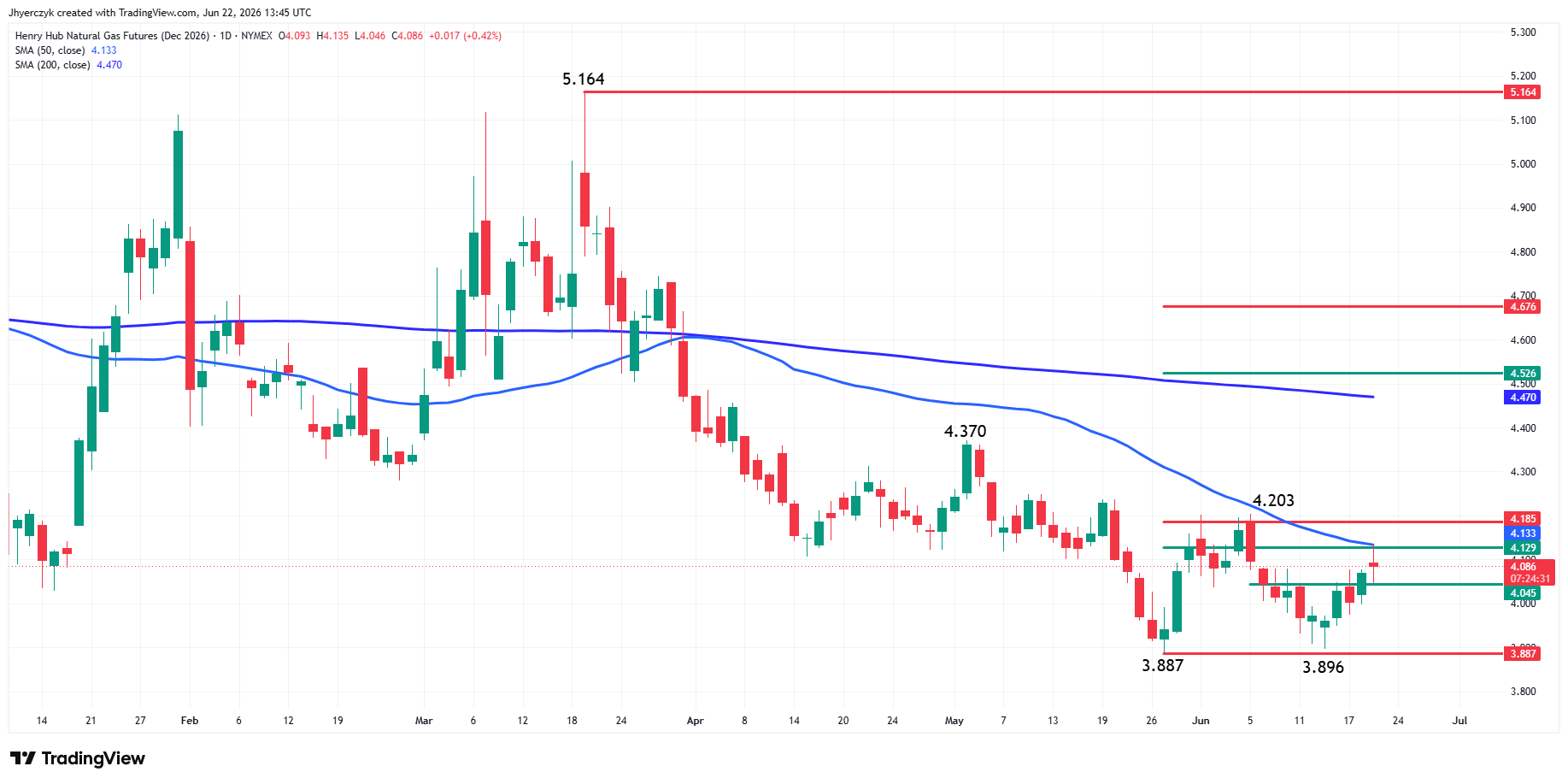
December natural gas futures are in a downtrend, but the support base suggests the market is building strength for an upside breakout. There are two bottoms at $3.896 and $3.887. Taking out $4.203 will change the trend to up according to the daily swing chart. This move will also confirm the double-bottom chart pattern with 4.519 the next objective.
The long-term range is $5.164 to $3.887. Its retracement zone at $4.526 to $4.676 is another major upside target. The intermediate retracement zone is $4.129 to $4.185. The short-term 50% level at $4.045 is support.
The nearest moving average is the 50-day at $4.133. Crossing to the strong side of this indicator will be a bullish sign and it could attract additional buyers. If the buying is strong enough, the rally could even extend into the 200-day MA at $4.470.
To sum it up, crossing the 50-day MA will be the first sign of strength. The second move will be a breakout over the swing top at $4.203. This will open the door to a potential surge into $4.470, followed by $4.526 to $4.676.
The Heat Is Not a One-Week Story
NatGasWeather has a strong ridge of high pressure expanding across the South, East, and parts of the Midwest with widespread temperatures in the 90s through the final week of June. The coverage is the story. This is not a single-region spike. Population-heavy areas from the Southeast through the Mid-Atlantic are under sustained above-normal temperatures and the forecast models keep adding cooling degree days instead of pulling back.
The market does not need a storage crisis to rally. It just needs injections to miss expectations for a couple of weeks in a row. If the heat verifies through the end of June, power burn is going to eat into the surplus that has been keeping the bears comfortable all spring. Storage looks adequate today. It looks a lot less adequate if the cooling demand forecasts hold and the heat carries into July.
Traders who have been leaning on the production side of the argument are running out of room. Output is still strong but it does not matter how much gas comes out of the ground when the demand side is pulling harder. Every cooling degree day the models add is another injection the market is not going to get.
LNG Demand Is Not Backing Off
U.S. LNG feedgas demand is near historically strong levels and the maintenance season is winding down. When the terminals come back to full rates, feedgas volumes have room to climb from here. That is more supply leaving the domestic market at the same time heat is pushing consumption higher.
Europe is still buying aggressively. Inventories came into the injection season below desired levels and the structural supply problems across the continent have not been solved. U.S. LNG is the most reliable source available and European buyers are not slowing down. Every cargo that leaves a Gulf Coast terminal is gas that does not go into domestic storage.
Operational concerns at Qatar’s massive LNG export complex reminded the market how fast global gas prices react when a major supplier faces uncertainty. Any disruption to competing supply increases the premium on U.S. cargoes and keeps feedgas demand elevated regardless of where the domestic price is trading. The Qatar situation may or may not develop further but it put the market on notice that the global LNG supply cushion is thinner than the bears assumed.
What to Watch
Heat and LNG demand are working in the same direction and neither driver is showing signs of fading. The weather models keep adding cooling degree days while LNG feedgas has room to run higher as maintenance wraps up. If injections start missing over the next two weeks, the storage cushion that held this market down all spring stops being the dominant story. The demand setup is there for a summer rally and the market is positioning for it.
The higher lows on the July contract say the selling pressure has been fading for weeks. The 50-day is support and a push through the swing top opens the path to the 200-day. December is building a double-bottom base with a trend change trigger sitting just overhead. Summer gas rallies tend to spike fast and burn out, which makes the $3.586 to $3.642 zone on July the area where the rally gets its real test.
More Information in our Economic Calendar.


