



Iran Doubt Puts the Floor Back Under Oil
July WTI crude oil settled at $96.00 on Friday, up $0.25 or 0.26%. July Brent crude oil settled at $104.80, down $0.87 or 0.83%.
Two benchmarks moving in opposite directions on the same session tells you something about where the pressure is coming from. For the week, Brent dropped around 5% and WTI fell more than 7%.
The Iran peace talks that had been pushing prices lower earlier in the week hit a wall Friday over enriched uranium and control of shipping lanes through the Strait of Hormuz. That brought risk premium back into the market heading into a long weekend with no resolution in sight.
July WTI Crude Oil Technical Analysis
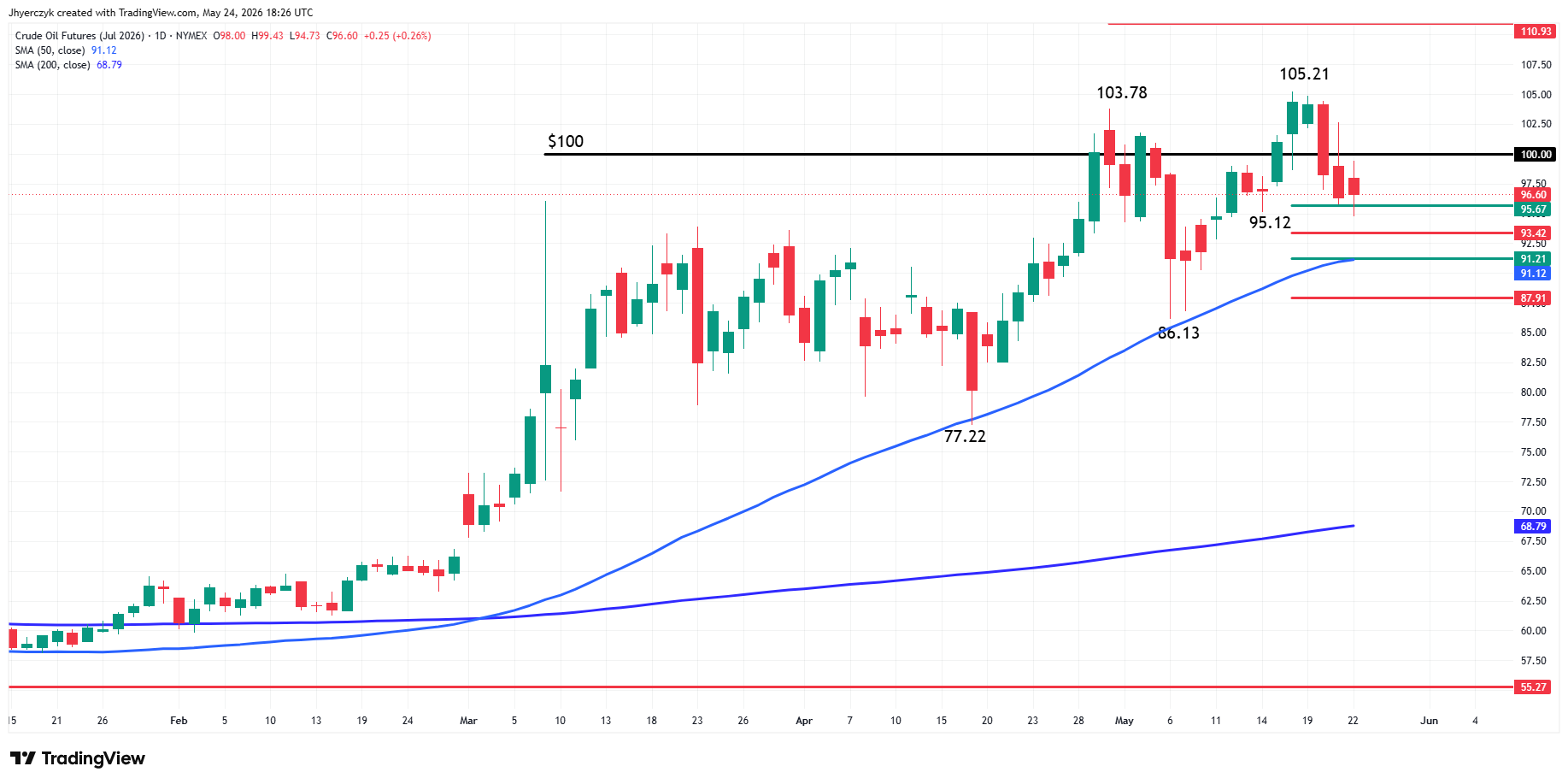
July WTI crude oil futures finished the week with a three-day losing streak, increasing the odds of a flat-to-lower opening on Monday. The main trend is up according to the daily swing chart and the major moving averages.
The main range is $86.13 to $105.21. Its retracement zone at $95.67 to $93.42 was successfully tested on Friday, when buyers came in at $96.60.
Another range is $77.22 to $105.21. Its retracement zone is $91.21 to $87.91. More importantly the 50-day moving average at $91.12 falls inside this zone.
On the upside, our primary focus is the $100.00 level. It’s not a retracement level, but a major psychological barrier. A trade through $105.21 will reaffirm the uptrend.
My work suggests that traders are likely to remain in buy the dip mode as long as the swing bottom at $86.13 holds as support. If it is taken out convincingly, traders could shift to “sell the rally” mode.
Heading into Monday’s U.S. holiday trade, dip buyers are going to have multiple choices, but for some, the 50-day moving average at $91.12 has to hold. For others, the first swing bottom at $86.13 has to hold.
Brent Oil Price Forecast
Every new Brent Oil analysis as it publishes, today's technical signal and key levels, live price — on one page.
See all Brent Oil forecastsJuly Brent Crude Oil Technical Analysis
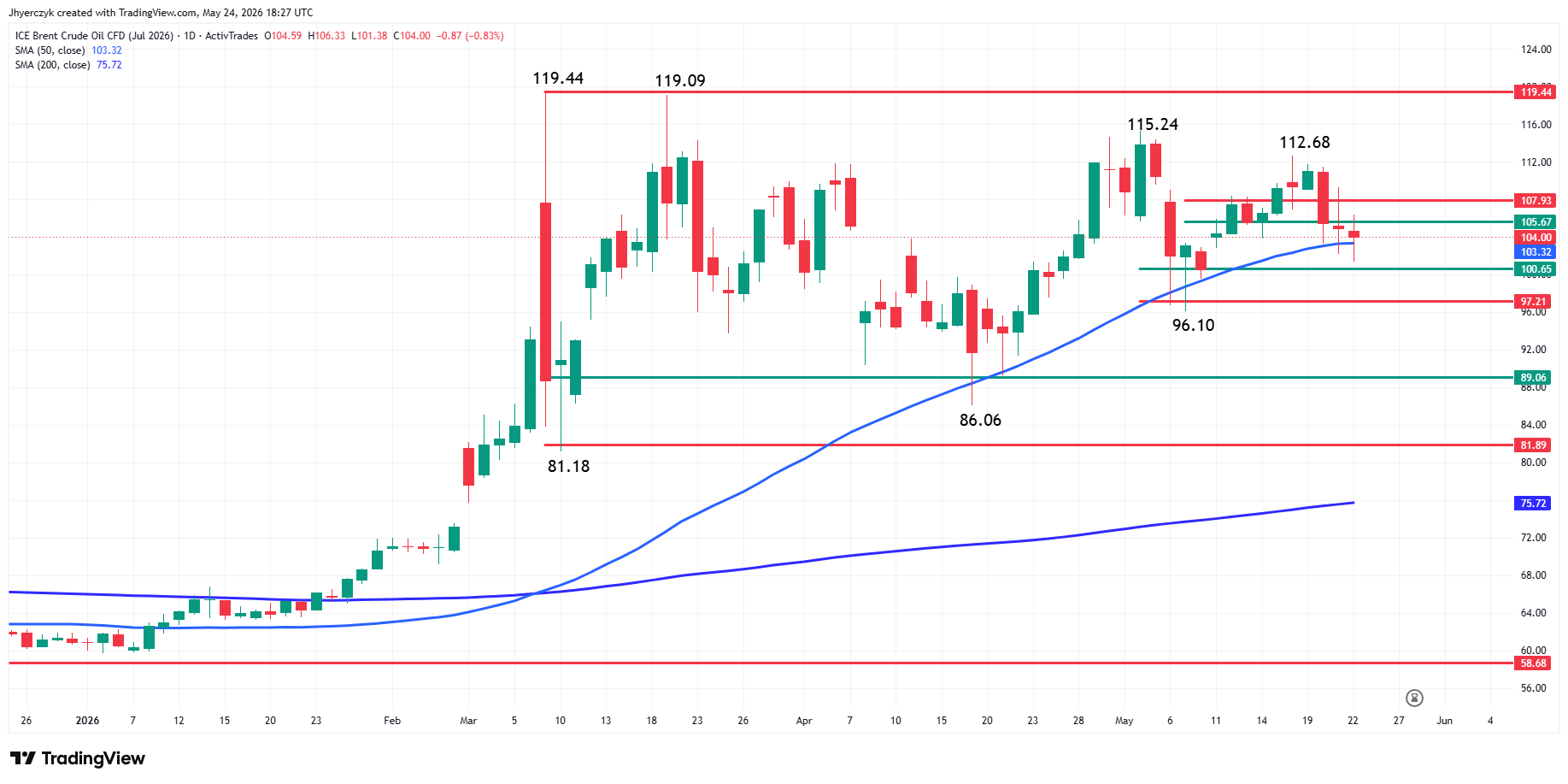
July Brent crude oil futures closed lower on Friday, straddling the 50-day moving average at $103.32 in the process.
The daily chart pattern indicates that Brent futures are weaker than WTI futures. Brent has a clear pattern of lower tops from $119.44, $109.09, $115.24 and $112.68. WTI does not. Brent crossed to the weak side of the 50-day MA on Friday, WTI did not.
Near-term resistance is pretty clear, a retracement zone at $105.67 to $107.93 and swing tops at $112.68 to $115.24.
Near-term support is the 50-day MA at $103.32, a retracement zone at $100.65 to $97.21 and a swing bottom at $96.10.
The lower-top price action suggests the market has already entered sell the rally mode. But I think it’s going to take a definitive break under the 50-day MA to solidify this thought. Taking out the swing bottom at $96.10 will change the main trend to down according to the swing chart. At this point, I think we will definitely enter the “sell the rally” zone.
Peace Talks Stall, Putting Crude Back on Edge
The Iran peace talks had been the reason crude oil sold off earlier in the week. Progress toward reopening the Strait of Hormuz and ending the conflict gave traders a reason to sell the risk premium out of the market and that is exactly what they did. Brent dropped 5% for the week. WTI dropped more than 7%. That kind of selling only happens when the market starts believing a deal is close.
Friday changed the tone. The negotiations ran into problems over Iran’s enriched uranium stockpile and who controls the shipping lanes through the Strait of Hormuz. Those are not small details. Those are the entire deal. President Trump has said the talks are in their “final stages” but final stages can last weeks when the sticking points are this big. Israeli concerns and the details on sanctions relief are still unresolved on top of that. Buyers showed up Friday because the certainty that was building around a deal all week started cracking.
U.S. Exports Keep WTI in the Fight
July WTI crude oil finished higher on Friday while July Brent crude oil finished lower. That split does not happen often and when it does it usually comes down to the export story. The United States is producing and shipping crude at a pace that gives WTI a built-in buyer base even when global prices are falling.
When supply disruption fears grow around the Strait of Hormuz, international buyers look to U.S. crude as the alternative and that demand supports WTI directly. Brent reflects the international supply picture more broadly and it absorbs the full weight of any potential shortages coming out of the Middle East. That is why Brent has the lower-top pattern on the chart and WTI does not.
Driving Season Arrives at the Right Time
Memorial Day weekend marks the beginning of the heavy driving season in the United States. Gasoline demand typically picks up from here through Labor Day and that seasonal pattern gives crude oil prices a floor even when geopolitical headlines are pushing prices lower.
Stronger domestic demand helped support July WTI crude oil on Friday and that support is not going away for the next three months. The question is whether the seasonal demand pickup is enough to offset the selling pressure that comes with a potential Iran deal removing barrels of risk premium from the market.
What to Watch
Traders come back Tuesday after the holiday and the Iran headlines are the only thing that matters. A deal reopening the Strait of Hormuz sends both benchmarks lower fast. No deal keeps the risk premium in place and probably adds to it because thin holiday trading means any headline moves prices more than it normally would.
The sticking points on enriched uranium and shipping lane control are real and neither side has shown willingness to budge on them yet. Summer driving demand and possible OPEC+ output increases later in the year are on the calendar but they are secondary to whatever comes out of these negotiations over the weekend.
Technically, July WTI crude oil stays in buy-the-dip mode as long as the swing bottom at $86.13 holds. July Brent crude oil is the weaker chart. It crossed to the weak side of the 50-day moving average at $103.32 on Friday and the lower-top pattern from $119.44 says sellers are in control until proven otherwise.
If you’d like to know more about how to trade crude oil, please visit our educational area.