Oil prices dropped in early Asian trading after U.S. President Donald Trump halted plans to strike Iran and provided more time for talks. WTI and Brent oil had rallied during the start of the week on the escalating crisis. But the prices slightly cool off on Tuesday morning. The drop reflects a bit of a war-risk premium being taken off by traders following Washington’s latest message. But the oil market is still tense as the conflict has not come to an end.
The greatest concern for oil is the Strait of Hormuz. The closure of the Strait has helped to sustain fears over oil supply. Any developments in the U.S.-Iran negotiations would have a negative impact on crude prices in the short term. But in the event of continued failure in negotiations or lack of movement in tankers, oil prices may rise quickly. Now the traders are waiting for Iran’s reply, the mediation of Pakistan and shipping movements in the Gulf.
Despite these events, the supply conditions remain tight. Commercial oil inventories are declining rapidly, and U.S. SPR stockpiles are at their lowest since July 2024. That means the market will be less protected in case it finally returns to a position of conflict. The sanctions waiver for Russian oil could ease the pain for some energy dependant countries but they cannot eliminate the primary risk from the Middle East. Oil prices could remain volatile, driven by short term diplomacy and supply risks.

WTI Technical Analysis – Triangle Breakout Could Trigger Next Rally
The monthly chart for WTI crude oil shows that oil prices remain above the red highlighted region in the chart below at $90 and are consolidating within the bullish structure. The reason for the strong correction from $120 is the key resistance at $110 from the descending channel pattern.
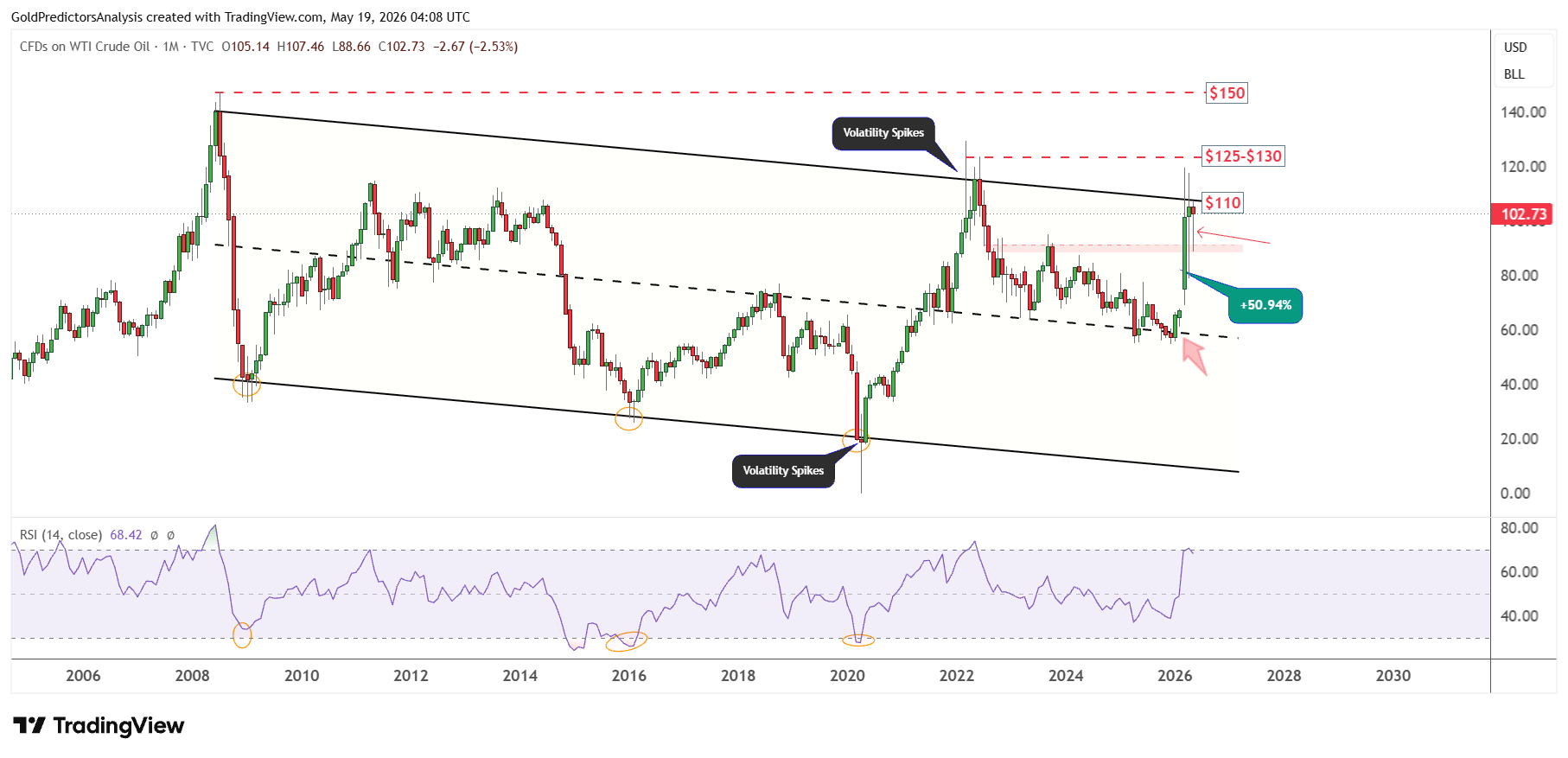
The price surged to $120 in March and April but failed to close the month above $110. This indicates that the recent correction was profit-taking due to technical concerns. Therefore, the fundamental reasons in the oil market will likely push prices higher if prices break above $110 after consolidating around the current range.
A confirmed break above $110 will likely push prices to the $125 and $130 area. However, a break above $130 will push prices towards $150 in the WTI market.
This bullish price action is also evident on the 4-hour chart, which shows the formation of triangle patterns within the broad range of $80 to $120. The price is now consolidating around $110 at the triangle pattern. A break above this area will likely push prices towards $120.
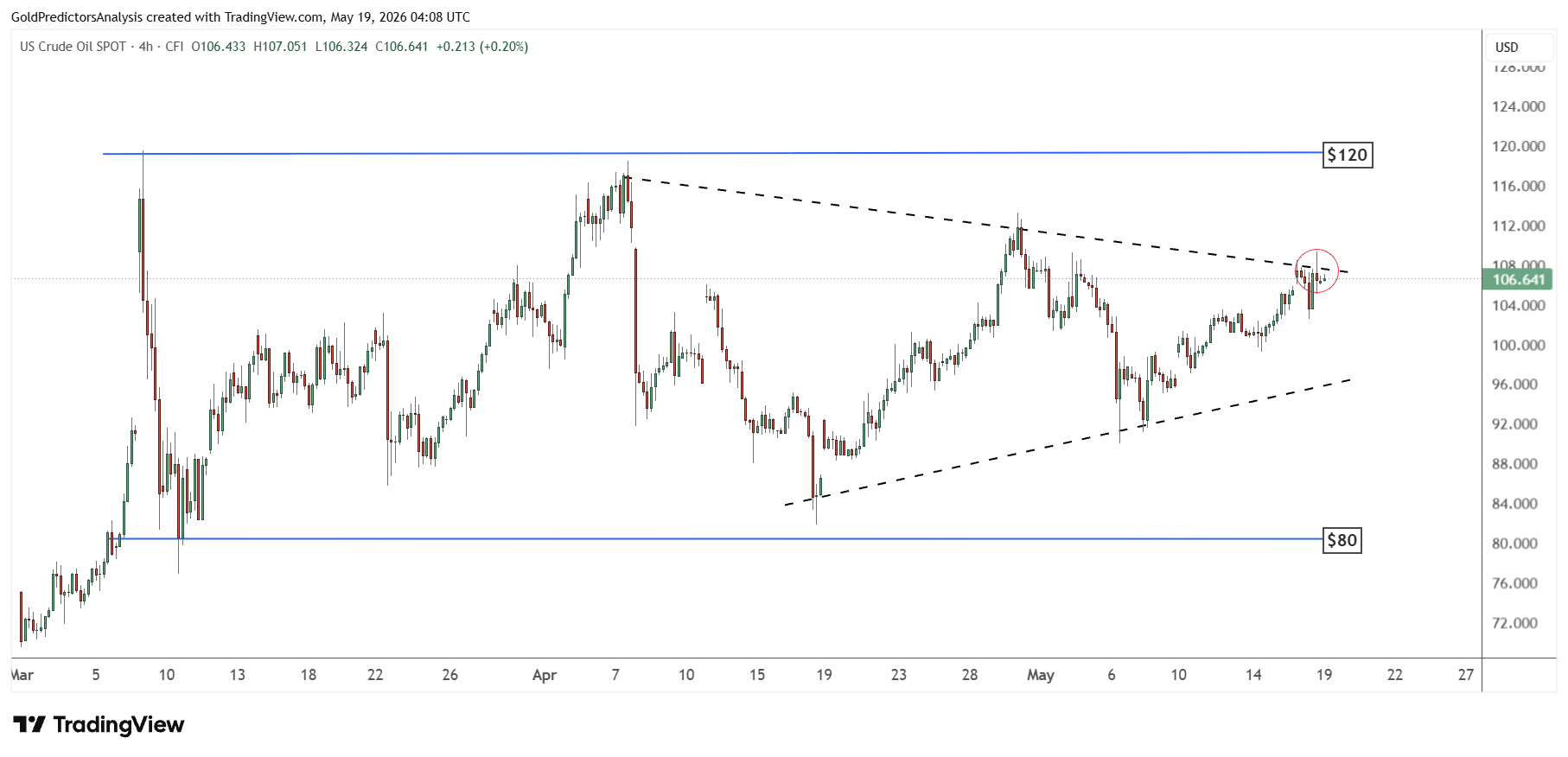
WTI prices must break $80 or $120 in order to define the next move in the market. A break above $120 will likely be a strong bullish move and push prices to much higher levels.
Brent Oil Price Forecast
Every new Brent Oil analysis as it publishes, today's technical signal and key levels, live price — on one page.
See all Brent Oil forecastsBrent Technical Analysis – Broadening Wedge Breakout Supports Higher Prices
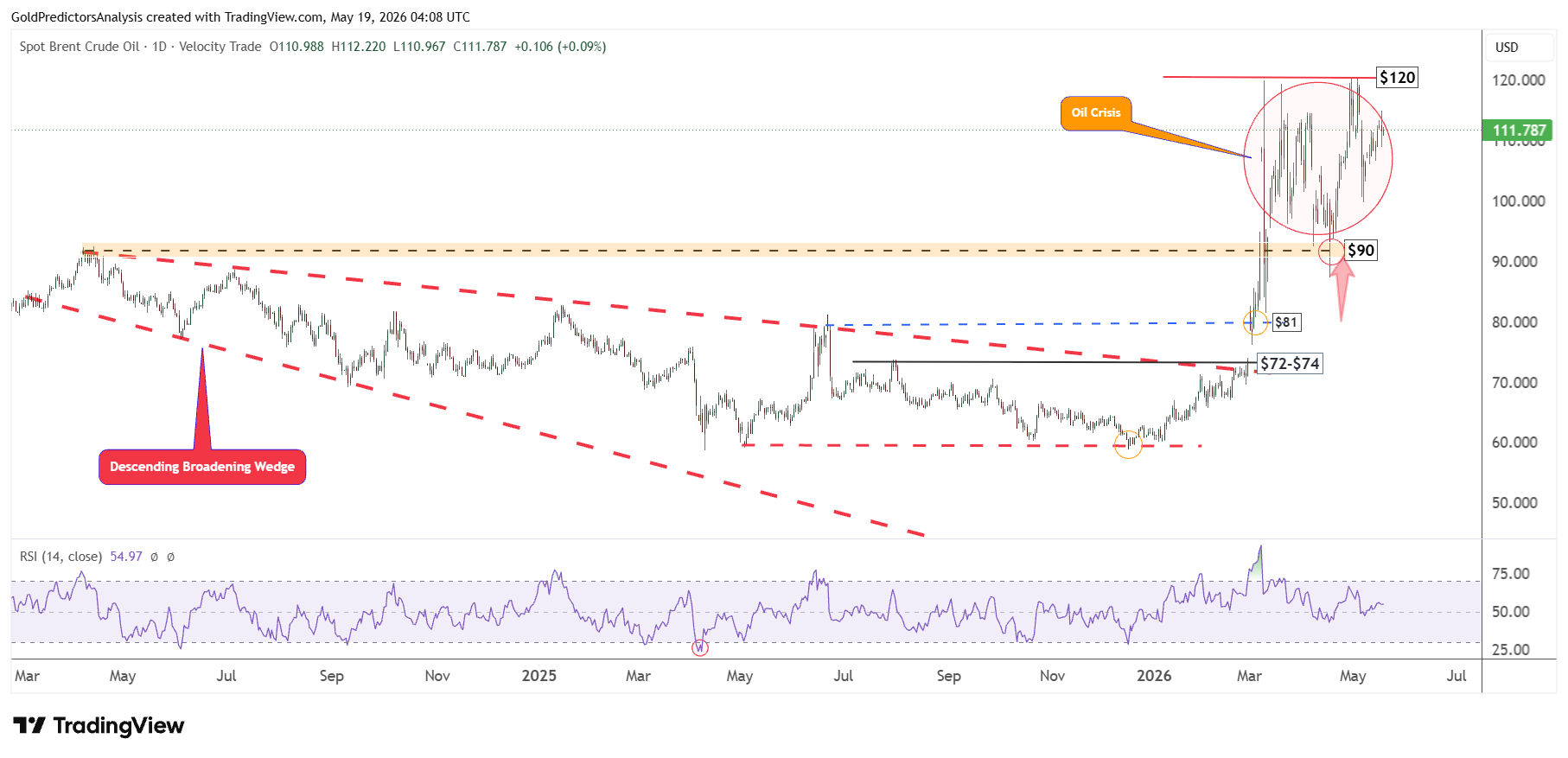
The daily chart for Brent crude oil shows strong consolidation between $90 and $120. Due to the oil crisis, strong volatility is observed within this band. The price is likely to define the next move if these levels are broken. This upside breakout from $90 after US-Iran war has pushed prices higher as the descending broadening wedge pattern is broken. This indicates a strong positive move. A break above $120 will likely push Brent crude oil to higher levels.
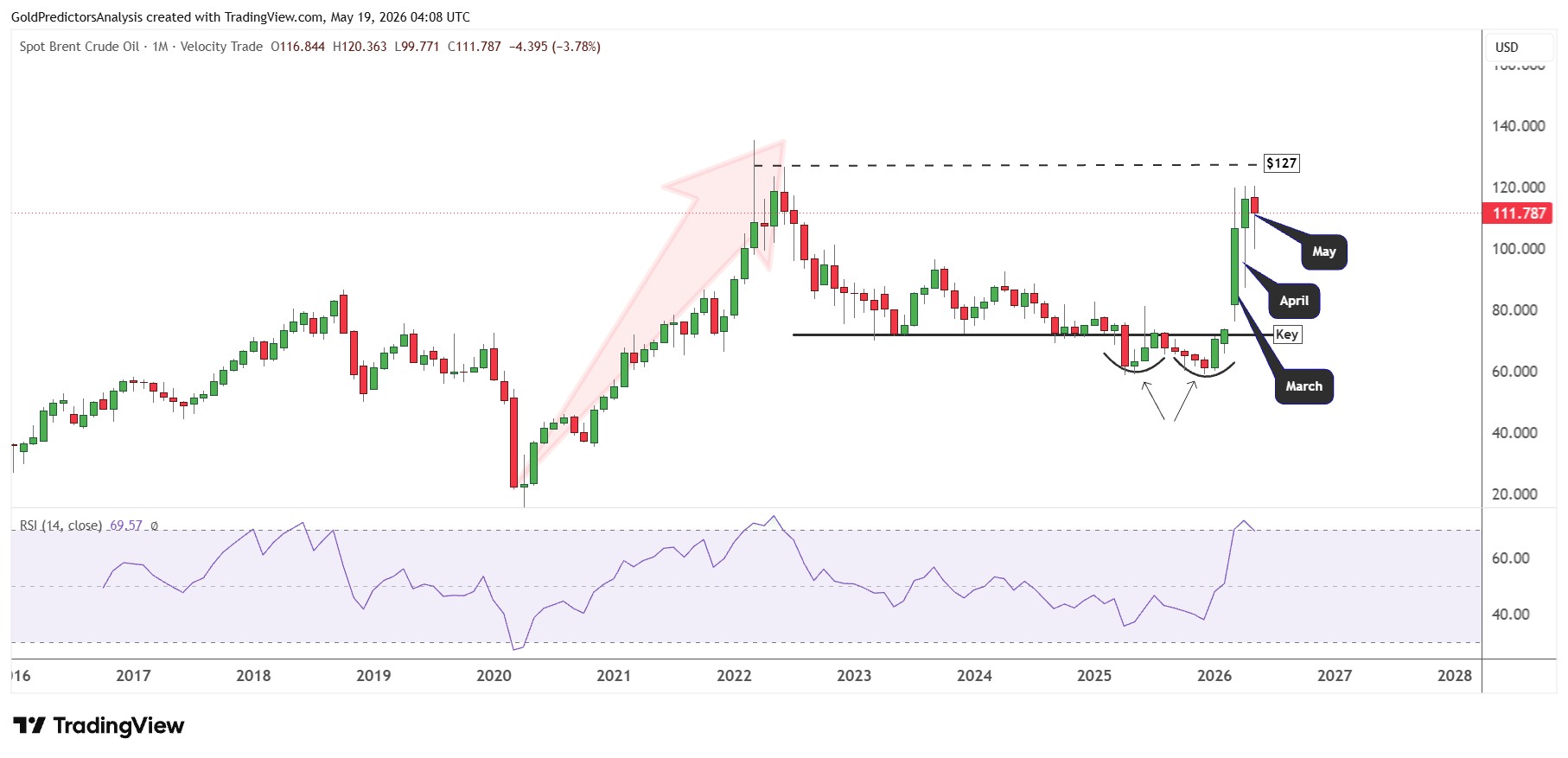
The monthly chart also shows the bullish momentum. The chart shows bullish candles for March and April. Now, the month of May is also showing a bullish move and pointing towards $127 in the short term.
A break above $127 will likely push Brent crude oil to much higher levels. The formation of a double-bottom pattern in 2025 indicates that Brent crude oil confirms the bottom. The confirmation of the bottom in 2025 suggests that prices will trend higher towards the $150 area during the next few months.
In closing
Oil prices could remain volatile as diplomacy will reduce the war-risk premium and tight supply will sustain the upward trend. The market is down in the short term due to the pause in U.S. military action and the turmoil in the closed Strait of Hormuz. But the risk remains in the energy sector. WTI and Brent are required to break above $120 to clear the way for another significant bullish move. Any pullback in oil can draw buyers and maintain upward trend in the next couple of months as long as supply risks remain elevated.
Read more: Hormuz Shock Fuels Inflation as Crude Oil Eyes Breakout