Oil prices rose again on Tuesday as markets responded to the concerns about worldwide supply. Brent crude and WTI crude recovered after the heavy losses of the previous session. The main reason behind the volatility is the ongoing disruption in Strait of Hormuz, one of the most important energy routes in the world. Traders are concerned that the war between the United States, Israel and Iran could keep supplies tight and drive energy costs up across global markets.

Strait of Hormuz Crisis Drives Oil Supply Fears
Fears of supply shortages pushed oil prices up by more than 2% in early trading. Brent crude surged over 2% to $102.90 a barrel. On the other hand WTI oil increased by over 1.40% to around $95.65. The rebound followed the previous session when Brent fell 2.8% and sharp drop of WTI by 5.3% after few ships got through the Strait of Hormuz.
The situation in the Strait of Hormuz is critical. This narrow waterway handles 20% of world’s oil and liquefied natural gas shipments. The war between the United States, Israel, and Iran has caused much traffic disruption through the route. The United Arab Emirates has already cut oil production by over half because exports are not able to move normally.
Strategic Reserve Release Offers Limited Market Relief
Governments and international energy agencies have attempted to cool market by releasing oil from strategic reserves. The International Energy Agency and its member countries agreed to release 400 million barrels from emergency stockpiles. The organization has around 1.4 billion barrels of reserves which can be used in case crisis gets worse.
However these releases may not fully balance the supply shock. According to the estimates, the total world reserves could be 4 to 6 million barrels per day. At the same time, supply gap caused by the Strait of Hormuz disruption may amount to between 5 and 8 million barrels per day. Because of this imbalance, banks increased their long term price outlook. Bank of America raised its 2026 Brent projection to $77.50 from $61 while Standard Chartered raised its projection to $85.50.
Brent Oil Price Forecast
Every new Brent Oil analysis as it publishes, today's technical signal and key levels, live price — on one page.
See all Brent Oil forecastsWTI and Brent Oil Charts Signal Continued Upside Potential
From technical perspective, WTI crude oil has formed a strong bullish price action by consolidating between the $68 and $62 levels before the breakout. The price breakout at $68 at the red dotted trend line has surged towards the $120 region.
The consolidation in WTI crude oil below the red descending trend line before the breakout indicates strong price compression, which suggests a bullish price action during the next few weeks.
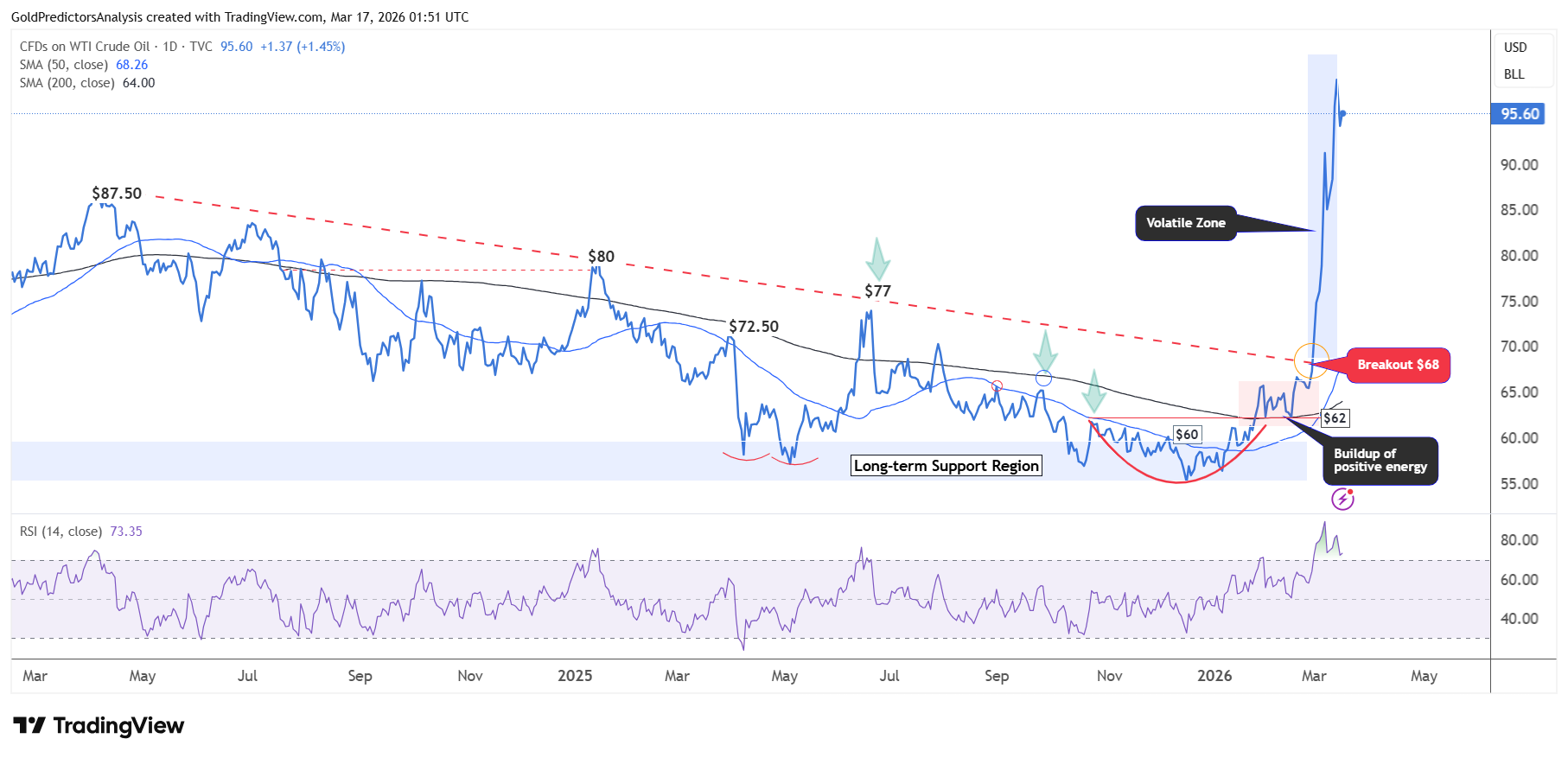
The RSI has already reached the strong overbought region. Therefore, the price remains in a short-term correction mode. However, this short-term correction will be considered another buying opportunity for the next move higher. As long as the Middle East crisis remains, the oil prices will likely remain volatile.
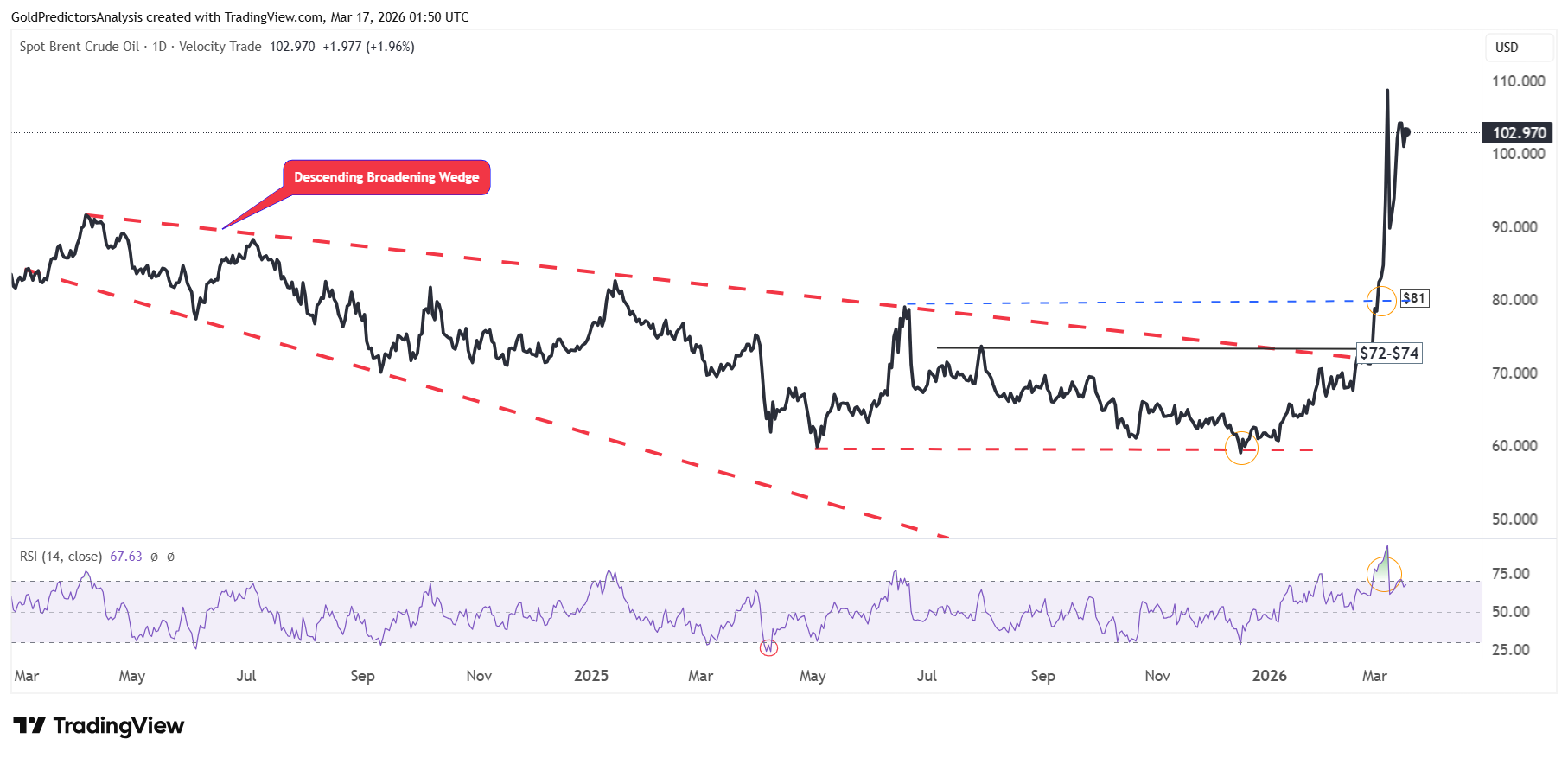
Brent crude oil also shows a strong bullish price action at the edge of the descending broadening wedge breakout area. The price broke at $74 then surged to break above the $81 area. This breakout indicates that $81 remains the floor in Brent crude oil during the Middle East crisis.
The reason for this strong correction from record highs is due to the extremely overbought conditions. However, the prices will most likely rise once this correction is over.
Conclusion
Oil Markets are extremely sensitive to geopolitics in the Middle East. The Strait of Hormuz disruption has led to one of the largest supply shocks in the last few years, sending Brent crude prices over $100 per barrel. Strategic reserve releases have helped stabilize markets at least for now, but they cannot replace normal trade flows. As long as the conflict rages and the Strait remains unstable, oil prices are likely to remain volatile and threats to global inflation may increase further.
From technical perspective, the price action shows a strong bullish outlook and as long as the $81 holds, the prices will likely continue higher.
If you’d like to know more about how to trade crude oil, please visit our educational area.