Stock Indexes Hover Near Record Highs as Fed and Tech Earnings Set the Stage
The major U.S. stock indexes are trading slightly lower after the cash market opening, bucking the pre-market futures trade, which showed early buying as being a little tentative. Traders are currently assessing the latest Fed monetary policy statement and Fed Chair Powell’s remarks, but they are also digesting the mixed earnings results from Meta and Microsoft. Furthermore, Apple is set to report after the close, so this uncertainty may not be lifted today despite the indexes lingering around record highs.
At 14:52 GMT, the Dow Jones Industrial Average is trading 49005.14, down 10.46, or -0.02%. The S&P 500 Index is at 6950.76, down 27.27 or -0.39% and the Nasdaq Composite is trading 23627.232, down 230.216 or -0.97%.

Fed Shifts Focus from Labor Market to Inflation—What It Means
To recap, the Fed left interest rates unchanged on Wednesday, but this was hardly a surprise and actually priced in for weeks. The key takeaways were the Federal Open Market Committee (FOMC) suggesting “economic activity has been expanding at a solid pace” and that the unemployment rate “has shown some signs of stabilization.” These points actually provide some clarity for investors because it appears the Fed has shifted from worrying about the labor market to focusing on inflation.
Given the immediate reaction by traders, it appears that the crowd felt the Fed delivered as expected with no major surprises. Investors are now anticipating comments from Fed members to see if they will in some way impact the timing for the first rate cut in 2026. Currently, the market is still pricing in two quarter percentage point cuts by the end of 2026, according to the CME FedWatch Tool.
Meta Soars, Microsoft Stumbles: The AI Investment Question
The early focus on Thursday will be on whether Meta Platforms‘ 9% jump in premarket trading will extend into the cash market session, or will Microsoft’s 6% drop drive the narrative.
Meta rallied after revealing a stronger-than-expected first-quarter sales forecast. Microsoft fell after the company reported that cloud growth slowed in the fiscal second quarter, while issuing soft guidance on operating margin for the fiscal third quarter.
The numbers may have surprised, but the reaction was textbook for this earnings season. We’ve witnessed over the past two weeks that investors have been primarily ignoring the past and focusing on the future, especially in the AI sector, where investors are starting to get a little nervous about how their major AI investments are performing and, most of all, when will they begin paying off.
S&P 500 Technical Analysis: The Key Level That Matters Most
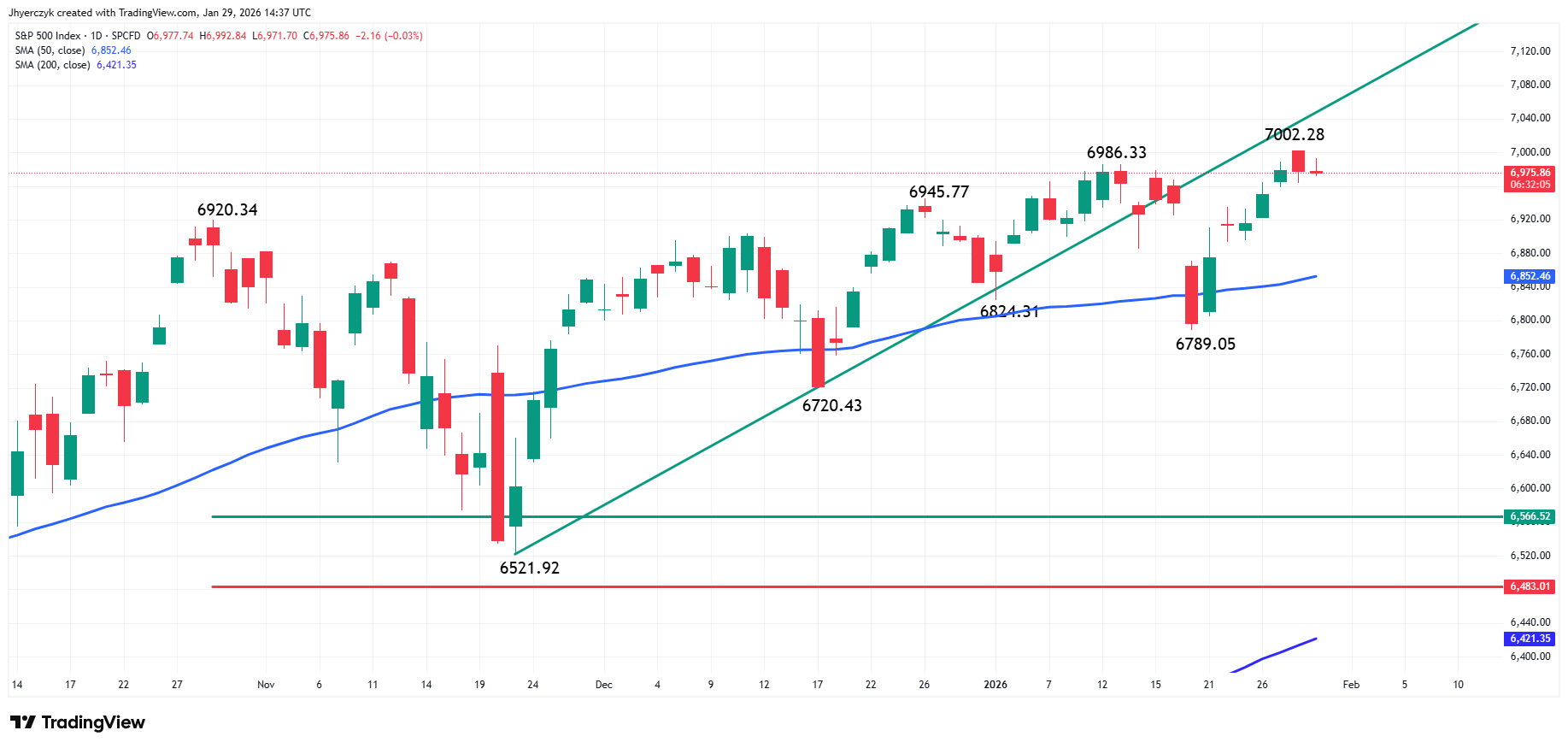
The S&P 500 Index (SPX) chart looks healthy after the benchmark crossed the 7000 level for the first time on Wednesday. However, it still looks a little vulnerable to the downside with the nearest major support the 50-day moving average at 6852.46. But is the 50-day MA really support or just an indicator controlling the trend and guiding the market higher?
In my opinion, the key to sustaining this bull market is breaking above the trend line from the November 21 main bottom at 6521.92. We could keep this bull market intact by continuing to make higher-highs, but that kind of rally won’t feel as bullish as if it were occurring when on the strong side of the trend line at 7048.00 today. So that’s the goal: recover the trend line at 7048, then wait for the surge.
More Information in our Economic Calendar.