
The S&P 500 often tells only part of the story. Because the index is market-cap weighted, headline moves can sometimes mask whether strength or weakness is truly broad-based beneath the surface. That is where market breadth becomes useful.
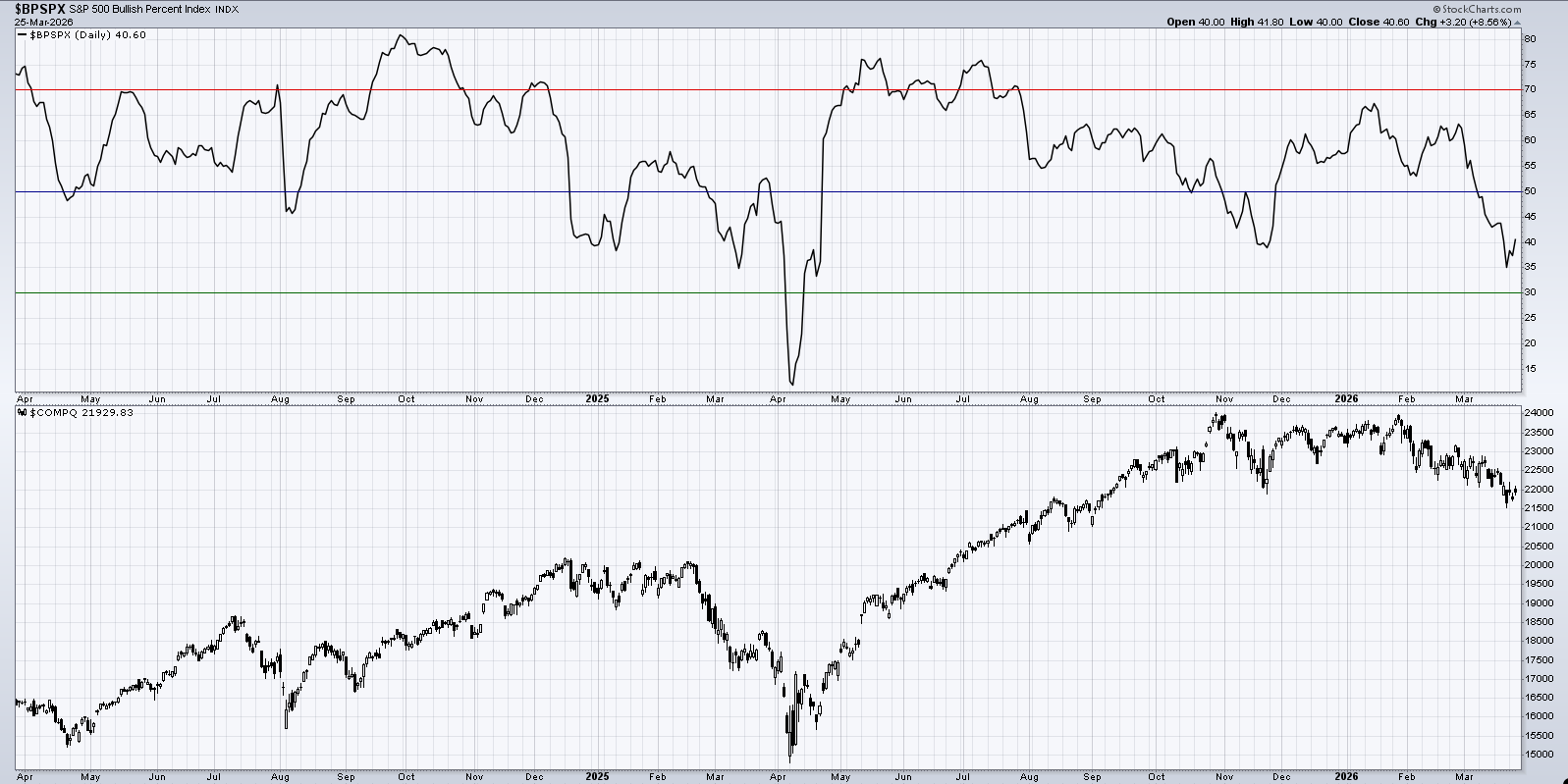
By examining the S&P Bullish Percent Index, which measures the percentage of S&P 500 stocks on Point & Figure buy signals, this analysis looks beyond the index level itself to assess internal participation and evaluate whether shifts in breadth have historically helped identify meaningful turning points in the market.

Understanding the S&P Bullish Percent Index
Market breadth refers to the number of individual stocks participating in a price movement. While the S&P 500 Index (SPX) is market-cap weighted (meaning giants like Nvidia or Apple have an outsized impact), breadth indicators like the S&P Bullish Percent Index (BPSPX) look under the hood to see if the average stock is actually healthy.
The BPSPX is a unique breadth indicator based on Point and Figure (P&F) charting. Instead of looking at closing prices or moving averages, it specifically tracks the percentage of stocks within the S&P 500 that are currently on a P&F Buy Signal.
- Binary Nature: A stock is either on a buy signal (bullish) or a sell signal (bearish). There is no neutral.
- Significance: It filters out noise and minor price fluctuations, focusing only on meaningful trend reversals.
- Formula: (Number of SPX Stocks on P&F buy signals/Total number of SPX stocks)*100
30 Year Analysis of the S&P 500 Bullish Percent Index and the S&P 500 Market Breadth Signals
With the advent of Large Language Models (LLMs), the ability to apply data science techniques have become exponentially easier. Analysts can now vibe-code their ideas into actionable insights. Thus, one should no longer take heuristics at face value but can now drill down and attain probabilistic and statistical metrics on indicators such the BPSPX.
Utilizing StockCharts.com data, the BPSPX was analyzed over the last 30 years in relation to the S&P 500 Index. The following occurrences were identified:
S&P 500 Price Forecast
Every new S&P 500 analysis as it publishes, today's technical signal and key levels, live price — on one page.
See all S&P 500 forecasts- BPSPX crosses under 70 (BPSPX70)
- BPSPX crosses under 50 (BPSPXU50)
- BPSPX crosses over 30 (BPSPX30)
- BPSPX crosses over 50 (BPSPXO50)
When these occurrences happened, the price return of the S&P 500 Index was looked at. The periods were as follows:
- 5-Day Price Return
- 10-Day Price Return
- 15-Day Price Return
- 1-Month Price Return
- 3-Month Price Return
- 6-Month Price Return
- 9-Month Price Return
- 12-Month Price Return
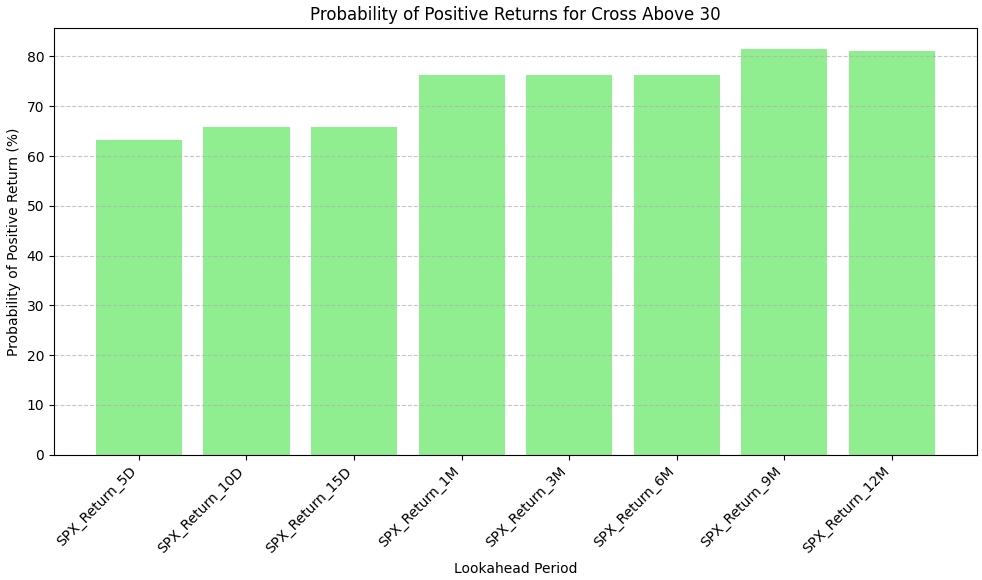
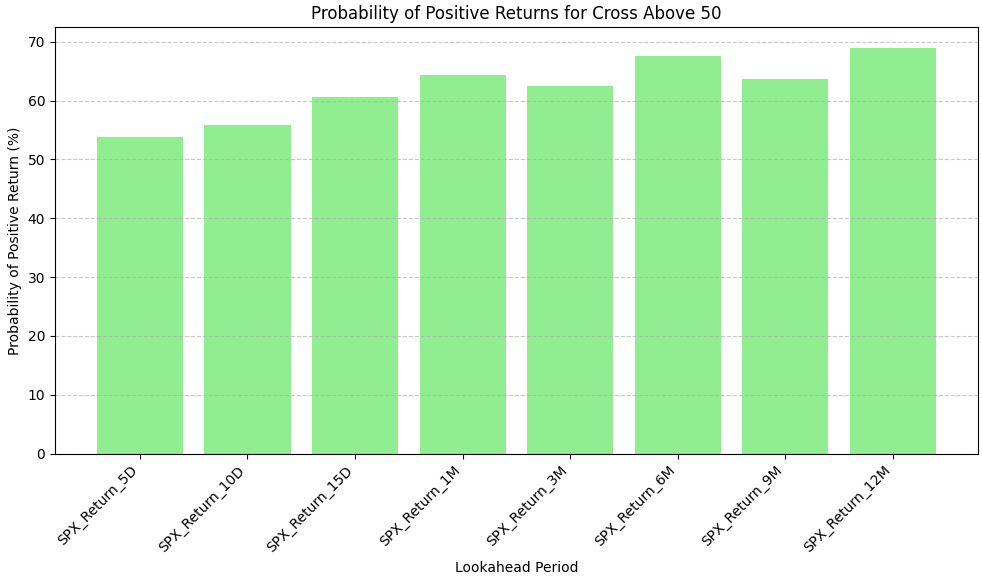
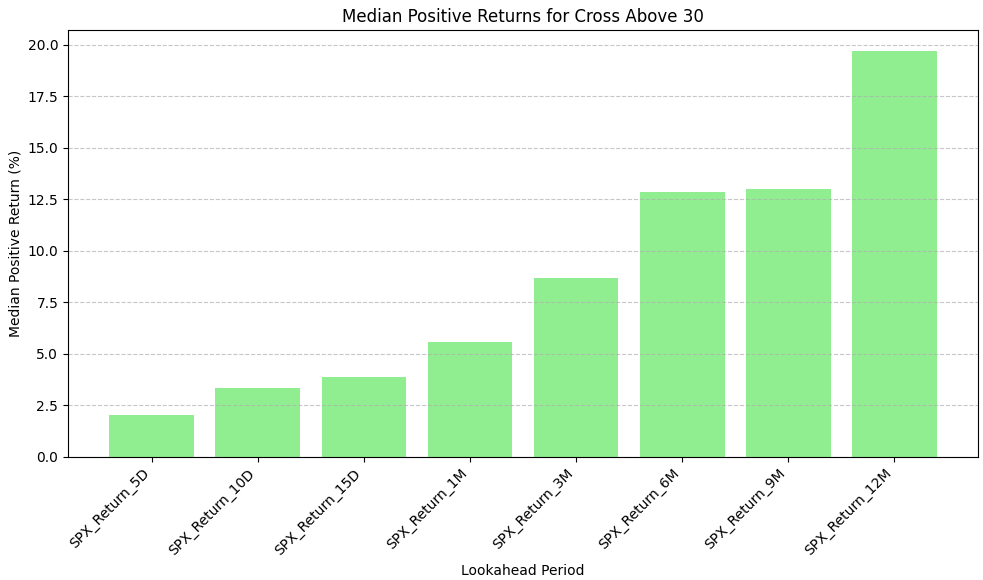
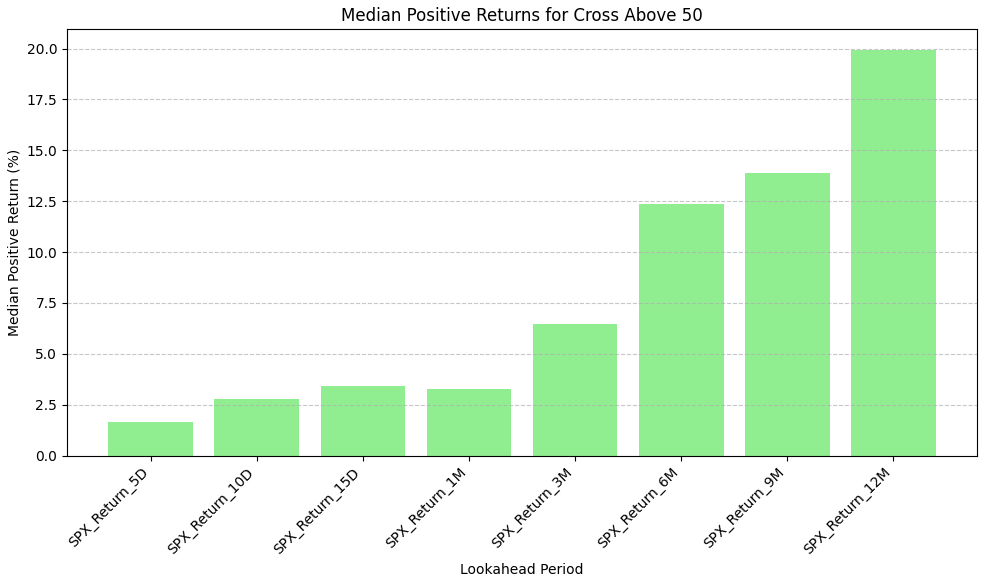
On the bullish side, the BPSPX30 stands out as the most consistent signal, with the highest probability of a positive outcome at 81.58% over 9 months, suggesting that breadth recoveries from weaker conditions tend to have the strongest follow-through. BPSPXO50, while less consistent at 69.00%, delivers the largest median positive return at 19.95% over 12 months, indicating stronger upside magnitude when the signal works.
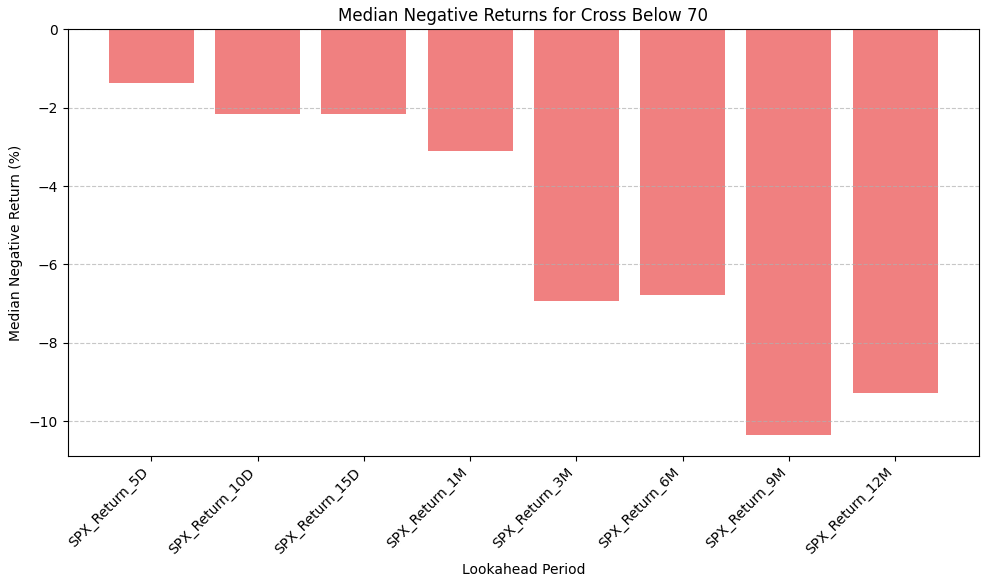
On the bearish side, the probabilities of negative outcomes are much lower, with BPSPX70 showing the highest at 43.53% over 15 days, but the associated median loss of -2.15% is relatively modest. BPSPXU50 is slightly less probable at 43.27%, but its -3.21% to -3.59% median losses over 10 to 15 days suggest a slightly more damaging breadth breakdown once participation weakens more materially.
BPSPX Signal Performance and Probability Summary
| Event | Outcome Type | Timeframe | Highest Probability (%) | Median Return at That Timeframe (%) |
| Cross Above 30 | Positive | 9M | 81.58 | 13.01 |
| Cross Above 50 | Positive | 12M | 69.00 | 19.95 |
| Cross Below 70 | Negative | 15D | 43.53 | -2.15 |
| Cross Below 50 | Negative | 10D / 15D | 43.27 | -3.21 / -3.59 |
Summary table of BPSPX signal probabilities and median returns. Source: StockCharts.com, TradingView
The strongest median upside outcomes are concentrated in the 6- to 12-month horizons, which suggests the BPSPX is more useful as an intermediate- to longer-term breadth signal than a short-term timing tool.
BPSPXO50 at 12 months produces the single highest median positive return at 19.95%, but BPSPXO30 at 12 months is nearly identical at 19.71% while carrying a materially higher 81.08% probability of a positive outcome, making it the stronger overall signal on a consistency-adjusted basis. That same pattern persists at the 9-month and 6-month horizons, where BPSPXO30 consistently delivers higher hit rates than BPSPXO50, even when its median upside is slightly lower.
Overall, the data suggests that breadth recoveries emerging from more depressed conditions, as captured by a move above 30, tend to offer the best combination of reliability and attractive forward returns.
Top Ranked Bullish BPSPX Signals
| Rank | Event | Timeframe | Median Positive Return (%) | Probability of Positive Event (%) |
| 1 | Cross Above 50 | 12M | 19.95 | 69.00 |
| 2 | Cross Above 30 | 12M | 19.71 | 81.08 |
| 3 | Cross Above 50 | 9M | 13.87 | 63.73 |
| 4 | Cross Above 30 | 9M | 13.01 | 81.58 |
| 5 | Cross Above 30 | 6M | 12.86 | 76.32 |
| 6 | Cross Above 50 | 6M | 12.37 | 67.65 |
Ranked bullish BPSPX performance table. Source: StockCharts.com, TradingView
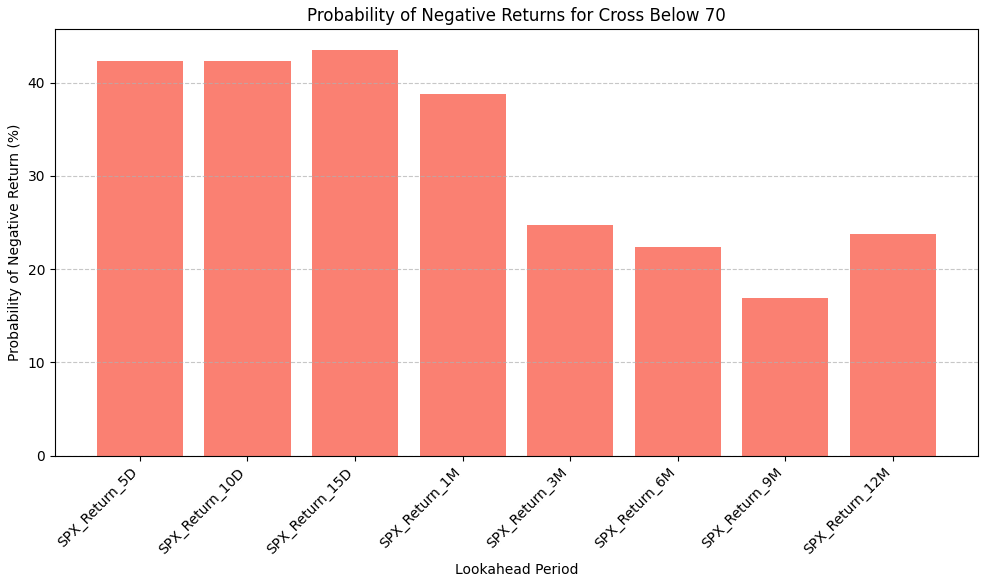
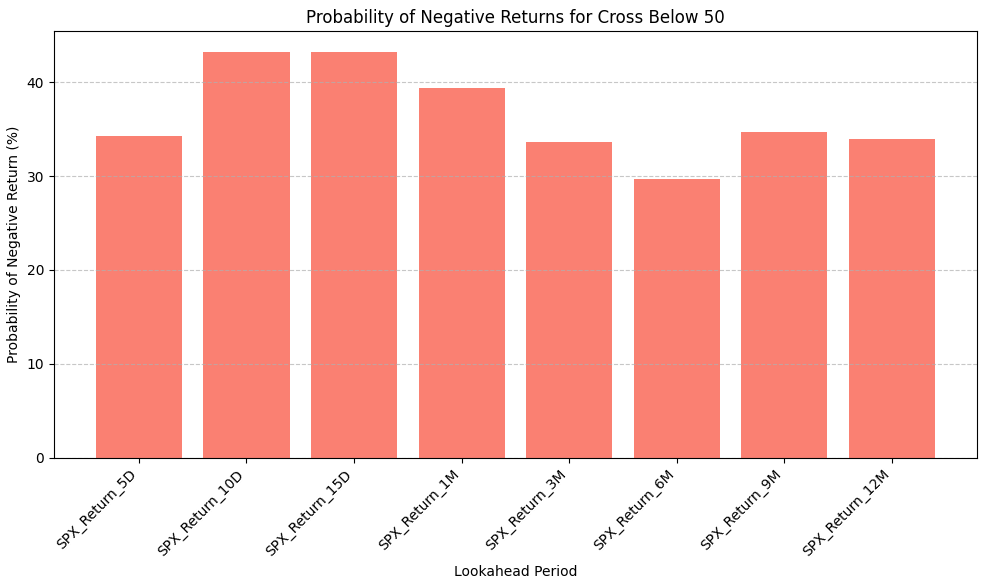
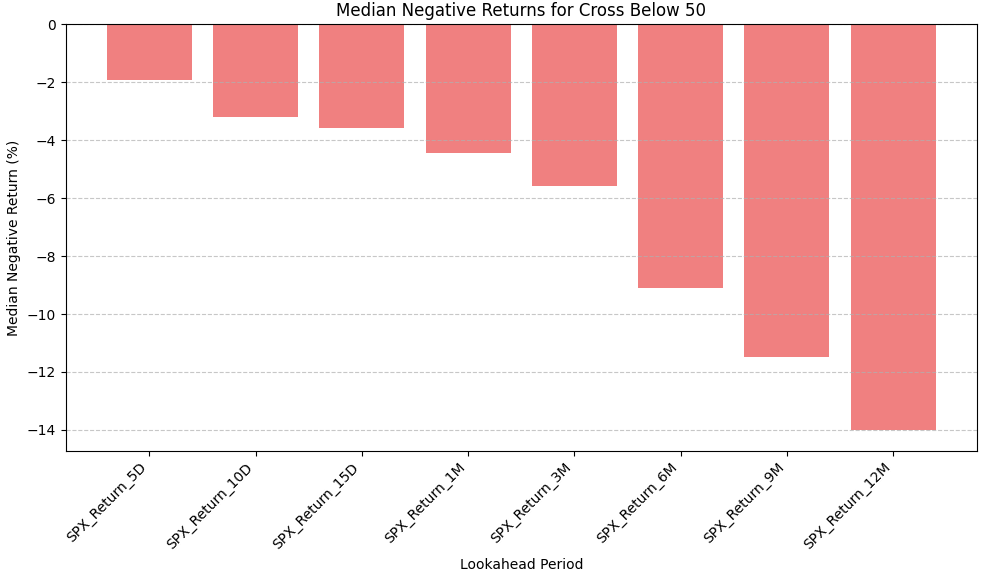
The most severe median downside outcomes are concentrated in BPSPXU50, particularly over the 6- to 12-month horizons, indicating that a deterioration in breadth below this level is a more serious bearish development than a move below 70.
The worst reading is BPSPXU50 at 12 months, with a median negative return of -14.01%, followed by -11.49% at 9 months, which suggests that once internal participation weakens materially, downside can persist well beyond the initial signal. By comparison, BPSPXU70 also shows meaningful losses, but its worst median declines tend to be less severe and, in the case of the 9-month horizon, occur with a much lower probability of a negative outcome at 16.87%.
Overall, the data implies that BPSPXU70 functions more as an early warning of weakening breadth, while BPSPXU50 is the more consequential breakdown signal, associated with deeper and more sustained market weakness albeit with a much significant lower probability of occurring.
Top Ranked Bearish BPSPX Signals
| Rank | Event | Timeframe | Median Negative Return (%) | Probability of Negative Event (%) |
| 1 | Cross Below 50 | 12M | -14.01 | 34.00 |
| 2 | Cross Below 50 | 9M | -11.49 | 34.65 |
| 3 | Cross Below 70 | 9M | -10.36 | 16.87 |
| 4 | Cross Below 50 | 6M | -9.10 | 29.70 |
| 5 | Cross Below 70 | 12M | -9.28 | 23.75 |
| 6 | Cross Below 70 | 3M | -6.94 | 24.71 |
Ranked negative returns for BPSPX bearish events. Source: StockCharts.com, TradingView
How BPSPX Market Breadth Signals Predict S&P 500 Index Turning Points
Taken together, the evidence suggests that the BPSPX can be an incredibly valuable breadth-based framework for identifying potential turning points in the SPX, particularly when viewed through a probabilistic lens rather than as a simple overbought or oversold heuristic.
The data indicates that bullish breadth recoveries, especially crosses above 30, have historically offered the most reliable forward upside over intermediate to longer horizons, while bearish deterioration below 50 has tended to signal the more meaningful downside risk.
In practical terms, the BPSPX appears most useful not as a precise short-term timing tool, but as a way to assess whether market internals are improving or breaking down beneath the surface, helping investors and traders better distinguish between temporary noise, early warnings, and more durable shifts in market direction.