Although the initial reaction triggered a sharp volatility spike across global gas benchmarks, price action now suggests that the market may be returning toward a consolidation phase, with traders evaluating whether the disruption represents a temporary shock or a structural supply crisis.
The natural gas market, in my view, is currently oscillating between two opposing forces: a sudden geopolitical supply shock and the growing flexibility of global LNG supply.
News: The shutdown of Qatar LNG created a broad supply shock
The main catalyst moving gas markets is the sudden halt of LNG production in Qatar.
After the drone attacks, linked to the escalation of the conflict in the Middle East, QatarEnergy suspended operations at the Ras Laffan and Mesaieed energy complexes, effectively stopping exports from the world’s largest LNG production hub.
Qatar represents about 20% of global LNG supply (and almost all of its gas must pass through the Strait of Hormuz), which means the disruption immediately created a significant gap in global gas flows.
The problem is not simply about logistical delays. The shutdown represents a temporary but real loss of production capacity, forcing energy importers to search for alternative sources of supply.
Natural Gas Price Forecast
Every new Natural Gas analysis as it publishes, today's technical signal and key levels, live price — on one page.
See all Natural Gas forecastsContext: Europe and Asia compete for LNG cargoes
The first market to react was Europe.
TTF natural gas futures jumped sharply after the shutdown, with prices rising 40–50% in just a few trading sessions as traders attempted to price the risk of a potential supply shortage.
This movement reflects a structural reality of today’s gas market: LNG has effectively globalized the price of natural gas.
Not only does Europe depend heavily on seaborne LNG after the collapse of Russian pipeline supplies, but Asian buyers (such as Japan, South Korea, and China) also rely heavily on LNG shipments from the Gulf.
This dynamic creates a classic Asia–Europe competition for LNG cargoes, with both regions trying to secure flexible shipments from the United States, Australia, and other exporters.
If the disruption persists, this competition could intensify dramatically.
Financial Analysis
LNG Shipping Disruptions Amplify the Supply Shock
Beyond production losses, the crisis is also affecting global LNG logistics.
The crisis in the Strait of Hormuz has practically blocked tanker traffic and forced shipping companies to reassess alternative routes.
At the same time, daily charter rates for LNG vessels have risen by more than 40%, reflecting the sudden increase in demand for LNG carriers.
Unlike conventional maritime transport, LNG shipping depends on a relatively small and highly specialized fleet of vessels.
Any diversion or delay can therefore immediately create slowdowns in the supply chain.
Even if production resumes quickly, diverted shipping routes could add weeks to delivery times, with the risk that some shipments arrive too late to stabilize certain markets.
A Structural Supply Cushion Limits an Excessive Price Spike
Despite the severity of the disruption, the global gas system today has greater flexibility than during previous energy crises.
The expansion of U.S. LNG export capacity has created new supply capable of at least partially offsetting disruptions elsewhere.
Some exporters have already signaled the possibility of redirecting uncontracted cargoes toward Europe or Asia to help stabilize the market.
This additional cushion explains why the market reaction so far resembles a volatility spike rather than the beginning of a sustained bullish cycle.
Technical Analysis: The Double Top Suggests a Compression Phase
From a technical perspective, natural gas yesterday attempted twice to break the resistance zone between 3.28 and 3.30 dollars, but failed to maintain momentum.
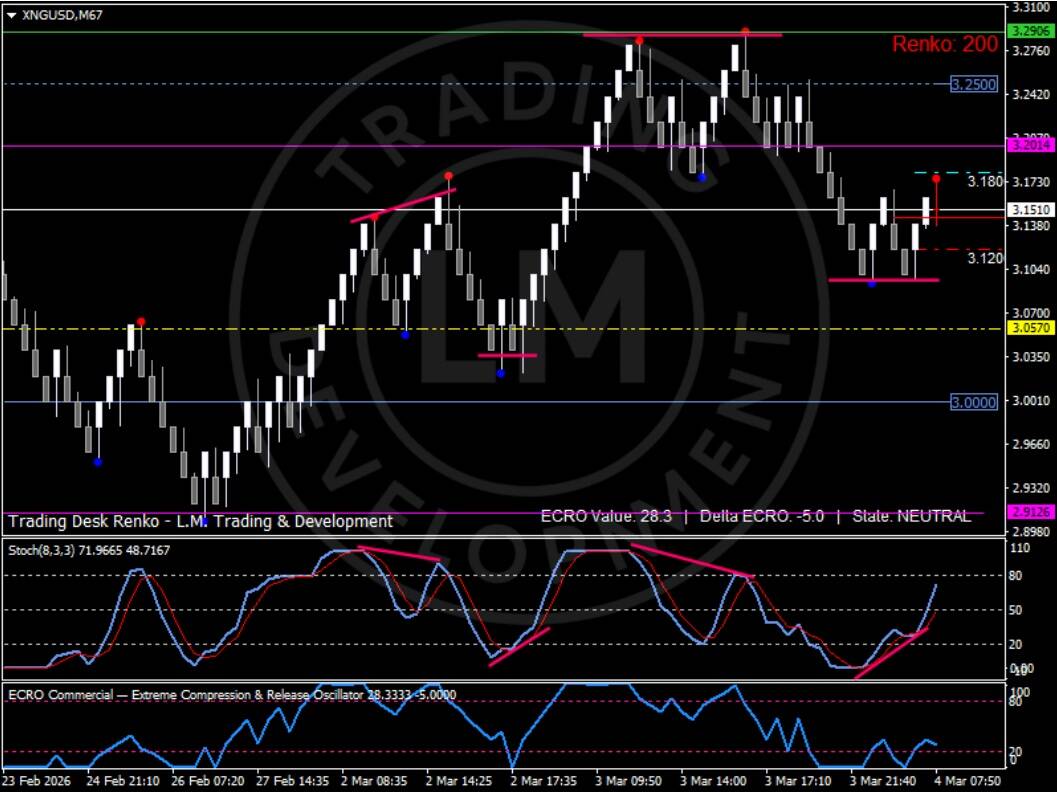
The price rejection created a double top structure, after which the market began rotating lower.
Momentum indicators that had reached overbought conditions during the rally have meanwhile cooled, suggesting that the market is simply rebalancing positioning rather than entering a decisive directional trend.
The short-term support now emerging in the 3.10–3.12 dollar area had already previously functioned as a consolidation zone.
In this scenario the Renko structure appears to be living more a phase of compression than a real expansion (yesterday’s high around 3.28 had already been tested on February 23).
Positioning and Risks
The most probable scenario, in my view, in the short term is a consolidation phase while markets absorb the geopolitical shock.
At the base remains a compression range between 3.05 and 3.20 dollars, unless further escalation in the Gulf significantly worsens supply conditions.
A clear break above 3.18 / 3.20 dollars could reopen the path toward 3.30, while a move below 3.05 would suggest that the geopolitical premium is fading.
The main risk remains a prolonged shutdown of Qatar LNG exports or a complete interruption of maritime traffic through the Strait of Hormuz.
In that case, the current volatility spike could rapidly turn into a global supply crisis.
Conclusion
Natural gas markets are currently “navigating” between geopolitical uncertainty and increasing supply flexibility.
The shutdown of Qatar LNG production has introduced a sudden shock into global energy markets, triggering a strong but potentially temporary increase in volatility.
Unless the disruption turns into a structural supply shortage, the most probable scenario in the short term remains consolidation in the 3.10–3.20 dollar area.