
Market Overview
Despite the hawkish minutes of the US Federal Reserve’s (Fed) January monetary policy meeting, the broad-based US Dollar Index (DXY) consolidated its previous gains and remained slightly subdued around the 97.70 level. However, the reason for its sluggish performance can be attributed to mixed signals from Fed officials.
This is why the market is in wait-and-see mode ahead of upcoming key US economic data. This is another reason why the US dollar is sluggish on the day.
Despite this, some investors remain bullish on the Greenback due to strong US economic indicators. Last week, we saw the January Nonfarm Payrolls report, and it came in stronger than people were expecting.
Because of that, the market’s starting to think the Fed will not need to cut rates aggressively. Thus, the strong job numbers basically mean the economy’s recovering and thats helped dolalr to stay higher,

US Dollar Remain subdued Amid Mixed Signals From Fed
So, even with the strong jobs report, the Fed’s January minutes showed that policymakers are not all on the same page. Some officials think more cuts might be needed if inflation keeps coming down, while others are warning against easing too soon because it could mess with their 2% inflation goal. This uncertainty keep the dollar gains under check.
Looking ahead, all eyes are on Friday’s PCE inflation report. If it comes in stronger than expected, that’s likely to give support to the dollar. But if inflation is weaker, we could start seeing speculation that the Fed might take a more dovish approach again.
GBP/USD Price Forecast
Every new GBP/USD analysis as it publishes, today's technical signal and key levels, live price — on one page.
See all GBP/USD forecastsGeopolitical Tensions Keep the Dollar in Safe-Haven Mode
Apart from this, the geopolitical risks are also keeping the dollar supported. There are reports the US could strike Iran this weekend, this kind of uncertainty force investors to flock to the dollar as a safe haven.
That’s helping the DXY stay near its recent highs, even though trading hasn’t been too active.
US Dollar Index (DXY) Near $97.60 Resistance as Descending Trendline Caps Upside
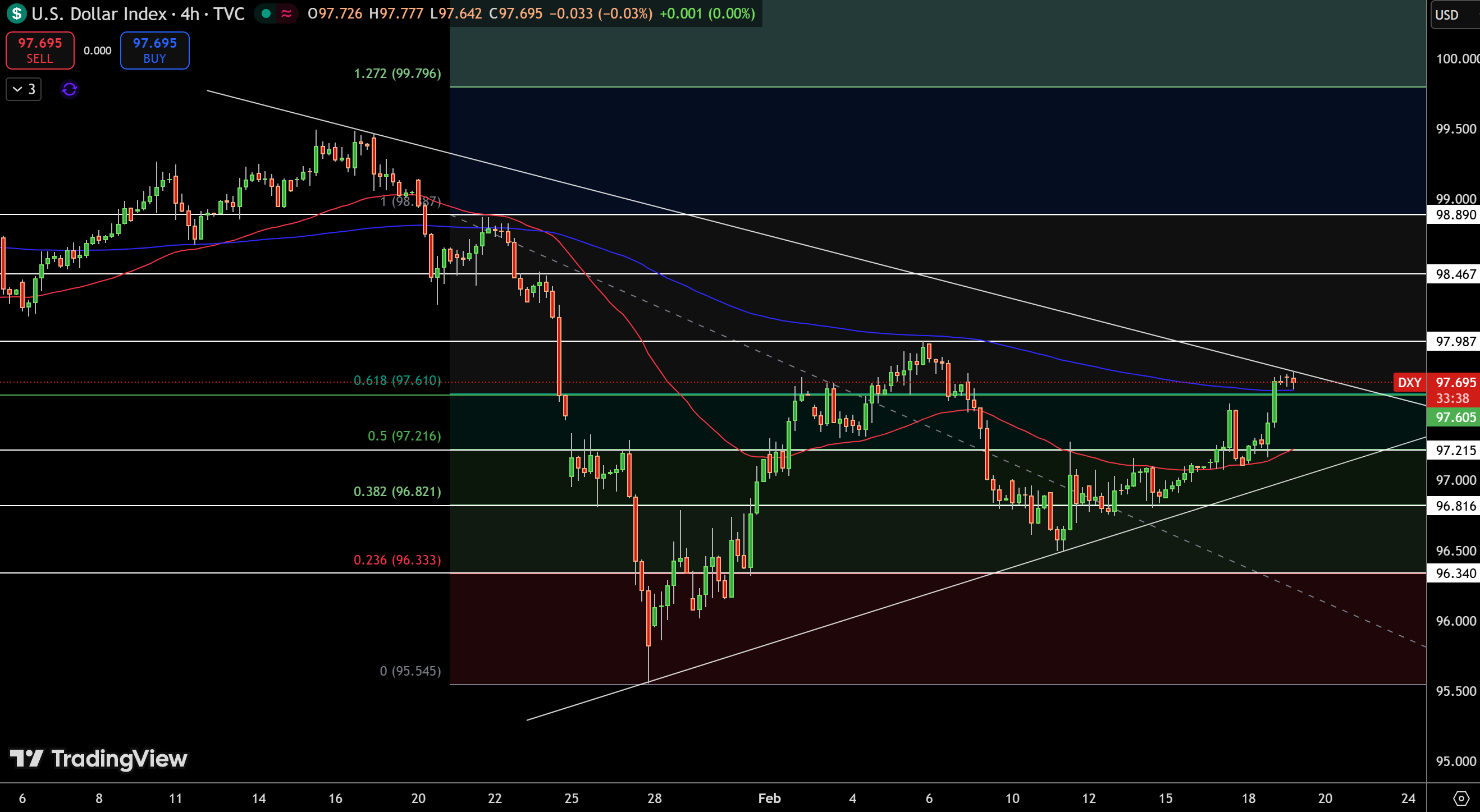
The U.S. Dollar Index is currently trading around $97.69 on the 4 hour chart, and its trying to squeeze into a pretty key confluence zone around $97.60-$97.80. We’ve got the 0.618 Fibonacci retracement at $97.61 being tested, as well as the long term descending trendline that comes in from the $99.80 high.
The 50 period EMA is just starting to turn around near $97.20 while the 200 period EMA is still sitting pretty high at $98.46, acting like a broad ceiling for the dollar.
Our first bit of support is located at $97.21, but if we take a closer look we can see it’s followed by some other key levels at $96.82 and $96.33. A clean break above $97.80 and we could be looking at $98.46, whereas a rejection here may very well pull the price back down toward $97.20.
Trade idea: If it drops below $97.60 then we’d be looking to sell down to $96.82 with a stop loss above $98.00.
GBP/USD Breaks $1.3550 Trendline – Bearish Pressure Builds
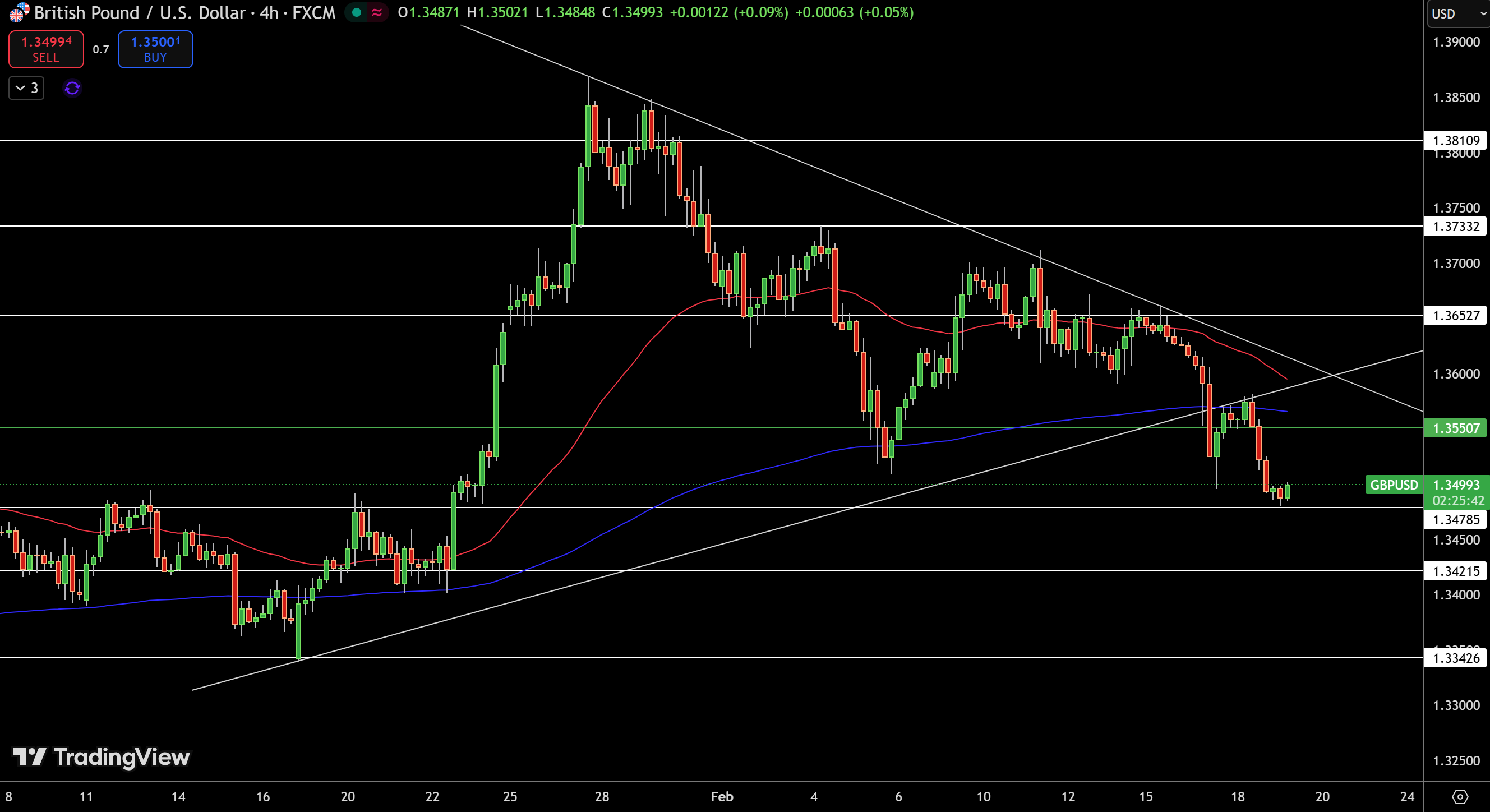
GBP/USD is trading near $1.3499 on the 4 hour chart after slipping below the $1.3550 trendline and breaking through the rising trendline that’s been in from $1.3340. The price is now below both the 50 period and 200 period EMAs – the 50 period is near $1.3600 while the 200 is at $1.3550. So that’s actually confirmed some short term downward momentum.
The 200 period EMA is the descending trendline from $1.3810 and it’s still in place which keeps the broader trend under some pressure. If we look a bit closer at the chart we can see some immediate support is located at $1.3478 and $1.3421 but resistance is seen at $1.3550 and $1.3652.
Trade idea: If it falls below $1.3485 then we’d be looking to sell down to $1.3420 with a stop loss above $1.3560.
EUR/USD Slips Below $1.1820 Demand Zone – Trendline at Risk
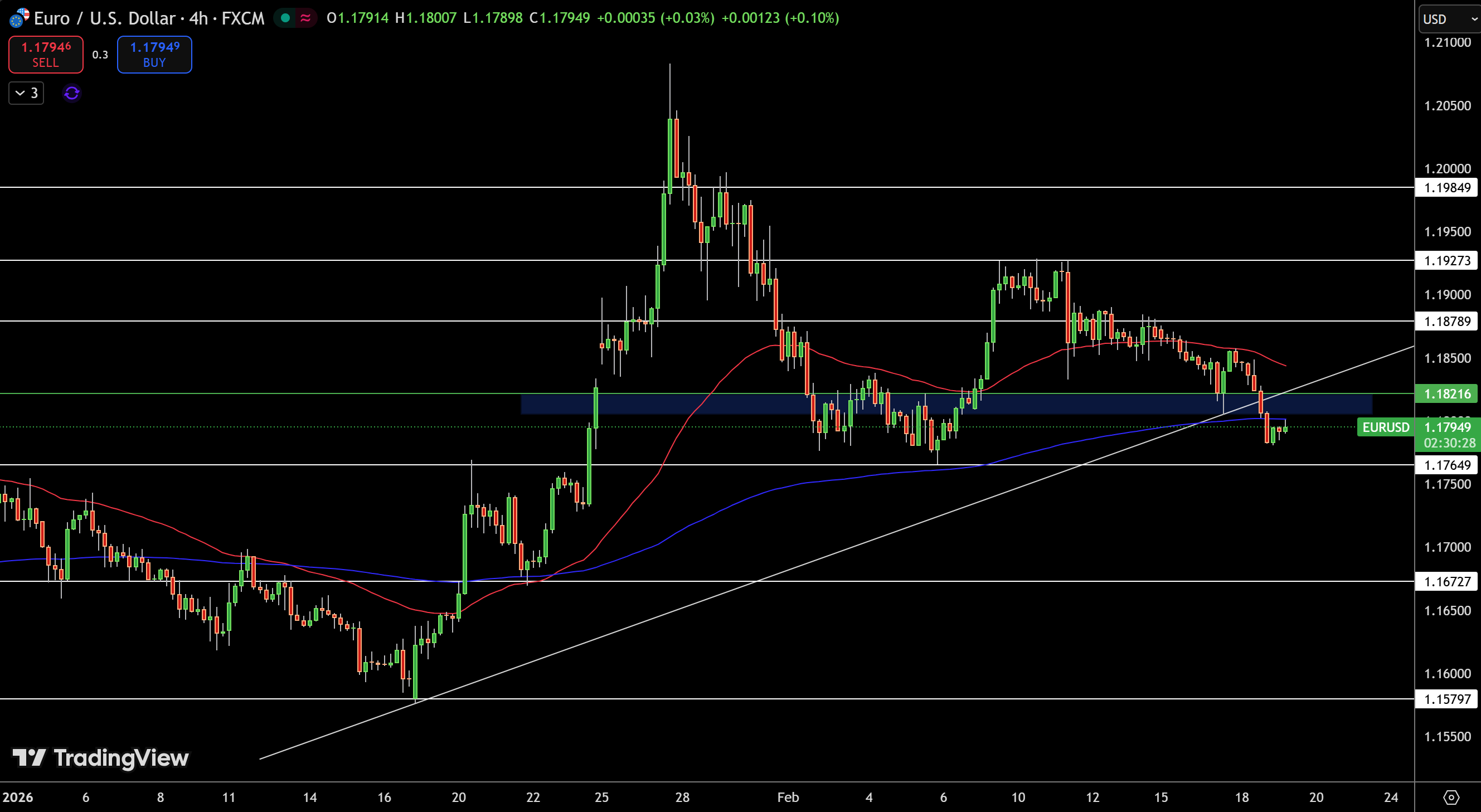
EUR/USD is currently trading near $1.1795 on the 4 hour chart after breaking below the important $1.1820 demand zone. The price has also slipped below the 50 period EMA near $1.1850 while the 200 period EMA is sitting lower around $1.1765. The rising trendline that’s been in place from $1.1580 is now under some pressure and a clean break could well give the price a bit of a kick down the road in terms of momentum.
Our immediate resistance is seen at $1.1820 and $1.1879 but if we look a bit closer we can also see some support at $1.1765 and $1.1672. If we do see the buyers fail to reclaim $1.1820 then the structure of the trade definitely shifts bearish and we’re looking toward $1.1670.
Trade idea: Sell below $1.1785, see how far we can push it to $1.1765 with a stop loss above $1.1830.