
Dollar Ticks Down a Bit as Ceasefire Boosts Mood, Reduces Fear of the Unknown
The U.S. dollar slipped a bit against its big-name rivals on May 8, 2026. That’s because the shaky truce between Washington and Tehran is now a month old and so far holding – which has started to look like it’ll stick – and there’s also been a bit of a partial return to normal with tanker traffic beginning to flow through the Strait of Hormuz again. With all that extra uncertainty cleared up, the dollar doesn’t need to be people’s go-to “safe haven” investment anymore, so investors are starting to look for higher returns in riskier currencies.
The euro is up a bit on the general feeling of improvement and hopes for more stability in Europe’s energy situation. Meanwhile, the British pound is also doing well, for it’s one of those currencies that usually benefits when the world looks like a less scary place. Both of them are getting a bit of a boost from the fact that the dollar isn’t looking quite so safe and sound because of all the uncertainty that had been hanging over the Middle East.
The markets are now looking ahead to some inflation data from the U.S, which will give us a better idea of where the Federal Reserve is headed next. But even though the ceasefire has given the dollar a bit of a reprieve, its still a fragile situation, and any hiccups in diplomacy or a flare-up of tensions in the region could turn the dollar’s safe-haven status back on in a heartbeat.

DXY Testing $97.61 Support – White Descending Channel Still in the Mix
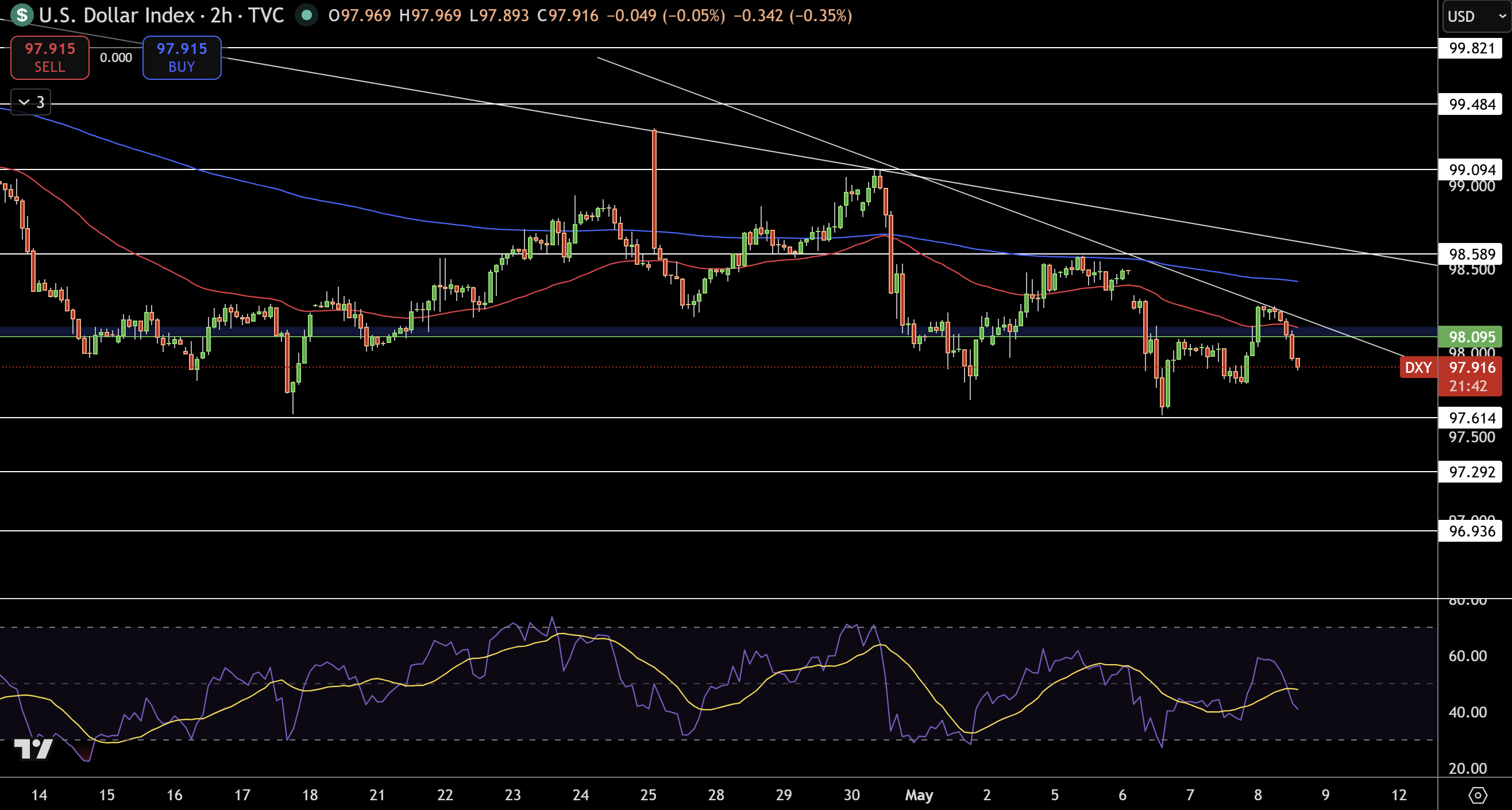
DXY is trading at $97.92 on the 2 hour chart – not looking good for the bulls, because it’s sliding along that lower blue channel with that pesky red moving average capping the rallies near $98.10. The price just recently touched $97.97, but kept form lower highs – not keen on that. It did respect that white descending trendline from April though.
Given how things are looking, it’s still holding above the $97.61 horizontal support – but that’s a pretty big one to hold – and shows bearish wicks too. RSI is at 48 with mild negative momentum, and that Fib retracement from May’s high is targeting $97.29-$96.94 downside. Volume profile has marked this area as pretty heavy resistance. So long as the price stays below $98.00, and inside this multi-week down channel – I’d say the structure is bearish.
Trade Idea: Sell at $97.91 – aiming for $97.29, with a stop at $98.10.
GBP/USD Reaches New Heights in Blue Ascending Channel – $1.358 Still Looking Solid
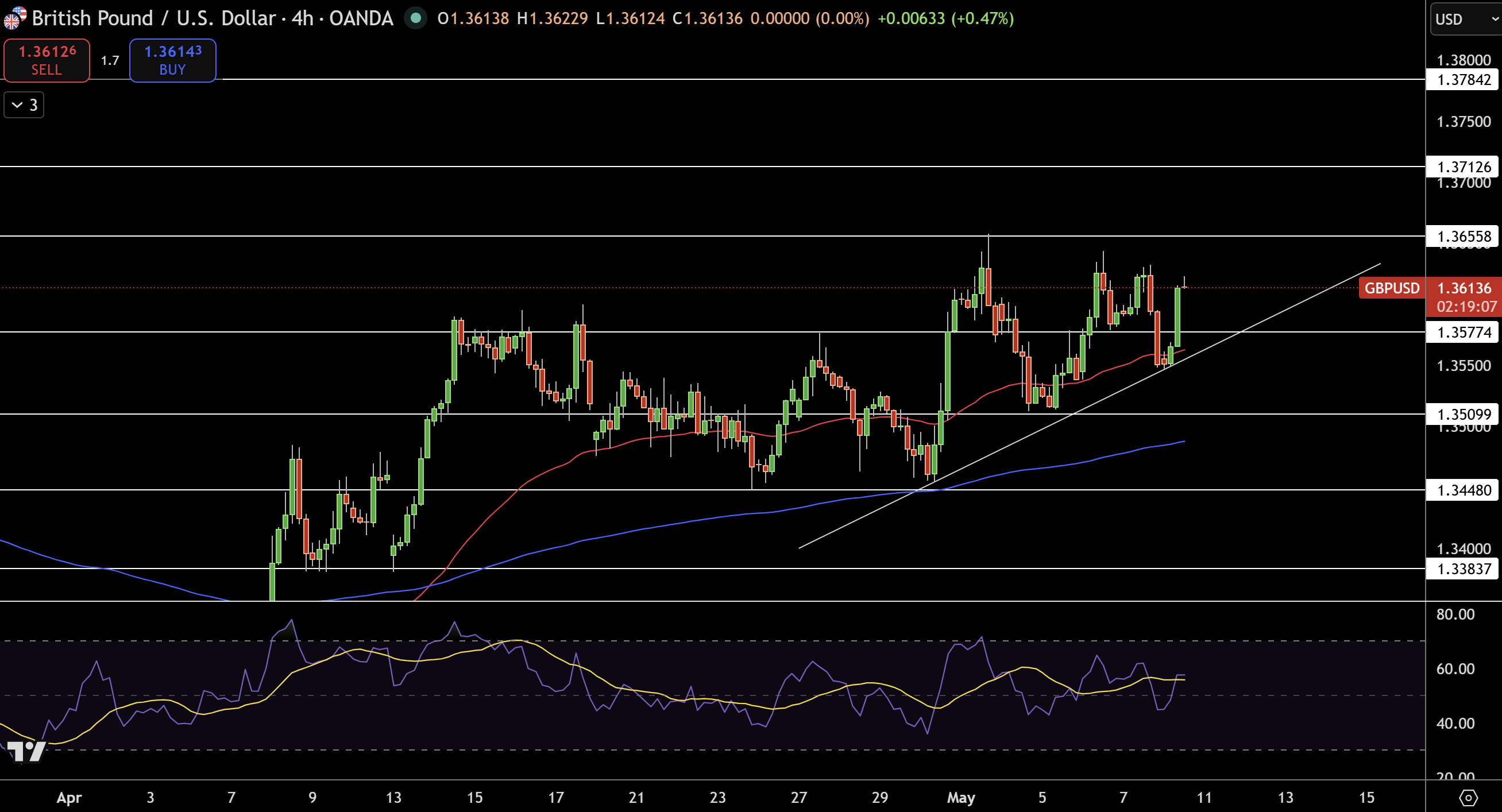
GBP/USD is trading at $1.3614 on the 4 hour chart, with the white trendline from the early May lows looking pretty resilient. And even though the price has just mildly touched the $1.3577 Fib level – those green candles tell us the buyers aren’t giving up just yet. The dynamic floor near $1.358 is being provided by the red 50 period moving average & it’s looking a little more wobbly than it did earlier. The price is printing a good bullish continuation after that strong move above the $1.36 pivot.
GBP/USD Price Forecast
Every new GBP/USD analysis as it publishes, today's technical signal and key levels, live price — on one page.
See all GBP/USD forecastsThe RSI is still holding above 55, which is a good sign for steady momentum without any pesky divergences turning up. As for where it might go next, you’ve got overhead resistance at $1.3656-$1.3713 where it previously had some trouble. Volume profile confirms that $1.36 is the price that’s fair value for buyers to be defending the channel floor with both hands – it’s looking pretty clean rising channel from April though.
Trade Idea: Buy at $1.3614 – your target is $1.3655, with a stop at $1.3575.
EUR/USD Making Tentative Gains Above Blue Trendline – $1.174 Still Holding Firm
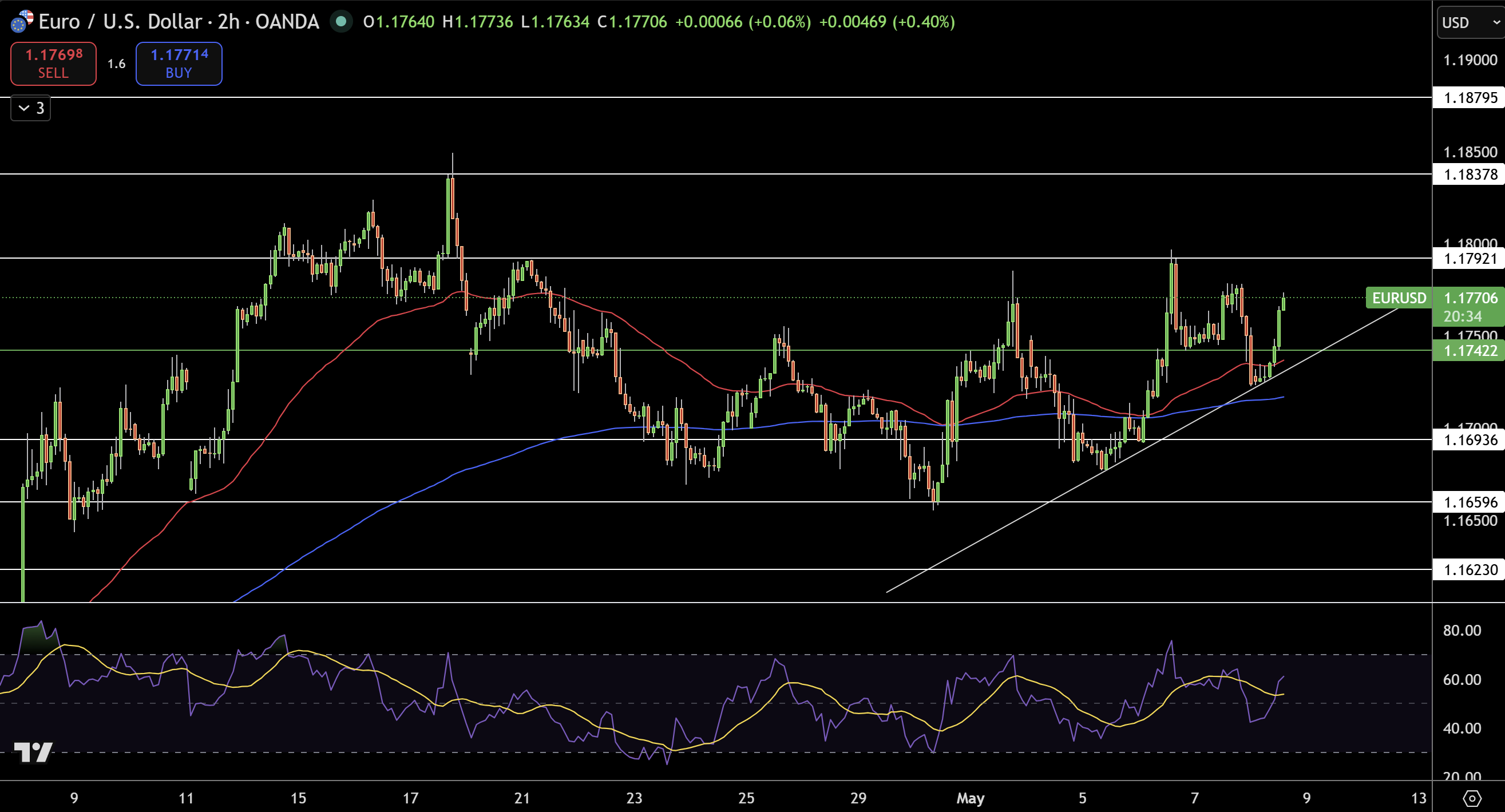
EUR/USD is sitting at $1.1771 on the 2 hour chart, slowly starting to push along that blue ascending trendline from mid-April lows – the price has been making some green rejection candles to defend that $1.174 level. The price is being supported by that red moving average confluence near $1.176 – and you can see it’s been forming higher lows inside this short-term range.
That recent bullish hammer is a great sign of buyer control at the 38.2% Fib level. RSI is looking pretty flat at 52 with neutral momentum – not much to get excited about. The next big test is going to be that overhead resistance at $1.179-$1.183 swing highs. Structure is a bit neutral-to-bullish above $1.174, while the channel floor provides a clear defense.
Trade Idea: Buy at $1.1770 – your target is $1.183, with a stop at $1.174.