
Dollar Index Lingers Near 99.50 As Energy Price Surge Puts the Squeeze On Yields
The dollar has been stuck in a tight range between 99.40 and 99.50 after almost hitting a 15-week high of 99.70 earlier in the week. The greenback had three days on the trot where it went up, and it’s being backed by rising oil prices and a renewed desire for safe havens.
Yesterday’s price action was very firm and showed just how much of a hold crude still has on the markets, pushing higher, and that’s only making price inflation worries even worse, which in turn is making the Fed less likely to ease up in the short term.
Even though the headline February CPI came in at 0.3 percent up on last month and 2.4 percent up on the year, it’s all about how that’s going to play out over the coming months, with the energy costs being what they are.

Inflation Risks Suddenly Redraw Fed Rate Expectations
The core CPI came in at 0.2 percent up on last month and 2.5 percent up on the year, almost as low as it’s been but still a long way off the Fed’s 2 percent target.
Even though that data wasn’t exactly super-aggressive, the traders came out and are now betting the Fed won’t cut rates next week, with the only rate cut in sight for September now being a 25 basis point cut. That marks a pretty big change of heart from the earlier thinking of multiple cuts.
Today’s Focus: Fed To Send Out A Signal & How The Energy Costs Are Going To Play Out
Today pretty much comes down to what the Fed has to say and where energy prices go from here. If oil stays high and the Fed voices some caution, the DXY might just try and test the 100 mark.
But if the Fed tones it down or things calm down a bit on the geopolitical front, then the index might just pull back to 98.80 and find some support.
GBP/USD Price Forecast
Every new GBP/USD analysis as it publishes, today's technical signal and key levels, live price — on one page.
See all GBP/USD forecastsU.S. Dollar Index Forecast: DXY Testing $99.68 Resistance – Break Toward $100.32?
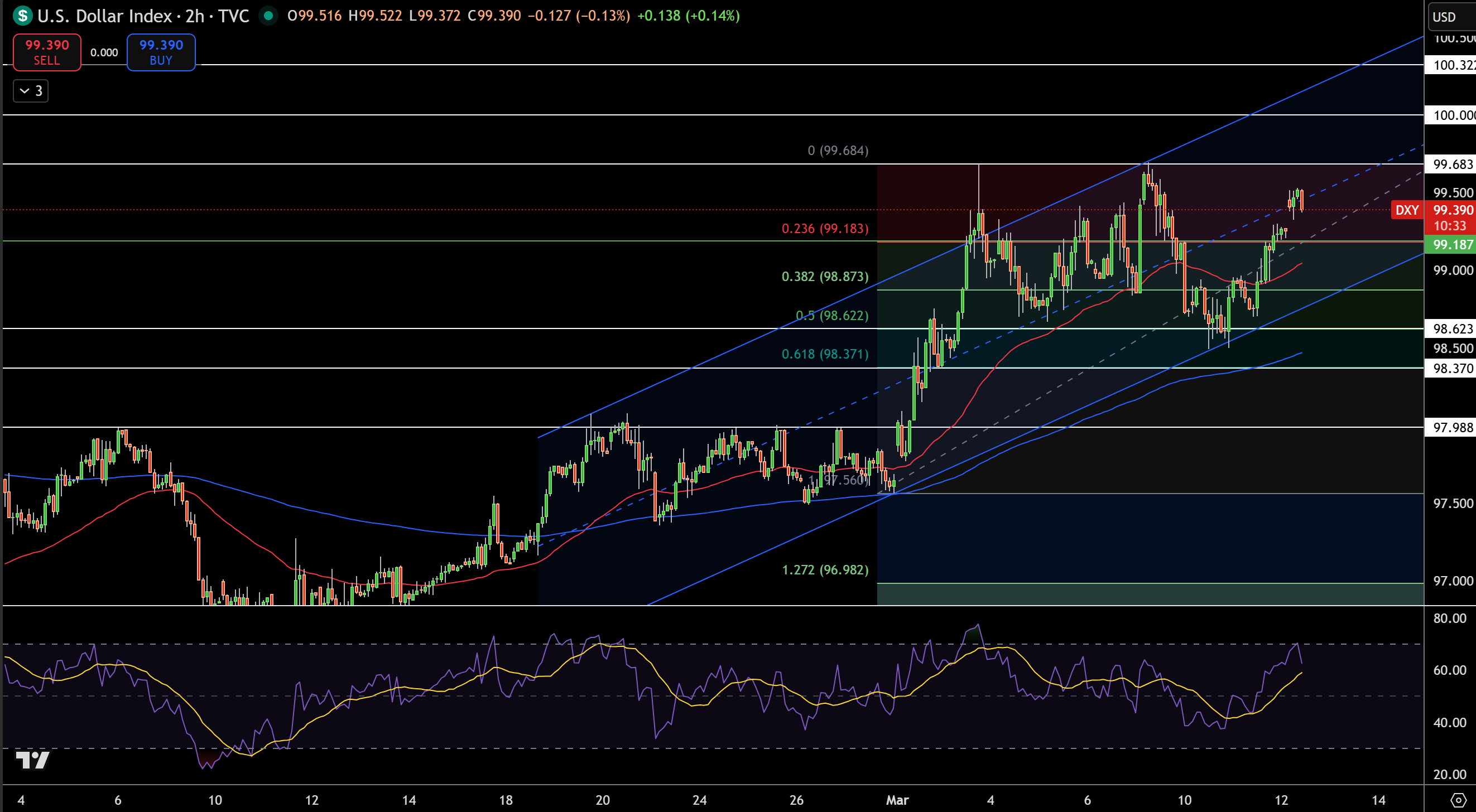
The US Dollar Index is currently trading around 99.39 on the 2 hour chart & looks like it’s about to hit the 0.236 Fibonacci level at 99.18 – which is roughly where the key resistance level of 99.68 is waiting for it. In short , DXY is still technically looking good as it’s firmly above both the 50-day EMA and the 200-day EMA, which is a big plus for a short-term bull run . The channel midpoint & the 0.382 Fib at 98.87 are both still acting as a kind of safety net for the price.
RSI is climbing steadily towards the 60 & 65 zones, and this is still a long way from overbought, so it’s still a pretty good sign that real upside momentum is building in the market. If the price can break above 99.68, it will be very likely to head towards 100 and 100.32. But if it can’t hold above 99.18 then we might see a pullback down to 98.62 or even 98.37 to test the support levels.
GBP/USD Forecast: Descending Trendline Caps $1.3400 – Breakdown Toward $1.3280?
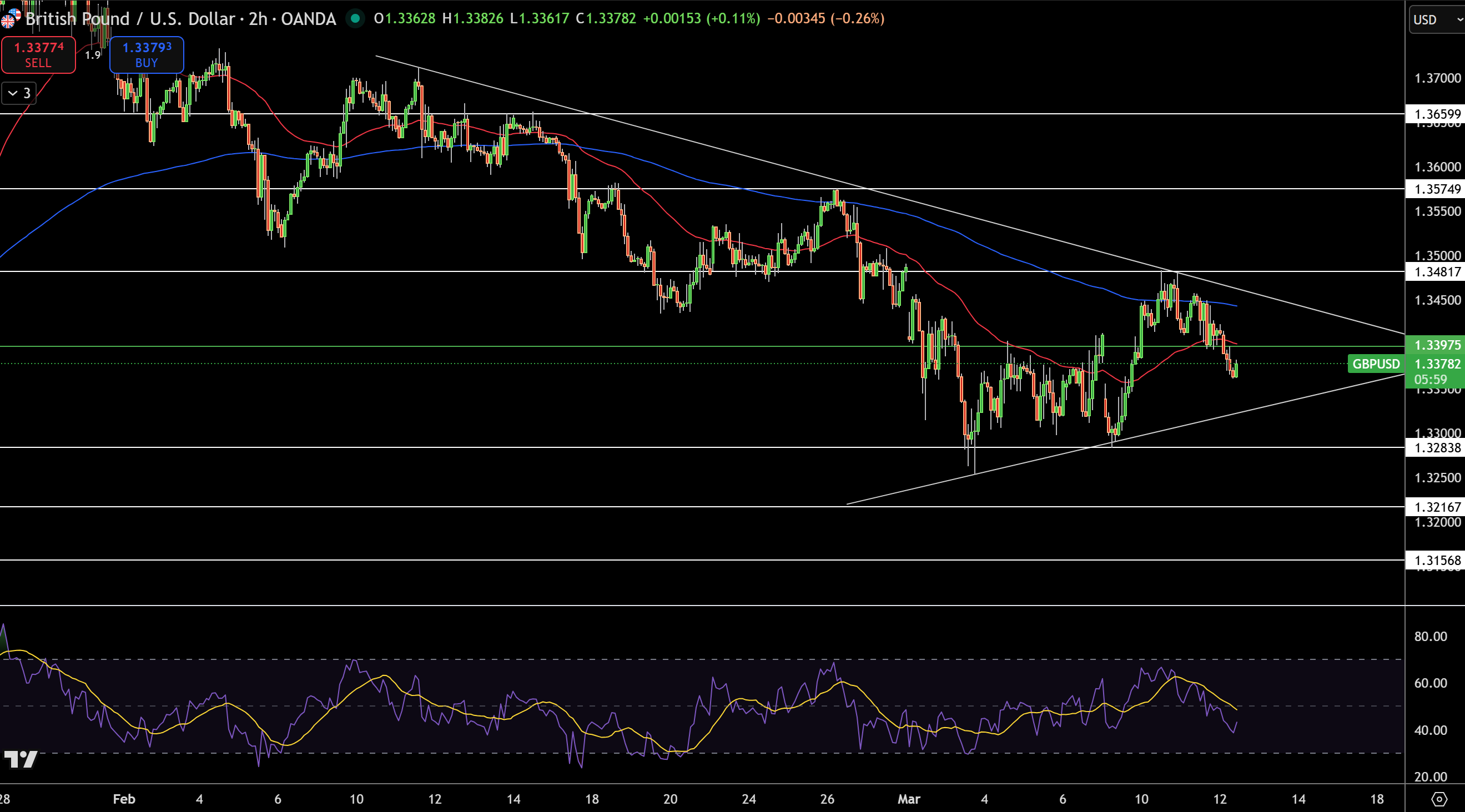
GBP/USD is currently hovering around $1.3378 on the 2 hour chart , and it’s stuck beneath a pretty clear downward trend line that’s been stuck in the way of any sort of rally since late January. The pair recently got rejected from the $1.3480-$1.3500 price zone and has gone back the other way , so it looks like the short-term trend is still a loser.
At the moment, the price is still sitting below the 200 EMA, while the 50 EMA is refusing to budge from its position as resistance, which isn’t helping the bears one bit. The small bounce from $1.3280 formed a little higher low, but the telltale signs of a dying rally are showing up – like the fact that the RSI is just starting to roll over near the mid-50s.
If we do see a proper break below $1.3300 , then we might start to see some real damage – and by that I’m talking $1.3215 and potentially even $1.3150 on the radar. But on the other end of the spectrum, only a genuine break above $1.3480 and out of that downward trend line will really put the bulls back in the driving seat.
EUR/USD Price Forecast: Bearish Channel Targets $1.1500 – Breakdown Below $1.1530?
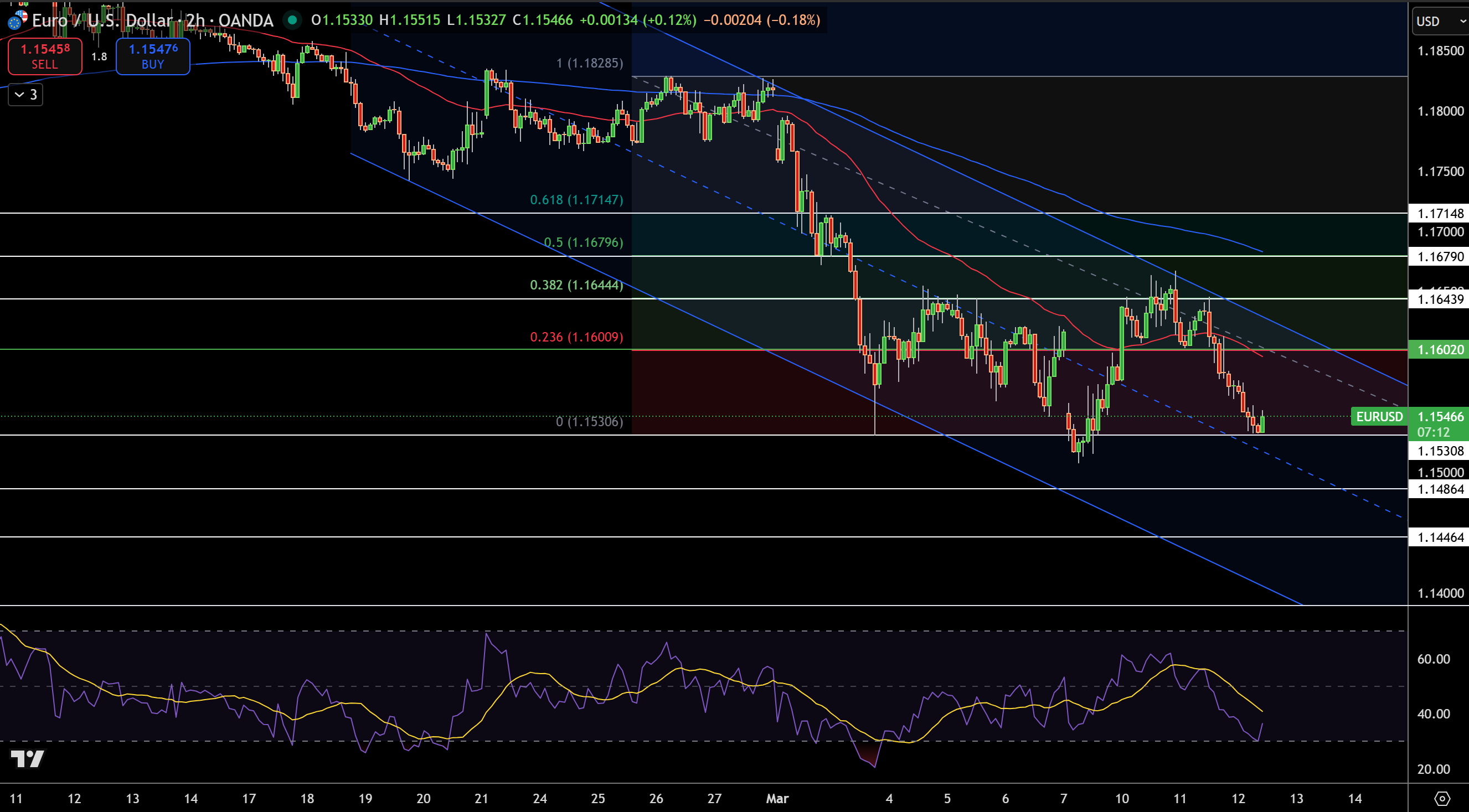
EUR/USD is currently hovering around $1.1546 on the 2hr chart, still stuck within a clear descending channel. Price has just bounced off the $1.1600 to $1.1640 resistance area and is now moving down towards that $1.1530 support level which quite recently was a real turning point.
From a technical standpoint, the pair is sitting below both the 50-day EMA and the 200-day ema which suggests a pretty strong bearish undertone. We have also seen resistance show up at the $1.1600 point which is the 0.236 Fibonacci retracement level – it’s been pretty solid. The broader retracement zone that runs out from $1.1644 to $1.1714 is also acting as a bit of a cap on any attempts to push upwards.
If price finally breaks down below $1.1530 then we could see a drop down towards $1.1486 – and in a worst case scenario even $1.1446. On the other hand if price were to push back above $1.1600 then we might be able to get some breathing room before things head south again.