


Yet, the U.S. natural gas benchmark at Henry Hub has remained remarkably low and insulated, trading near $3.00 per million British thermal units (MMBtu) and even dipping to a low of $2.50/MMBtu in late April. For any active market trader, this phenomenon highlights the unique structural mechanics that separate regional gas dynamics from global oil trading.
To understand why U.S. natural gas remains shielded from the current crisis, we must examine the market’s underlying structural realities.
Why U.S. Natural Gas Prices Struggle to Rise
Several structural reasons explain why U.S. natural gas prices have not followed oil during the Persian Gulf crisis and why they may struggle to rise—and may remain low—for the foreseeable future.
First, unlike the global oil market or highly volatile assets like Bitcoin and foreign exchange, the natural gas market is composed of distinct regional markets rather than a single global market. While a Persian Gulf crisis directly threatens international shipping lanes and disrupts European and Asian benchmarks (TTF and JKM), the U.S. market remains heavily insulated by its geographical isolation and vast domestic infrastructure. As the world’s largest natural gas producer, the U.S. is entirely self-sufficient and operates as a net exporter with limited physical exposure to Persian Gulf disruptions. Consequently, Henry Hub pricing remains fundamentally tied to local supply and demand dynamics.
Second, the U. S. sits on an enormous shale reserve base, estimated at 29.4 billion barrels of shale oil and 379.4 trillion cubic feet (Tcf) of shale gas. This sheer volume of available potential supply means any threat of a structural shortage is easily mitigated by existing domestic capacity. Furthermore, higher oil prices from Middle East tensions encourage U.S. shale companies to ramp up drilling in oil-rich basins like the Permian. Because natural gas is extracted there as ‘associated gas’—a direct byproduct of oil production—this drilling surge introduces an unexpected influx of supply. Consequently, a global oil rally fundamentally triggers a domestic supply expansion, exerting downward pressure on Henry Hub prices.
Third, while high global prices make exporting U.S. liquefied natural gas (LNG) highly profitable, the available physical infrastructure creates a major bottleneck. The U.S. cannot build new export terminals overnight—it can only run its current facilities at maximum capacity. This limitation pulls a steady but capped baseline of 12 to 14 billion cubic feet per day (Bcf/d) of exports out of the domestic market, leaving the rest of the supply trapped at home, which in turn puts additional pressure on local prices.
Fourth, robust wind and solar generation are actively displacing natural gas consumption within the electric power sector. According to Bluegold Trader, renewables are currently displacing up to 10 Bcf/d of gas burn, with over 230 Bcf displaced in the past 30 days alone. This structural shift effectively caps natural gas price upside, even as overall power demand continues to grow.
Fifth, the retirement of coal-fired power plants has slowed down. Driven by the massive expected electricity demand from modern data centres, AI, and cryptocurrency mining, coal generation may actually increase in the near term, directly biting into the market share that would otherwise belong to gas-fired generation.
Finally, long-term geopolitical conflicts usually matter less to prices than local weather forecasts. Recent mild weather across the U.S. has kept heating and cooling demand low, pushing gas storage inventories well above normal levels. While forecasts for hotter weeks ahead might cause brief price jumps, daily weather updates still matter far more to the market than overseas political risks.
Natural Gas Price Forecast
Every new Natural Gas analysis as it publishes, today's technical signal and key levels, live price — on one page.
See all Natural Gas forecastsMarket Implications and Trading Outlook
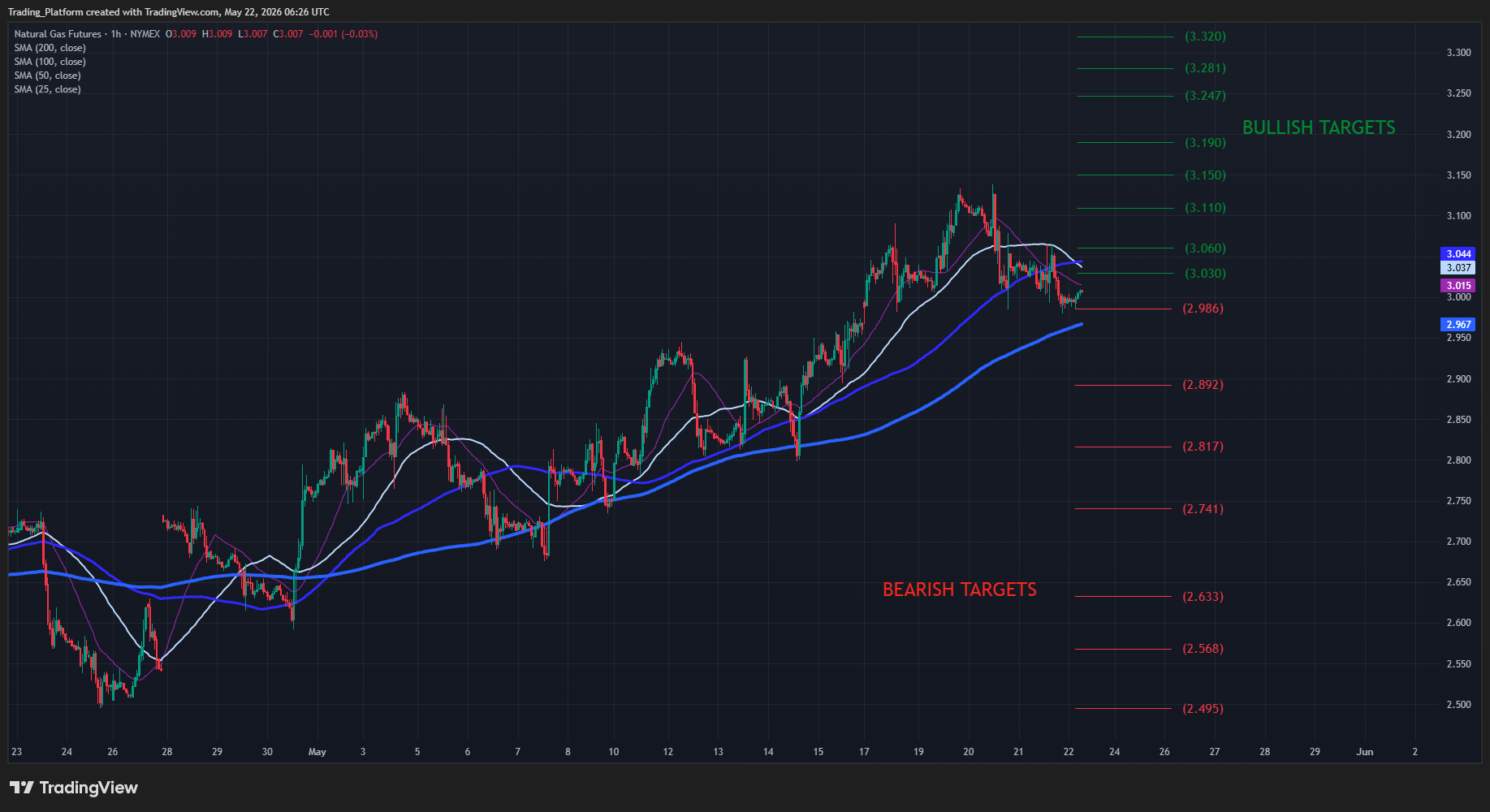
‘Many market participants expected U.S. natural gas to automatically mirror oil spikes during a Middle East crisis, but U.S. Henry Hub prices are driven by domestic fundamentals and often ignore distant risk premiums,’ concludes Kar Yong Ang, a financial market expert at Elev8 broker. ‘Indeed, a geopolitical oil boom can actually worsen a local natural gas glut, putting severe downward pressure on short-term spot prices. Technically, the trend remains bullish, but a retracement towards $2.900 seems likely, and should the weather turn out to be cooler than expected, the natural prompt-month futures contract may drop as low as $2.750.
Natural gas NYMEX futures
Disclaimer: This article does not contain or constitute investment advice or recommendations and does not consider your investment objectives, financial situation, or needs. Any actions taken based on this content are at your sole discretion and risk—Elev8 does not accept any liability for any resulting losses or consequences.