
XRP enters another losing streak as US XRP-spot ETFs react to delays in crypto legislation and geopolitical risks.
The US XRP-spot ETF market snapped a 10-week inflow streak as two key events hit sentiment.
US President Trump threatened tariffs on eight European NATO members before withdrawing the threat on reaching an agreement about Greenland. Nevertheless, the initial threat of tariffs triggered a flight-to-safety, leaving the US XRP-spot ETF market in the red for the week.
Delays to markup votes on draft text for the Market Structure Bill added to the negative sentiment.
Despite these events, the medium-term outlook for XRP remains bullish. XRP-spot ETF net inflows since launch, increased XRP utility, and expectations of the Senate eventually passing crypto-friendly legislation remain tailwinds.
Below, I will explore the key drivers behind recent price trends, the medium-term (4-8 weeks) outlook, and the key technical levels traders should watch.

US XRP-Spot ETF Market Snaps 10-Week Inflow Streak
The US XRP-spot ETF market saw only its second day of net outflows on Tuesday, January 20, as markets reacted to legislative developments and Trump’s tariff threats. There was no ETF trading on Monday, January 19, because of a US holiday.
Total net outflows of $53.32 million on January 20 outpaced net inflows of $12.68 million from Wednesday through Friday, leaving weekly net outflows of $40.64 million.
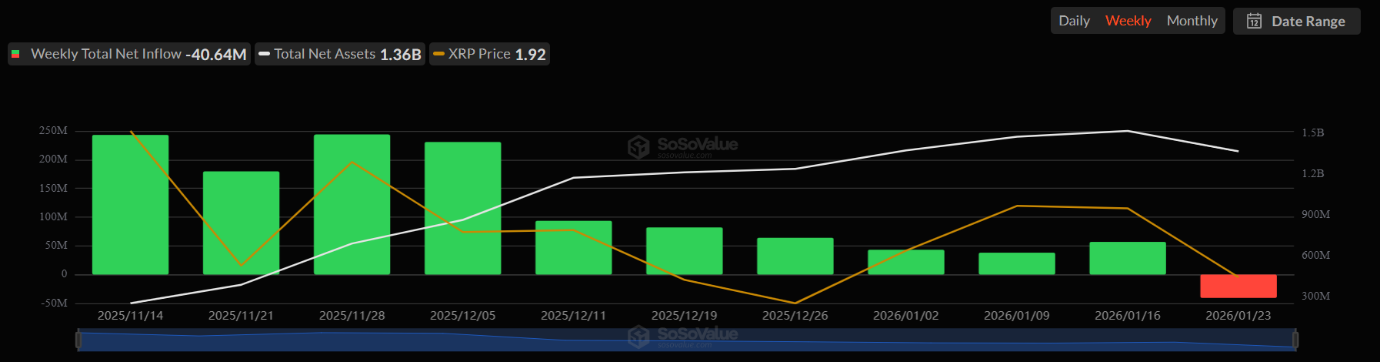
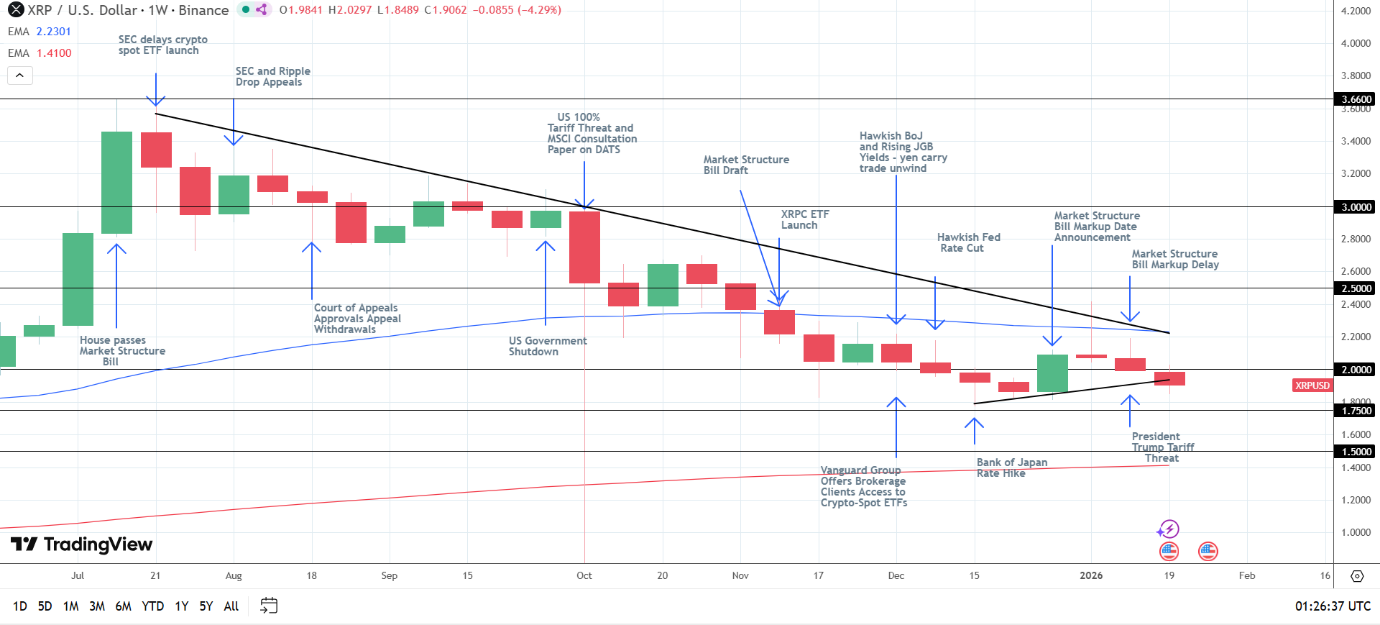
Crucially, the outflows weighed on demand for XRP, leaving the token down 4.29% for the week ending January 25.
Despite the net weekly outflows, three consecutive days of net inflows from Wednesday to Friday underscored the robust institutional demand for XRP, supporting the bullish short- to medium-term outlook for the token.
Notably, US XRP-spot outflows were modest relative to the US BTC-spot ETF market, which saw total net outflows of $1.32 billion in the reporting week ending January 23.
Bitcoin Price Forecast
Every new Bitcoin analysis as it publishes, today's technical signal and key levels, live price — on one page.
See all Bitcoin forecastsUS Senate Delays Crypto Legislation Markup Votes
The US Senate Banking Committee and Senate Agriculture Committee delayed progress of the Market Structure Bill, weighing on demand for XRP.
Reports of the Agriculture Committee delaying the release of its draft text for the Market Structure Bill triggered an XRP pullback in early January. Meanwhile, the Banking Committee postponed its markup vote on its draft text on January 15, increasing selling pressure.
The Agriculture Committee released its draft text on January 21 but had to delay its markup vote, set for January 27, due to adverse weather.
These events dampened hopes for crypto legislation to be in place by the end of the first quarter.
XRP’s price action underscored the token’s sensitivity to crypto-related regulatory developments. The token rallied to a January 6 high of $2.4151 after the Banking Committee announced a markup vote date of January 15. However, XRP tumbled to a low of $1.8489 in the week ending January 25, reflecting investor disappointment.
Crypto experts view the Market Structure Bill as key for increased XRP utility. The passing of the Market Structure Bill could be the next price catalyst. For context, XRP surged 14.69% on July 17 after the US House of Representatives passed the Market Structure Bill to the Senate. However, the US government shutdown, alongside delays to the launch of XRP-spot ETFs, weakened demand for XRP, which dropped to a December low of $1.7712.
Given optimism that the Senate will eventually pass crypto-friendly legislation, XRP would likely retarget its all-time high of $3.66 should the Senate pass the Bill.
XRP Price Forecast: Short-, Medium-, and Long-Term Targets
Increased XRP utility and resilient longer-term demand for XRP-spot ETFs affirm the positive short-term outlook (1-4 weeks), with a target price of $2.5. Meanwhile, expectations that the Senate will pass the Market Structure Bill continue to support XRP at current price levels. These factors reinforce the bullish longer-term price projections:
- Medium-term (4-8 weeks): $3.0.
- Longer-term (8-12 weeks): $3.66.
Key Downside Risks to the Bullish XRP Outlook
Several events could challenge the constructive bias. These include:
- The Bank of Japan hints at multiple rate hikes to reach a hawkish neutral interest rate (potentially 1.5%-2.5%). A higher neutral rate would narrow US-Japan rate differentials. A narrower rate differential could lead to a yen carry trade unwind, as seen in mid-2024. A yen carry trade unwind would invalidate the short-term outlook.
- Falling expectations of an H1 2026 Fed rate cut.
- Further delays and partisan challenges to the Market Structure Bill.
- XRP-spot ETFs report outflows.
These scenarios would weigh on risk assets, sending XRP below $1.85 and signaling a bearish trend reversal.
Technical Analysis: Levels to Watch
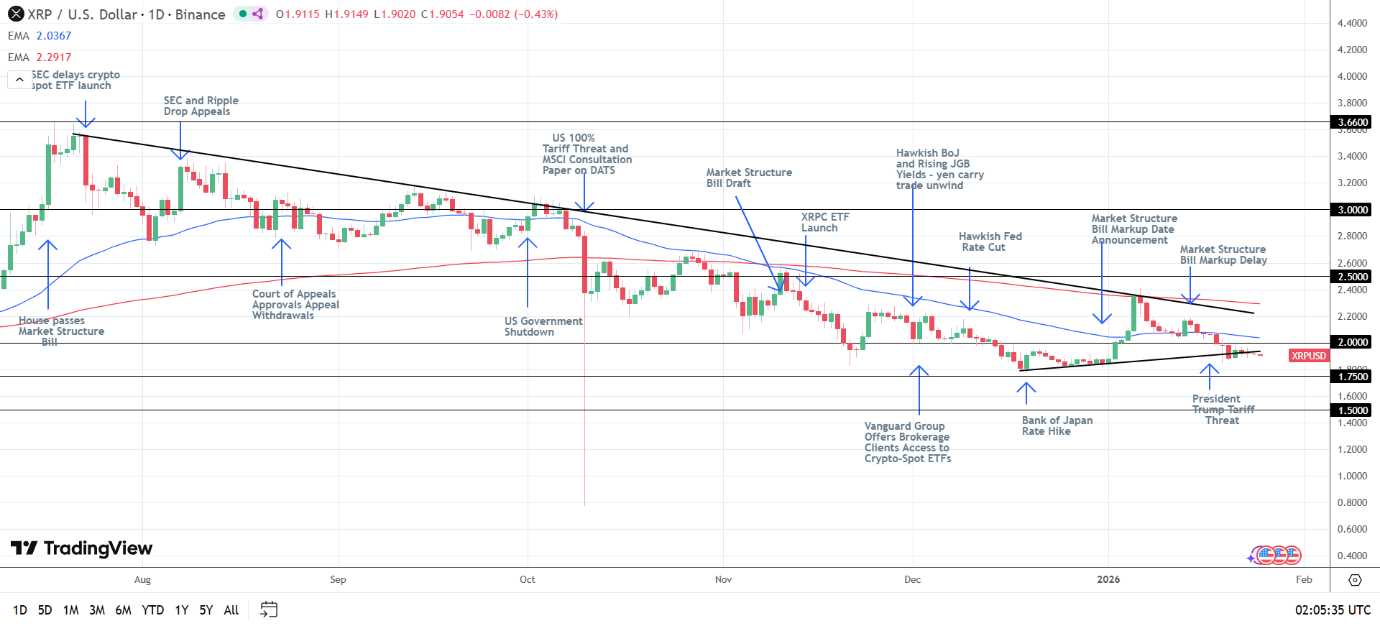
XRP fell 0.25% on Saturday, January 24, following the previous day’s 0.19% loss, closing at $1.9136. The token tracked the broader crypto market cap trend, which dropped 0.32%.
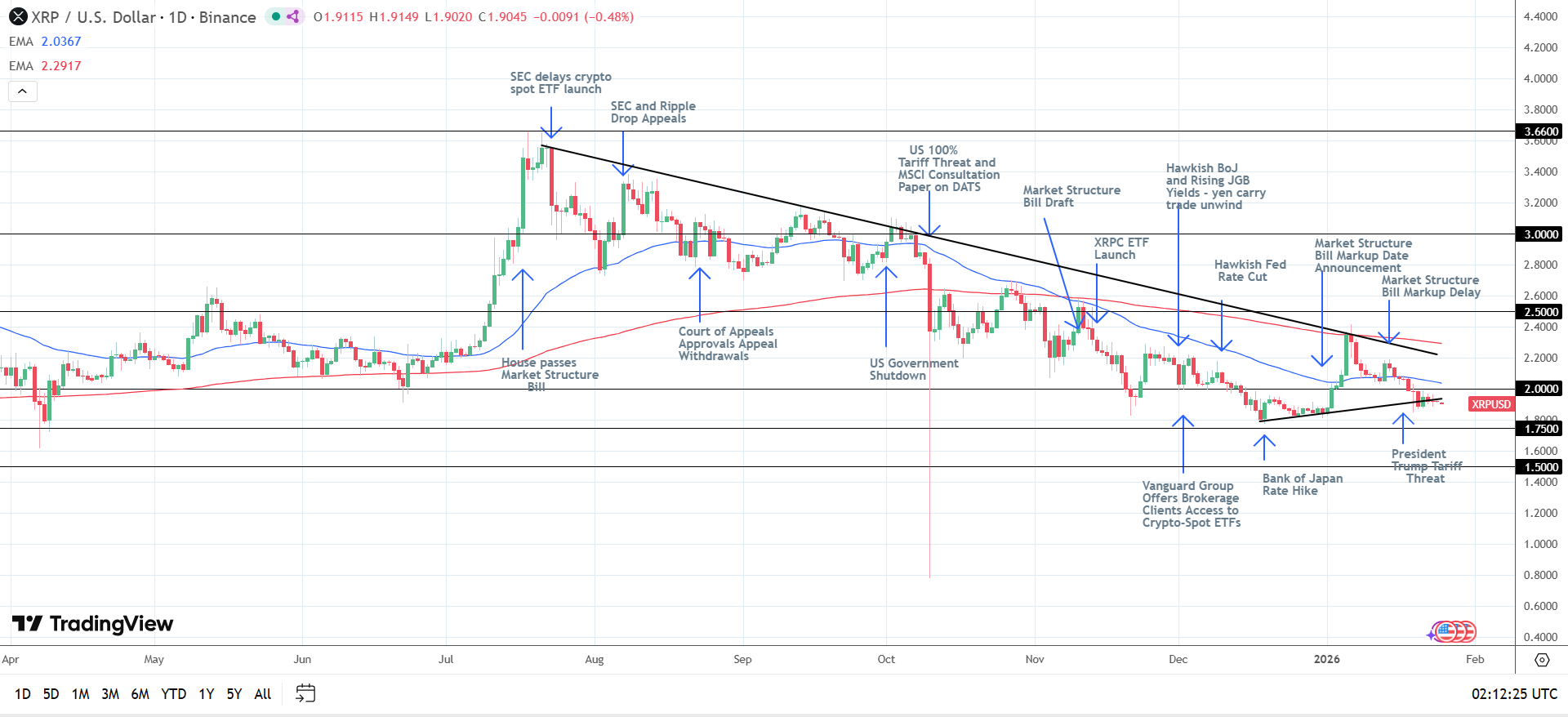
The losses left XRP trading below its 50-day and 200-day EMAs, signaling a bearish bias. However, the bullish fundamentals continue to offset bearish technicals, reaffirming the positive outlook.
Key technical levels to watch include:
- Support levels: $1.85, $1.75, and then $1.50.
- 50-day EMA resistance: $2.0367.
- 200-day EMA resistance: $2.2917.
- Resistance levels: $2.0, $2.5, $3.0, and $3.66.
On the daily chart, a breakout above $2.0 would enable the bulls to target the 50-day EMA. Significantly, a sustained move through the 50-day EMA would indicate a near-term bullish trend reversal. A bullish trend reversal would bring $2.2 into play. A break above $2.2 would open the door to testing the 200-day EMA.
Importantly, a sustained move through the EMAs would reaffirm the bullish medium- and longer-term price targets.
Fundamental Events Driving Near-Term Price Action
Near-term price drivers include:
- XRP-spot ETF flows.
- US economic data and the Fed’s monetary policy stance.
- US crypto-related regulatory developments.
- The Bank of Japan’s rate path.
Reclaiming $2 Remains Key for XRP’s Bullish Structure
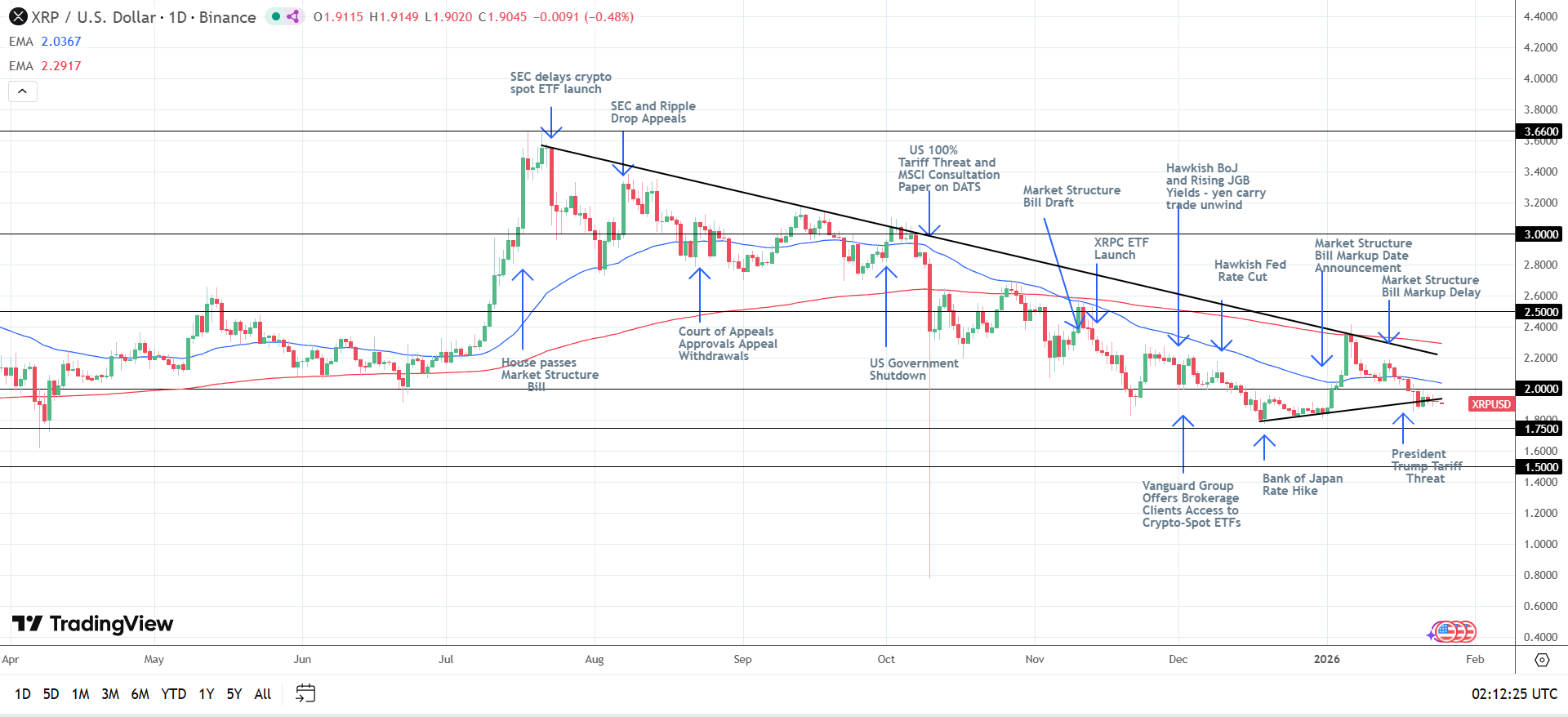
Breaking above $2 is crucial for the short- to medium-term outlook. The bullish fundamentals, as outlined above, continue to counter bearish technicals, supporting a near-term rebound. XRP’s recovery from December’s low of $1.7712 and January gains of 3.43% reaffirmed the bullish structure and short- to medium-term price targets.
A break above $2.0 would bring the upper trendline into play. A sustained move through the upper trendline would affirm the bullish trend reversal and validate the bullish structure, supporting the price targets:
- Medium-term (4-8 weeks): $3.0.
- Longer-term (8–12 weeks): target of $3.66.
However, a sustained drop below the lower trendline to sub-$1.85 levels would invalidate the bullish structure, indicating a bearish trend reversal.
XRP Outlook Hinges on Crypto Legislation, ETFs, and Central Banks
Looking ahead, crypto-related regulatory developments will be crucial for XRP’s near-term price outlook. Bipartisan support for draft texts of the Market Structure Bill would boost hopes that the Senate will pass the Bill, driving demand for XRP.
However, US economic data, the Fed’s upcoming interest rate decision, and XRP-spot ETF flow trends will also influence the near-term price outlook.
Rising bets on an H1 2026 Fed rate cut, and a dovish BoJ neutral rate (potentially 1%-1.25%) would lift sentiment. Strong buying interest in US XRP-spot ETFs, the progress of the Market Structure Bill, and increased XRP utility would reinforce the constructive bias.
In summary, these factors support a medium-term (4–8 weeks) move to $3.0. The US Senate’s passing the Market Structure Bill would reaffirm the longer-term (8–12 weeks) price target of $3.66.
Beyond 12 weeks, favorable developments are likely to send XRP to its all-time high of $3.66 (Binance). A break above $3.66 would support a 6- to 12-month price target of $5.