
The European Central Bank convenes for its first policy meeting of 2026 on Thursday, February 5th, and while no rate change is expected, President Christine Lagarde’s messaging could prove pivotal for the euro’s direction.
With EUR/USD hovering below the psychologically significant 1.20 level and markets divided on the ECB’s next move, traders are watching closely for clues about the central bank’s policy trajectory amid shifting inflation dynamics, euro strength concerns, and unprecedented uncertainty emanating from Washington.

The ECB’s Economic Outlook: Where Do Inflation and Growth Stand?
At its final meeting of 2025 in December, the European Central Bank delivered a notably optimistic assessment of the eurozone economy, upgrading its growth forecasts and signaling confidence in its inflation trajectory. The central bank now projects economic growth of 1.4% for 2025 (up from previous estimates), 1.2% for 2026, and a return to 1.4% for both 2027 and 2028.
On the inflation front, the ECB’s December projections painted a picture of price pressures gradually normalizing around the central bank’s 2% target. The ECB forecast inflation to average 2.1% in 2025, then decline to 1.9% in 2026 and fall slightly further in 2027, before rebounding back to the 2% target in 2028.
These projections were based on an assumption of stable monetary policy, with the ECB signaling that if its forecasts prove accurate, interest rates would likely remain unchanged throughout 2026. The central bank characterized its current policy stance as being in a “good place” – with inflation at target, growth at potential, and interest rates in a neutral setting that neither stimulates nor restricts the economy.
Recent economic data has slightly complicated what had appeared to be a broadly favorable outlook. Figures published by Eurostat for January showed headline inflation in the euro area easing to 1.7%, down from 2.0% in December and its lowest level since September 2024. Even more notable, core inflation unexpectedly slipped to 2.2% from 2.3%, reflecting a continued cooling of price pressures, particularly in the services sector.
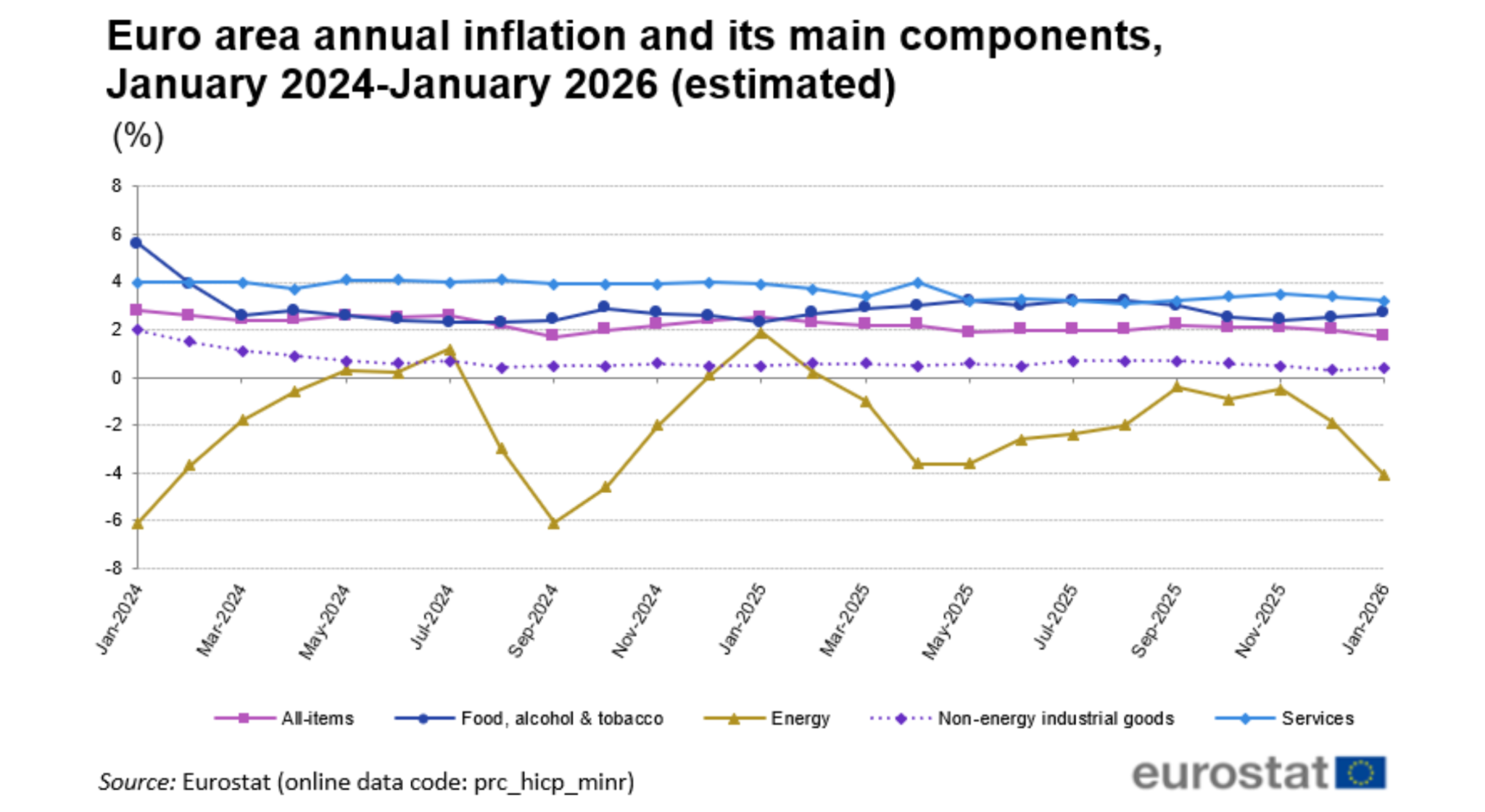
While inflation hovering just below target might seem like mission accomplished for the ECB, the downward trend has sparked debate among policymakers about whether disinflationary forces could prove stronger than anticipated. Two particular factors are raising concerns: the sharp appreciation of the euro against the dollar in recent weeks, which reduces import prices and dampens inflation, and the continued influx of lower-priced Chinese goods into European markets, which could exert additional downward pressure on prices.
ECB Governing Council member Gediminas Simkus highlighted the institution’s achievement in being the only major central bank to bring inflation back to target last year, despite an environment marked by U.S. tariffs, the war in Eastern Europe, excess supply from China and rising food prices. Nonetheless, he cautioned that ongoing political instability remains a key risk and could quickly disrupt the current policy balance maintained by the ECB.
EUR/USD Price Forecast
Every new EUR/USD analysis as it publishes, today's technical signal and key levels, live price — on one page.
See all EUR/USD forecastsThe Policy Debate: Hold, Hike, or Cut?
Thursday’s meeting is widely expected to result in the ECB holding its three key interest rates steady for the fifth consecutive meeting. The deposit facility rate should remain at 2.00%, the main refinancing operations rate at 2.25%, and the marginal lending facility rate at 2.40%. Markets assign virtually no probability to a rate change at this particular meeting.
However, beneath the surface consensus on holding rates steady this week, a fascinating debate is emerging among ECB officials and economists about what the central bank’s next move will be – and when it might come.
The Case for Future Rate Hikes
Surprisingly, despite inflation running below target, some within the ECB have left the door open to the possibility of rate increases later in 2026. This seemingly counterintuitive stance stems from several factors.
First, the ECB’s upgraded growth outlook suggests the eurozone economy may prove more resilient than previously thought. If growth consistently exceeds expectations while remaining around the 1.2-1.4% range, it could generate upward pressure on prices as the economy approaches full capacity utilization.
Second, some policymakers worry that the current 2% deposit rate may not be sufficiently restrictive if inflation proves stickier than forecasts suggest, particularly if wage growth remains elevated or if energy prices continue their recent upward trajectory. Oil and European natural gas prices have surged since the start of the year, which could ease the disinflationary pressures that have dominated recent months.
Third, recent comments from key ECB officials have fueled speculation about potential tightening. ECB board member Isabel Schnabel, chief economist Philip Lane, and President Lagarde herself have all made remarks that markets interpreted as keeping the option of late-2026 rate hikes on the table. Some market participants argue that the ECB’s decision to upgrade its eurozone growth forecasts could suggest the central bank is preparing the ground for a policy shift that could ultimately point toward tighter, rather than looser, monetary conditions.
As one analyst put it, the upgraded forecasts could signal that the ECB views current monetary policy as appropriately calibrated for an economy that’s performing better than expected – and if that performance continues, a shift toward tightening rather than easing might be warranted.
The Case for Future Rate Cuts
On the opposite side of the debate, a growing contingent of economists argues that the ECB’s next move is more likely to be a rate cut, potentially restarting the easing cycle that was paused in June 2025.
The primary argument for cuts centers on the recent inflation trajectory. With headline inflation at 1.7% and core inflation declining to 2.2%, both measures are trending below the ECB’s 2% target. If this disinflationary trend continues or accelerates, the central bank may find itself in a position where maintaining rates at current levels becomes unnecessarily restrictive.
The euro’s recent strength against the dollar adds weight to this argument. A higher euro reduces the cost of imported goods and services, including crucial energy imports, creating a natural disinflationary force. If EUR/USD continues to appreciate significantly above current levels, the ECB might need to offset this tightening in financial conditions through lower interest rates.
Additionally, the influx of cheap Chinese goods into European markets represents a structural disinflationary pressure that could persist for an extended period. As Chinese manufacturers face weak domestic demand, they’re increasingly turning to export markets, flooding Europe with competitively priced products that undercut domestic producers and suppress inflation.
Some economists also point to ongoing economic fragility in key eurozone countries, particularly Germany’s manufacturing sector, which continues to struggle with weak global demand and high energy costs. If growth disappoints relative to the ECB’s upgraded forecasts, the case for supportive monetary policy through rate cuts would strengthen considerably.
Diego Iscaro, head of European economics at S&P Global Market Intelligence, offered a nuanced middle-ground view: “With underlying inflation still a little too high for comfort and expectations that the eurozone economy will regain momentum later in the year, we believe the most likely outcome is that the ECB will keep rates unchanged for the foreseeable future.”
The Consensus: Hold and Debate
The reality is that economists and policymakers are genuinely split on the ECB’s next move, with some officials recently stating that both a hike and a cut are equally likely depending on how the data evolves. This uncertainty reflects the unusual position the ECB finds itself in – having successfully brought inflation back to target, but facing significant two-way risks that could push prices either meaningfully above or below the desired level.
ECB chief economist Philip Lane articulated this balanced approach in mid-January, stating that “the ECB will not debate any rate change in the near term if the economy stays on course, but new shocks, like a potential deviation by the Federal Reserve from its mandate, could upset the outlook.”
This statement encapsulates the ECB’s current posture: maintain the status quo as long as the economy develops roughly in line with projections, but remain prepared to act in either direction if circumstances change materially.
Have a look at our next article Can Lagarde Push the EUR/USD Higher? (Part 2) to get insights into the EUR/USD Dynamics