It’s been the star of Wall Street’s AI boom, but Nvidia (NASDAQ: NVDA) is now facing major headwinds at a time when its trailing twelve months (TTM) P/E ratio has grown to 36x and its market capitalization sits at $4.4 trillion. Is the stock strong enough to out-innovate its challenges at such a sky-high valuation?
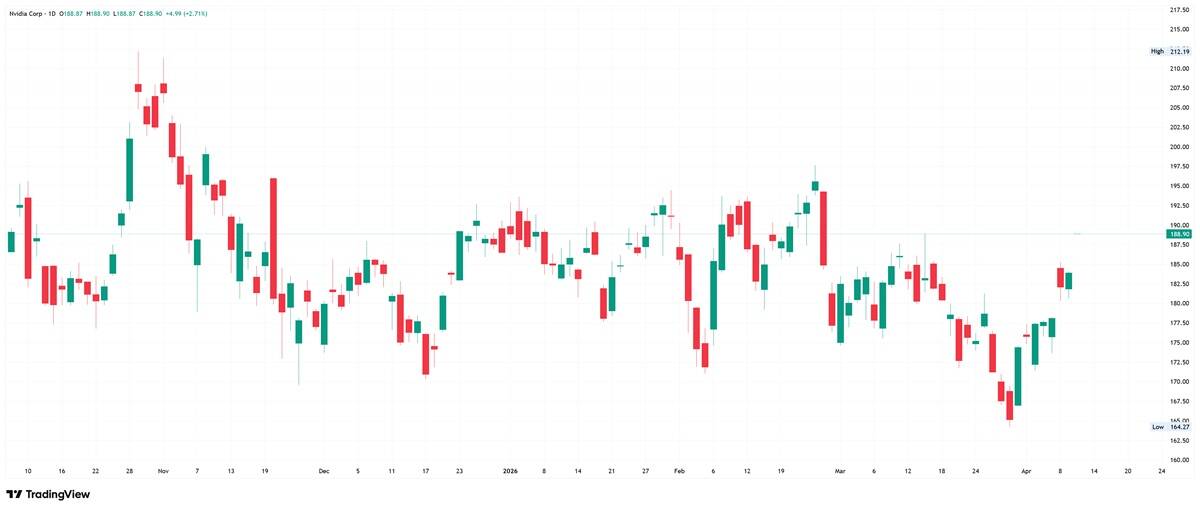
The stock ended the first quarter of 2026 6.49% lower as all of the Magnificent Seven collective of stocks that have dominated US markets in recent years struggled to sustain their momentum as the conflict in Iran created widespread inflation fears throughout Wall Street.
Nvidia is still the standout performer among artificial intelligence stocks in the United States, having rallied around 1,000% since OpenAI’s launch of ChatGPT on November 30, 2022. The semiconductor giant became the world’s first $4 trillion stock in July last year, having quickly overcome the shock of the Trump administration’s reciprocal tariffs to soar to new highs.
However, NVDA has been moving largely sideways since Q3 2025 as investors have become increasingly wary of the industry’s cyclical investing and external factors hampering the performance of growth stocks.
Despite this, Nvidia still has an exceptionally strong innovation pipeline to support an AI ecosystem that the World Economic Forum (WEF) estimates will contribute up to 14% of global GDP by 2030, at a value of around $15.7 trillion.
Could a $5 trillion market capitalization still be in sight for Nvidia? Or will mounting headwinds force a correction? Let’s take a deeper look at the stock’s outlook as uncertainty looms over Wall Street:
Growing Challenges
The war in Iran has created fresh challenges for investors, with the closure of the Strait of Hormuz creating a spike in oil prices that’s prompted inflation fears throughout Wall Street.
With the prospect of energy price inflation driving a hawkish monetary reversion from the Federal Reserve, investors have been moving out of growth stocks like Nvidia in their masses, driving losses throughout the Magnificent Seven.
The Roundhill Magnificent Seven ETF (MAGS) closed Q1 2026 11.34% lower as investors looked more to defensive options.
Although a ceasefire has been agreed in Iran, Nvidia has continued to move lower amid fears that the conflict could resume earlier than expected, contributing to the already high levels of uncertainty surrounding the Middle East.
These geopolitical concerns have arrived at a time when AI stocks like Nvidia have already been facing heightened scrutiny over whether the industry is in a bubble due to its exceptionally high rate of growth.
The rate of circular financing among AI firms, in particular, has been a cause for concern, with Nvidia investing $30 billion in ChatGPT owner OpenAI as part of a $110 billion funding round in February, as well as $10 billion in Anthropic last year.
High levels of circular financing have drawn comparisons to the infamous dotcom bubble at the turn of the 21st century, but there are some key differences to draw on.
“This isn’t a direct repeat of that dot-com bubble,” claimed a Wealthify explainer on the ongoing AI boom. “The profitability of today’s big tech companies is completely different to that era, with profits allowing companies to reinvest into developing and improving their offerings.”
“Whether AI’s impact is more transformative than the introduction of electricity or the internet (as some have suggested) remains to be seen. It’s about the scale, depth, and reach of its potential impact.”
Innovation Leader
Nvidia is a unique stock in the AI landscape because of its exceptionally strong position as a market leader in developing artificial intelligence infrastructure through its GPUs.
This means that it won’t be developing the AI models that are competing for a customer base and instead will grow as adoption rates increase.
CEO Jensen Huang recently claimed that Artificial General Intelligence (AGI) has already been achieved, with major implications for world productivity and efficiency gains that can reshape corporate productivity.
The company also expects $1 trillion in sales for its Blackwell and Vera Rubin chips as a direct result of agentic AI demand.
This means that Nvidia is in a strong position to continue growing, provided that the artificial intelligence industry achieves its potential. It also suggests that the stock is well placed to overcome the short-term disruption presented by the war in Iran.
What’s Next for NVDA?
We can expect Nvidia sales to continue boosting its bottom line despite geopolitical challenges. However, the growth prospects of the stock will be closely tied to the outlook in the Middle East and the fate of the Strait of Hormuz.
Should we see more energy price disruption in the weeks and months ahead, the implications for inflation could drive interest rate hikes that would harm the ability of firms like Nvidia to achieve their ambitions.
Despite this, the long-term prospects for Nvidia seem bright, just so long as the AI boom doesn’t go bust.