
US stock futures steadied in early Asian trading on Monday, December 15, as markets looked to recover Friday’s losses. However, the gains were modest as markets reacted to weak economic data from China and rising 10-year Japanese Government Bond (JGB) yields.
Japanese economic data bolstered expectations of a Bank of Japan rate hike on Friday, December 19, lifting JGB yields and yen demand. Typically, rising JGB yields and a stronger yen would fuel yen carry trade unwind jitters, weighing on sentiment. While US equity futures were higher, the Nikkei 225 slid 1.46% in morning trading.

Crucially, rising JGB yields, a stronger yen, and a lower Nikkei 225 are the early signals of a yen carry trade unwind. However, the outlook remains bullish for US stock futures, given the resilient US economy and hopes for a March Fed rate cut.
Below, I’ll outline the key market drivers, the medium-term outlook, and the key technical levels traders should watch.

BoJ Tankan Survey Signals Easing US Tariff Risks
On Monday, December 15, Japanese economic indicators reinforced BoJ Governor Ueda’s view that US tariff risks have faded. The Tankan Large Manufacturers Index rose from 14 in Q3 to 15 in Q4, while the Tankan Large Manufacturing Outlook Index climbed to 15 in Q4 (Q3: 12).
The higher Large Manufacturers and Large Manufacturing Outlook Indexes signaled improving sentiment. A pickup in business sentiment would likely lead to higher wages, boosting consumer spending. Crucially, an upswing in spending would fuel demand-driven inflation, supporting a more hawkish BoJ rate path.
The stronger data raised demand for the yen, leaving USD/JPY down 0.28% to 155.355 in morning trading.
Dow Jones Price Forecast
Every new Dow Jones analysis as it publishes, today's technical signal and key levels, live price — on one page.
See all Dow Jones forecasts
China’s Economy Hits a Speedbump
Market focus remains on the BoJ’s upcoming interest rate decision and looming US jobs and inflation data. However, Chinese economic data tested risk sentiment in the morning session. Retail sales growth slowed from 2.9% year-on-year in October to 1.3% in November, signaling a slump in domestic consumption. House prices fell at a sharper pace in November, adding to Beijing’s challenge in boosting domestic demand.
Meanwhile, fixed asset investment and industrial production also pointed to a loss of economic momentum. The Hang Seng Index fell 0.85% to 25,756 as traders reacted to the data. Beijing’s recent pledge to roll out fresh stimulus cushioned the downside.
Fed Speakers in Focus Ahead of Crucial US Economic Data
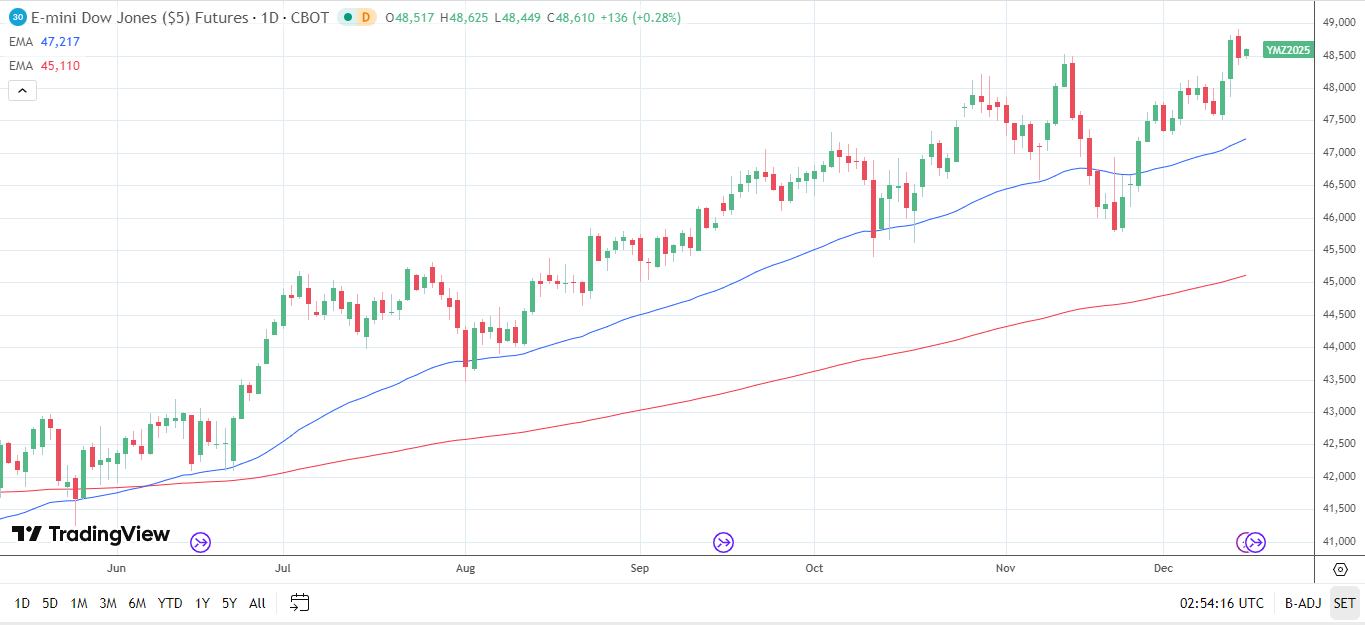
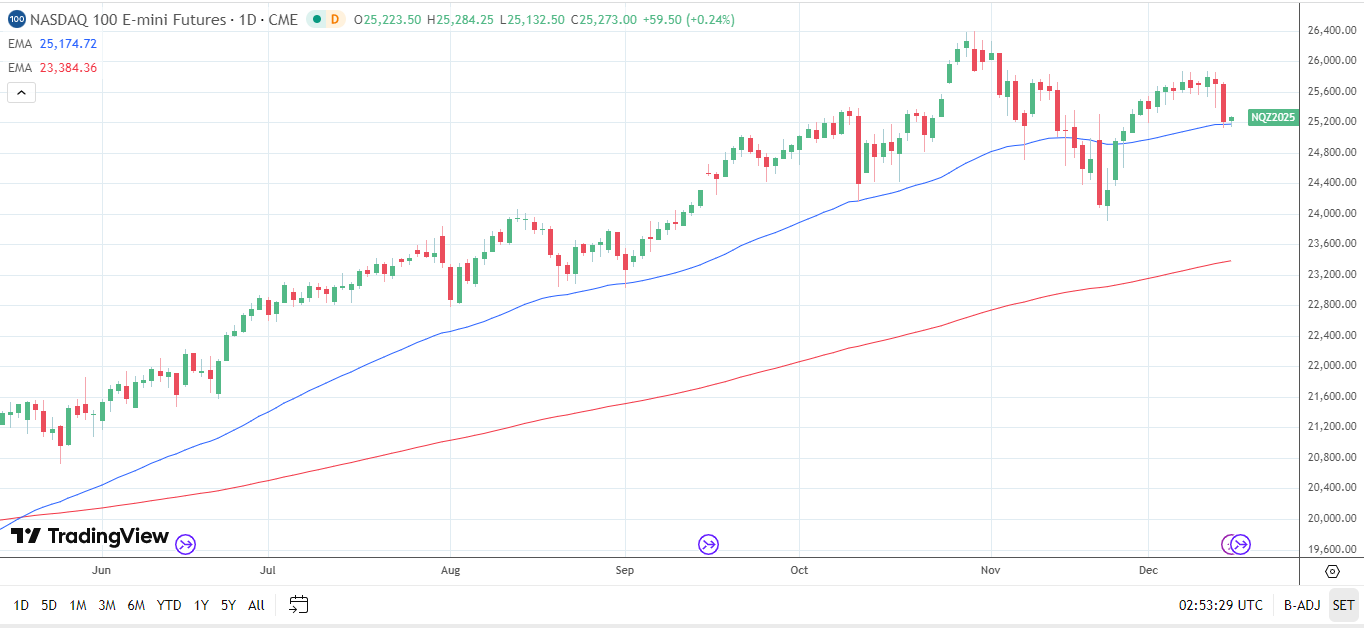
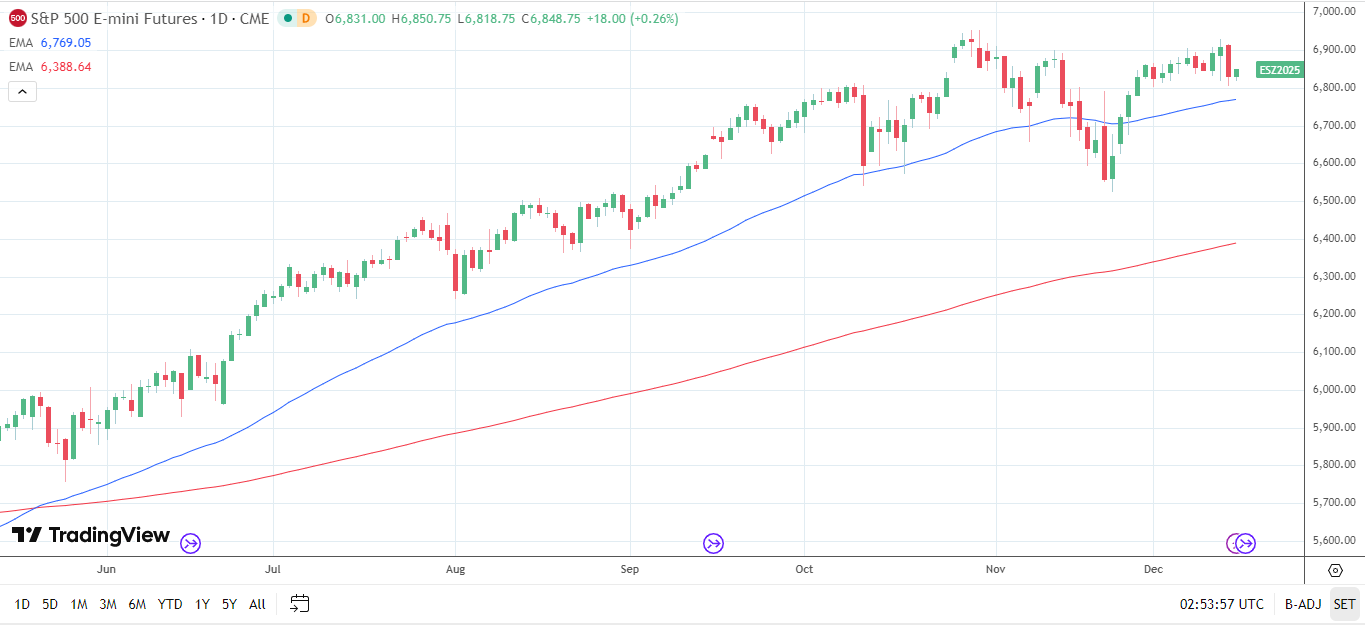
Futures posted gains despite the weak Chinese data and rising JGB yields. The Dow Jones E-mini advanced 136 points, the Nasdaq 100 E-mini gained 60 points, while the S&P 500 E-mini climbed 18 points.
Later on Monday, FOMC members will influence risk sentiment as the dust settles from last week’s interest rate decision and the Fed’s dot plot. FOMC member Stephen Miran and New York Fed President John Williams are due to speak. Support for a March rate cut would likely lift sentiment, supporting the bullish short- to medium-term outlook for US stock futures.
Notably, NY Fed President Williams reignited bets on last week’s rate cut on Friday, November 21, triggering a market rebound from September lows.
According to the CME FedWatch Tool, the chances of a March Fed rate cut increased from 46.5% on Friday, December 5, to 49.5% on December 12. Dovish rhetoric would support a recovery of Friday’s losses, bringing 2025 highs into view.
Key Technical Levels for Dow Jones, Nasdaq 100, and S&P 500
Despite Friday’s sell-off and modest morning gains, the Dow Jones E-mini, the Nasdaq 100 E-mini, and the S&P 500 E-mini remained above their 50-day and 200-day EMAs, indicating a bullish bias.
Near-term trends will hinge on Fed rhetoric, 10-year US Treasury and JGB yields, USD/JPY trends, upcoming US data, and the BoJ interest rate decision. Key levels to monitor include:
Dow Jones
- Resistance: December 12 record high of 48,917, and then 49,000.
- Support: 48,750, 48,000, 47,500, and then the 50-day EMA (47,217).
Nasdaq 100
- Resistance: 25,500, 25,750, 26,000, and then the October 30 record high of 26,399.
- Support: the 50-day EMA (25,175), 24,500, and then 24,000.
S&P 500
- Resistance: the October 30 record high of 6,954, and then 7,000.
- Support: the 50-day EMA (6,769), 6,500, and then 6,250.
Short-Term and Medium-Term Outlook Hinges on the Fed and BoJ
In my opinion, the short- to medium-term outlook remains bullish despite the Fed’s single 2026 rate cut and hawkish BoJ policy stance. A 25-basis-point BoJ rate hike would narrow the US-Japan rate differential but still fuel yen carry trades, albeit with less profitability.
Several scenarios are likely to derail the bullish short- and medium-term outlook, including:
- Bank of Japan declares a 2% neutral rate, signaling multiple rate hikes and a sharply narrower US-Japan rate differential.
- Hawkish Fed chatter, supporting one 2026 rate cut.
- US jobs and inflation data temper bets on a March Fed rate cut.
Conclusion: Outlook Bullish
In summary, robust US economic data would boost demand for US equity futures. However, traders should closely monitor BoJ chatter, JGB yields, the USD/JPY, and the Nikkei 225 for intensifying yen carry trade unwind warning signals.
Key levels would include a USD/JPY drop to 150 and 10-year JGBs at 2%, an important level to watch. These sharp moves would likely trigger a Nikkei 225 sell-off, weighing on broader risk sentiment.
While 10-year JGB yields have eased back from last week’s highs, yields remain elevated, exposing US stock futures to unwind risk.
Follow our live coverage and consult the economic calendar for real-time market updates.