
US stock futures posted losses in early trading on Tuesday, January 20. Fears of a full-blown US-EU trade war weighed on sentiment for a second session.
On Saturday, January 17, President Trump announced tariffs on eight NATO members to pressure EU leaders into agreeing to the US acquiring Greenland. The threat triggered a flight to safety. The US President reiterated his intent to acquire Greenland in the interest of national security in the early hours of January 19.
Despite increased geopolitical tensions, strong US economic data, market expectations of upbeat AI-linked earnings, and bets on multiple Fed rate cuts support a bullish medium-term outlook for US stock futures.
Below, I’ll outline the key market drivers, the medium-term outlook, and the key technical levels traders should watch.

US President Trump Reiterates Intent to Acquire Greenland
On Monday, January 19, President Trump emphasized the importance of the US acquiring Greenland, stating:
“NATO has been telling Denmark, for 20 years, that you have to get the Russian threat away from Greenland. Unfortunately, Denmark has been unable to do anything about it. Now it is time, and it will be done!!!”
Trump’s determined statement suggests there may be no backing down on his tariff threat without the EU offering a compromise solution.
Crucially, the EU is likely to retaliate if a 10% tariff takes effect on February 1, which could potentially nullify the 2025 US-EU trade deal.
On Saturday, January 17, President Trump announced 10% tariffs on Denmark, Finland, Norway, Sweden, France, Germany, the Netherlands, and the UK. The tariffs take effect on February 1, if no agreement is reached, and rise to 25% on June 1.
Denmark has reportedly deployed more troops to Greenland following Trump’s tariff threat and comments on January 19. However, it remains to be seen whether this will be enough to placate a US President keen to take full control of the territory.
The threat of an all-out trade war exposes US companies to sanctions. According to The Guardian:
“EU leaders have threatened to deploy the bloc’s anti-coercion instrument (ACI) – widely known as the “big bazooka” – which was devised to give the EU more powerful tools to respond to political bullying and trade blackmail from another country.”
The ACI enables the EU to introduce trade sanctions, including export restrictions, end protections on intellectual property, and exclude companies from its internal market.
Crucially, US-EU trade developments will be pivotal for the cautiously bullish short-term and constructive medium-term outlook for US index futures.
Dow Jones Price Forecast
Every new Dow Jones analysis as it publishes, today's technical signal and key levels, live price — on one page.
See all Dow Jones forecastsUS Labor Market and Earnings in Focus
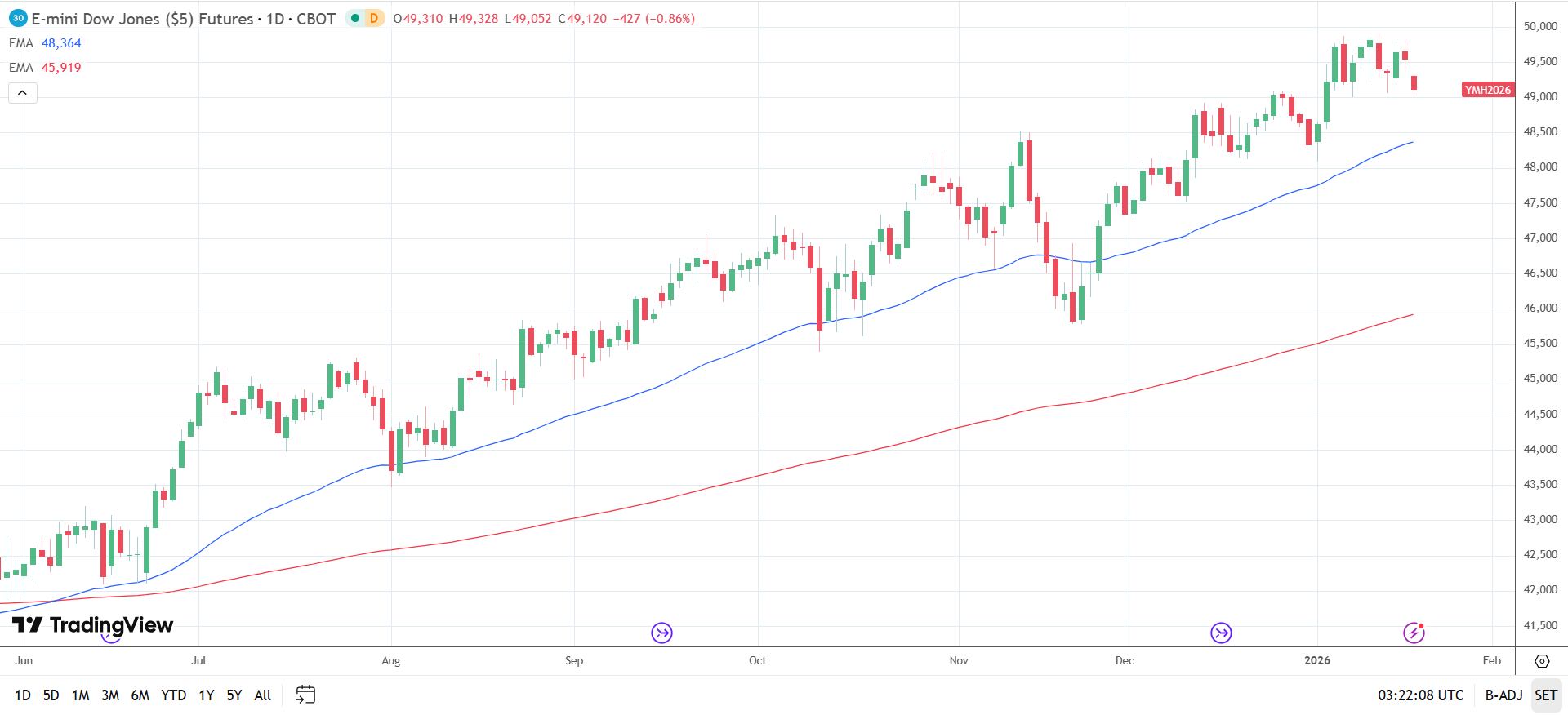
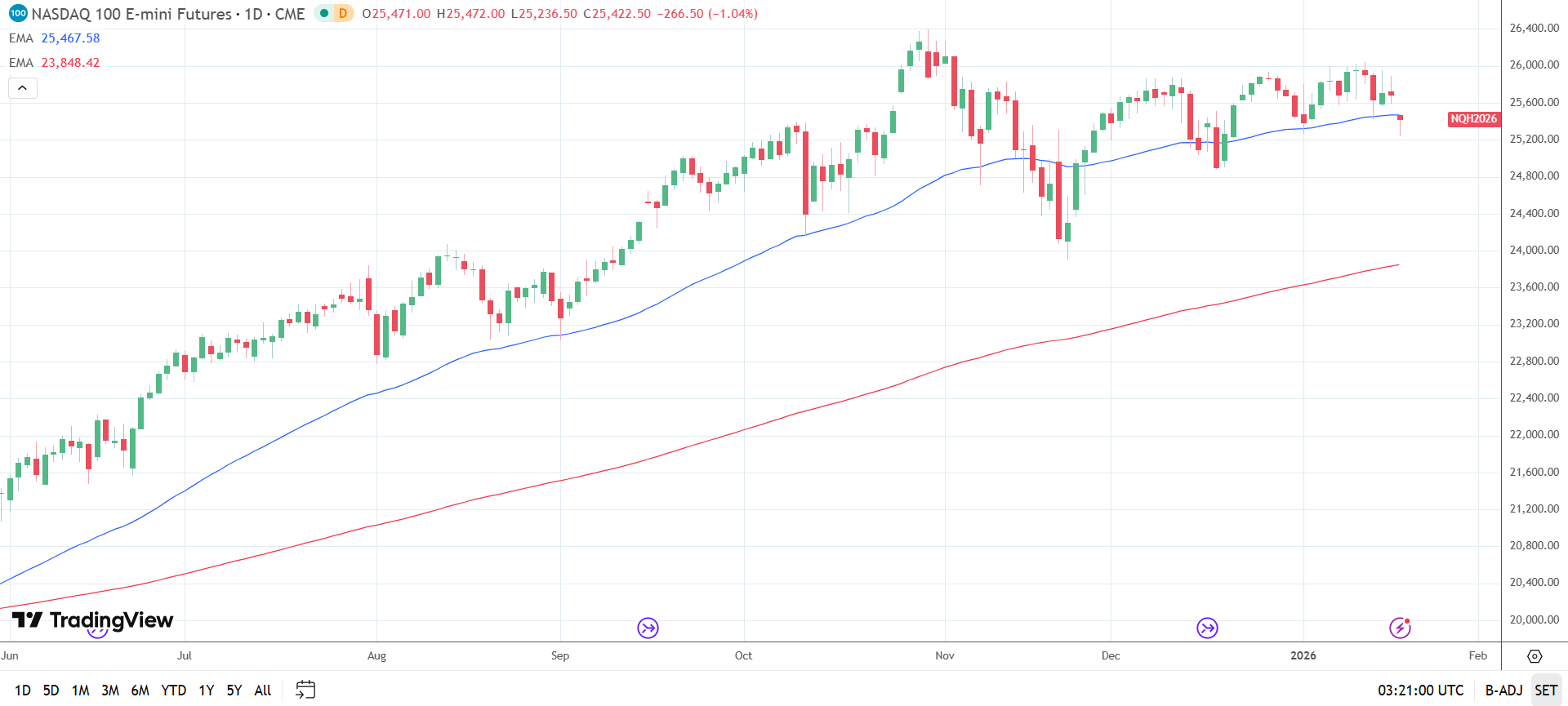
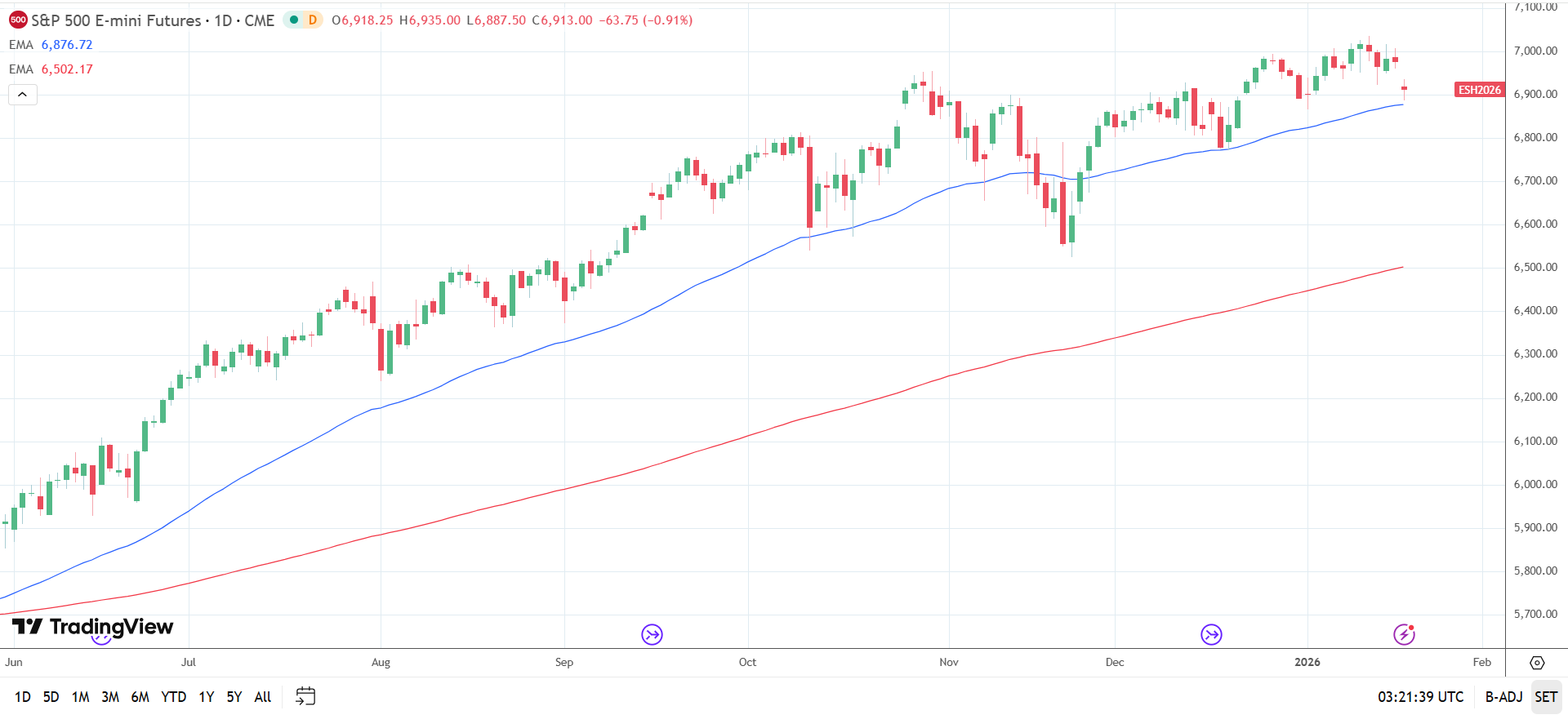
US futures fell sharply during the Asian morning session on January 20. The Dow Jones E-mini and the Nasdaq 100 E-mini tumbled 427 points and 267 points, respectively, while the S&P 500 E-mini fell 64 points.
Later Tuesday, US labor market data will influence sentiment toward the Fed rate path. The ADP’s weekly employment report will give insights into labor market conditions. Weaker data would likely boost demand for US stock futures.
However, earnings reports will likely be key for the session ahead. Netflix (NFLX) will release its Q4 earnings. Netflix’s updates on its plans to acquire Warner Bros. Discovery and the company’s outlook are likely focal points. Importantly, topping estimates would boost demand for tech stocks and align with optimism over Q4 earnings, key to the bullish short- to medium-term outlook.
Key Technical Levels for Dow Jones, Nasdaq 100, and S&P 500
Despite the morning losses, the Dow Jones E-mini and the S&P 500 E-mini remained above their 50-day and 200-day EMAs. The EMAs indicated a bullish bias, aligning with positive fundamentals. However, the Nasdaq 100 E-mini traded below its 50-day EMA, signaling a bearish near-term bias.
Near-term trends will hinge on US-EU trade headlines, earnings, and US economic indicators. Key levels to monitor include:
Dow Jones
- Resistance: the January 13 record high of 49,901, and then 50,000.
- Support: 49,000 followed by the 50-day EMA (48,364).
Nasdaq 100
- Resistance: the 50-day EMA (25,468), 26,000, followed by the October 30 record high of 26,399.
- Support: 25,000 and then 24,500.
S&P 500
- Resistance: the January 13 high of 7,036, followed by 7,500.
- Support: the 50-day EMA (6,877) and then 6,500.
US Stock Futures Outlook: Fed Rate Cut Bets and Earnings Keep Bullish Bias
In my opinion, the short-term price outlook remains cautiously bullish. Optimism over Q4 earnings and expectations of an H1 2026 Fed rate cut affirm the positive outlook. These fundamentals align with bullish technicals for the Dow and S&P 500, while offsetting the bearish near-term technicals for the Nasdaq.
However, several events would derail the bullish medium-term outlook, including:
- A full-blown EU-US trade war.
- The Bank of Japan announces a hawkish neutral interest rate (potentially 1.5%-2.5%). A narrower US-Japan rate differential may lead to a yen carry trade unwind, repeating the market sell-off in mid-2024, unraveling the short-term outlook.
- Upbeat US economic indicators and hawkish Fed rhetoric would cool bets on multiple Fed rate cuts.
- Corporate earnings and outlooks disappoint.
- If the US Supreme Court rules tariffs illegal, it will likely fuel concerns over US policy and debt.
Conclusion: Cautiously Bullish Bias
In summary, a resilient US economy, a dovish Fed rate path, upbeat sentiment toward earnings, and a cautious BoJ support a cautiously bullish short-term and a constructive medium-term outlook for US stock futures.
However, traders should closely monitor developments in US-EU trade. The threat of a retaliatory response by the EU and US warnings of countermeasures would weigh on risk assets.
Despite the risk of a trade war, hopes that the EU and the US will reach an agreement on Greenland will likely cushion the losses. US stock futures are likely to retarget new highs if US-EU trade tensions ease, earnings impress, and the Fed supports a rate cut.
Follow our live coverage and consult the economic calendar for real-time market updates.