US stock futures had a mixed start to the session on Wednesday, January 28. Markets shifted their attention to Fed Chair Powell’s press conference and key earnings results.
Market optimism over tech stock earnings has sent the Nasdaq 100 E-mini futures and the S&P 500 E-mini futures toward their all-time highs.
Despite the mixed morning, lingering bets on a Fed rate cut in H1 2026 and upbeat sentiment toward upcoming earnings support a bullish medium-term outlook for US index futures.
Below, I’ll outline the key market drivers, the medium-term outlook, and the technical levels traders should watch.

US President Trump Boosts Sentiment in Early Trading
The Asian markets reacted to President Trump’s overnight speech on January 28, driving demand for US stock futures.
Speaking at a highly anticipated rally in Iowa, President Trump hinted at sharply lower interest rates, stating:
“I will announce it soon! You will see rates come down a lot.”
The US President also triggered a US Dollar sell-off, sending the US Dollar Index to its lowest level since February 2022. When asked about the weaker US Dollar, Trump reportedly quipped:
“The Value of the Dollar is great.”
The Kobeissi Letter commented on President Trump’s reaction to the weaker US Dollar, stating:
Dow Jones Price Forecast
Every new Dow Jones analysis as it publishes, today's technical signal and key levels, live price — on one page.
See all Dow Jones forecasts“It’s a clear signal that President Trump is willing to tolerate a weaker Dollar to push rates lower and boost US exports.”
Earnings and Fed Chair Powell Take Center Stage
US futures saw a mixed Asian session on January 28. The Dow Jones E-mini was flat, while the Nasdaq 100 E-mini and the S&P 500 E-mini advanced 144 points and 18 points, respectively. Market bets on the Mag-7 topping earnings estimates boosted demand for tech stocks listed on the Nasdaq and S&P 500.
Later on Wednesday, the Fed interest rate decision and Fed Chair Powell’s press conference are the main events on the economic calendar. Hints at an H1 2026 rate cut would likely fuel demand for risk assets. A more dovish Fed rate path would support the bullish short- to medium-term outlook for US equity futures.
According to the CME FedWatch Tool, the probability of a June Fed rate cut has plunged from 83.4% on December 26 to 65% on January 27. Strong US labor market data and sticky inflation have curbed bets on a June cut. However, Powell could change the narrative if he sees inflation cooling in the near term. Uncertainty about Powell’s policy outlook may induce some market volatility in the lead-up to the press conference.
Meanwhile, the Magnificent Seven will also be under the spotlight as investors assess the outlook for AI-linked stocks. Meta (META), Microsoft (MSFT), and Tesla (TSLA) are on the earnings calendar. Strong earnings and positive outlooks would likely overshadow Fed Chair Powell’s press conference, sending the Nasdaq 100 and S&P 500 to new highs.
Key Technical Levels for Dow Jones, Nasdaq 100, and S&P 500
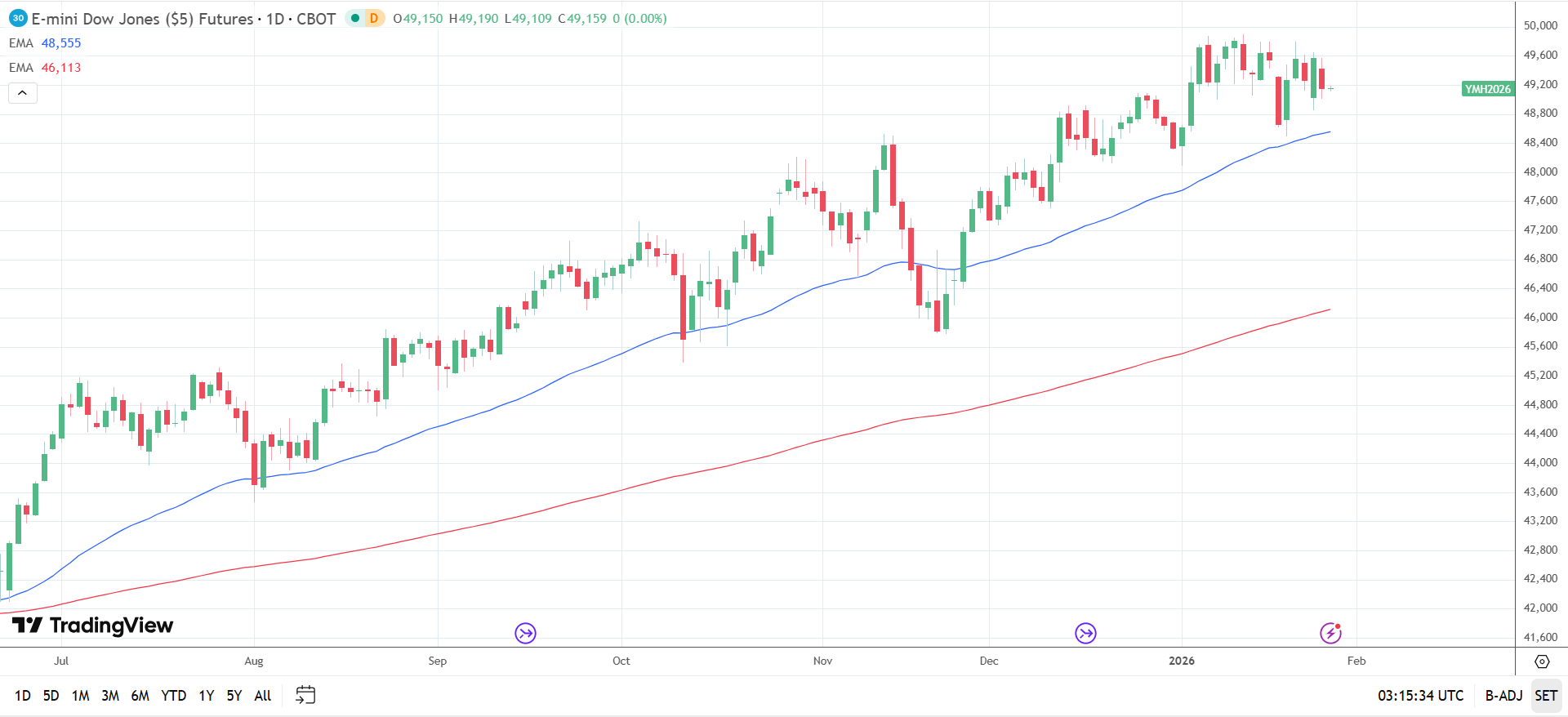
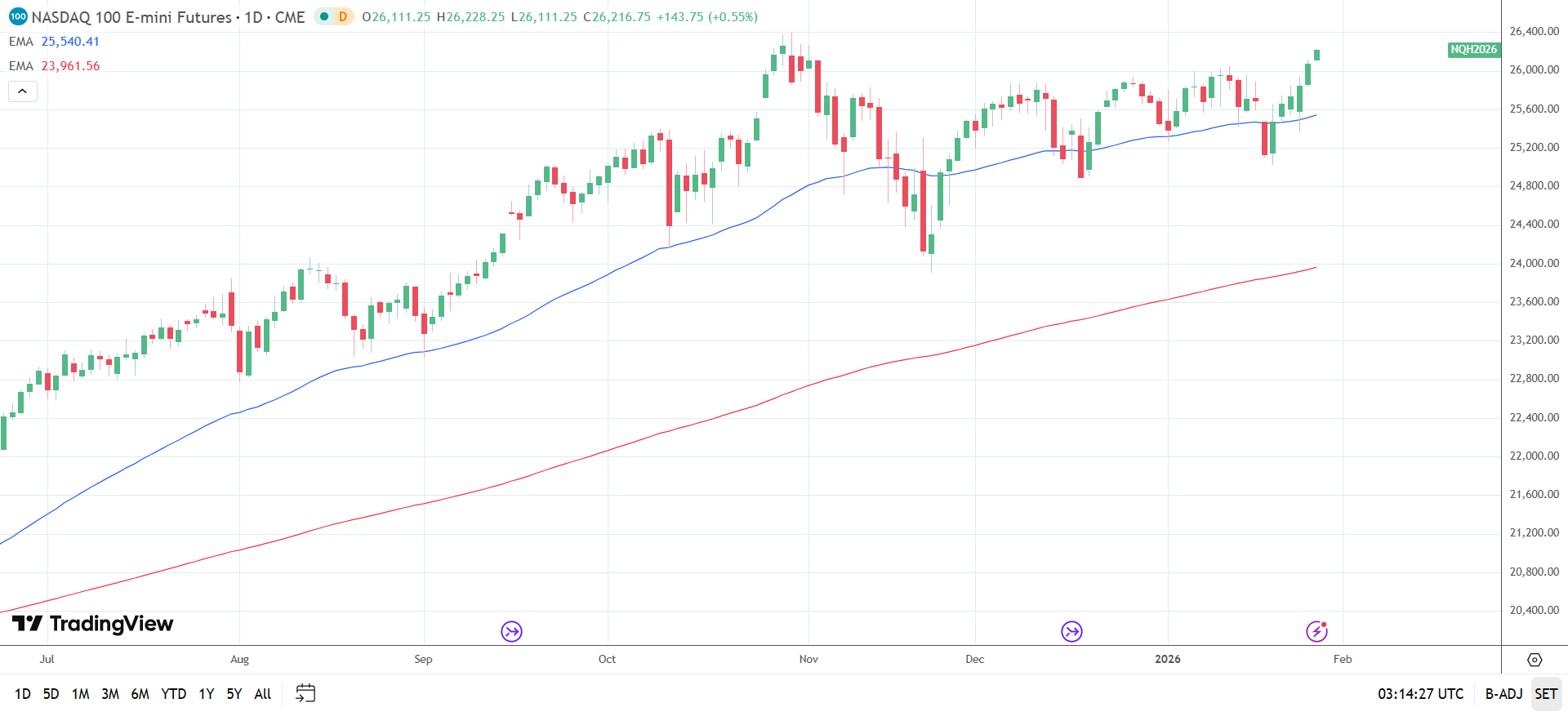
The steady morning session left the Dow Jones E-mini, the Nasdaq 100 E-mini, and the S&P 500 E-mini trading above their 50-day and 200-day EMAs. The EMAs indicated a bullish bias, aligning with favorable fundamentals.
Near-term trends will hinge on tariff headlines, earnings, Fed Chair Powell, and US economic indicators. Key levels to monitor include:
Dow Jones
- Resistance: the January 13 record high of 49,901, and then 50,000.
- Support: 49,000 followed by the 50-day EMA (48,555).
Nasdaq 100
- Resistance: the October 30 record high of 26,399.
- Support: the 50-day EMA (25,540), 25,000, and then 24,500.
S&P 500
- Resistance: the January 13 high of 7,036, followed by 7,500.
- Support: the 50-day EMA (6,895) and then 6,500.
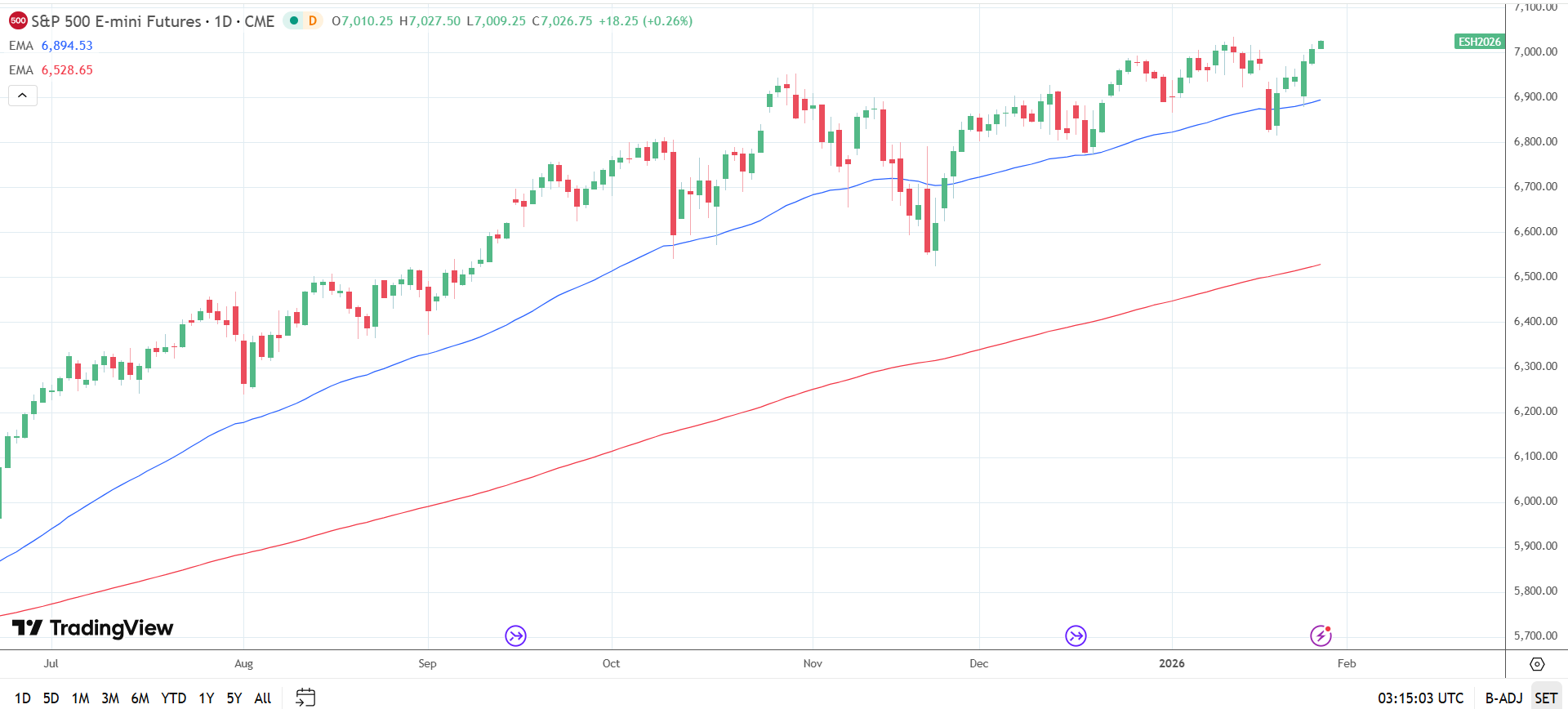
Outlook: Trump, Powell, and Earnings Support Bullish Outlook
In my opinion, the short-term price outlook remains bullish. Lingering bets on an H1 2026 Fed rate cut and market optimism over Q4 tech earnings reaffirm the bullish outlook. These bullish fundamentals align with technicals for US equity futures.
However, several events would challenge the bullish medium-term outlook, including:
- Rising geopolitical tensions.
- The Bank of Japan signals a higher neutral interest rate (potentially 1.5%-2.5%). A narrower-than-expected US-Japan rate differential may trigger an unwind of yen carry trades. Such an event would invalidate the short-term outlook.
- Fed Chair Powell sinks expectations of multiple Fed rate cuts in 2026.
- Corporate earnings and outlooks disappoint.
Conclusion: Bullish Outlook Intact
In summary, the robust US economy, a dovish Fed rate path, strong earnings, and a cautiously hawkish BoJ reaffirm a bullish short- and medium-term outlook for US stock futures.
However, traders should closely monitor BoJ chatter, yen intervention threats, and USD/JPY trends. Hawkish BoJ chatter, a dovish Fed Chair, and more intervention warnings could send USD/JPY sharply lower, potentially triggering an unwind of yen carry trades. USD/JPY rose 0.39% to 152.757, supporting US risk assets.
Despite risks of an unwind of yen carry trades, US stock futures remain on target to strike new all-time highs if US economic data raises expectations of a June Fed rate cut. Fed rate cuts are likely to have a more lasting effect on company earnings and equity valuations than narrowing US-Japan rate differentials on risk sentiment.
Follow our live coverage and consult the economic calendar for real-time market updates.