130k Jobs Added in January, but Revisions Tell a Different Story
We knew these revisions were coming, but not to the extent that the economy only added 181,000 jobs in 2025 – that equates to about 15,000 positions added per month on average.
At the headline level, 130,000 new payrolls were added to the economy in January, up from a paltry 50,000 jobs last December. Unemployment also ticked lower to 4.3% from 4.4%, while wage growth came in stronger than analysts had anticipated.
The large revisions help rationalise the lacklustre market reaction following the announcement. Take the USD/JPY, for example. We saw an initial pop higher with gains swiftly pared, reflecting the mixed data. US equity indexes actually ended the day largely flat – a notably muted reaction for what would typically be considered a strong jobs print.
Regarding job growth, health care alone accounted for 82,000 positions. This narrow breadth, along with disappointing US data in the lead-up to the jobs report, could also have been behind yesterday’s messy price action.

Fed Implications
Although the jobs report was essentially a tale of two halves, I believe it provides the Fed some breathing room to focus on the inflation side of its mandate for now, as price pressures remain above the central bank’s 2.0% target.
Friday’s January CPI report will be interesting; economists expect the MM readings to remain around 0.3%, above the 0.1-0.2% pace needed to meet the Fed’s target. Both headline and core YY measures are forecast to ease to 2.5% from 2.7% and 2.6%, respectively.
Prior to the announcement, June was fully priced in for the Fed’s first rate cut this year, though July is now in focus (-27 bps). As of writing, March is pretty much off the table (-3 bps), with April’s meeting equally doubtful (-6 bps).
Dow Jones Price Forecast
Every new Dow Jones analysis as it publishes, today's technical signal and key levels, live price — on one page.
See all Dow Jones forecastsMarket Snapshot and What’s Ahead
For Stocks, as I noted, US benchmarks were ultimately flat yesterday, though Asian equities continued to extend their gains overnight. South Korea’s KOSPI jumped 3.3% to refresh all-time highs of 5,522, with Australia’s ASX 200 also climbing 0.3% to 9,043. Japan’s Nikkei 225, however, ended flat, following strong gains this week after PM Sanae Takaichi’s landslide victory.
In the fixed-income space, US Treasury yields bear flattened, while in FX, the USD was flat, with the JPY continuing to outperform. The GBP barely moved in response to the December UK GDP numbers that landed at 7:00 am GMT today. Economic activity grew by a meagre 0.1%, up from back-to-back monthly contractions in October and November. Annual growth improved moderately in 2025 to 1.3% from 1.0% in 2024.
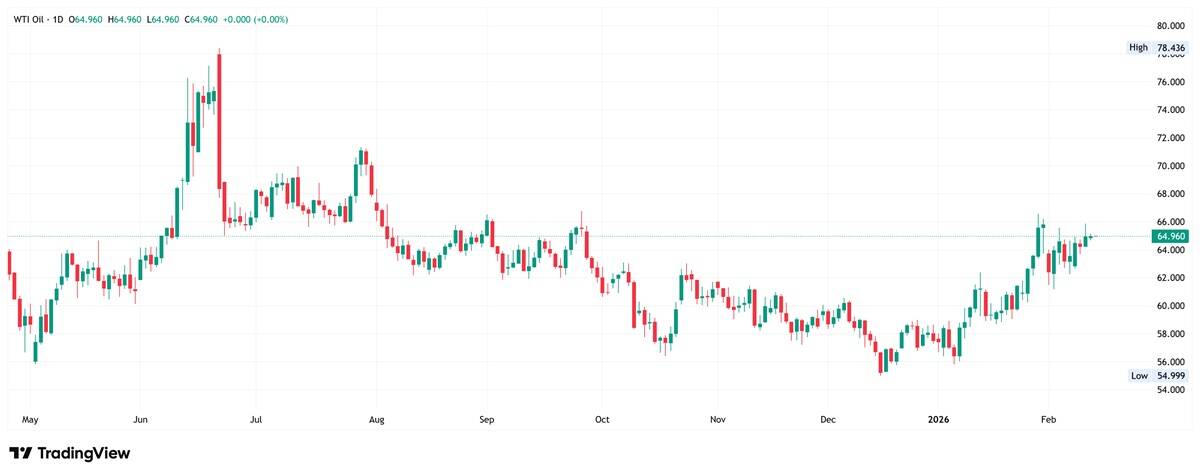
For commodities, Oil prices continue to attract bids amid Middle East tensions, whilst Spot Gold and Silver traded moderately higher. Technically, WTI Oil – thanks to a lacklustre response from daily resistance at US$66.02 – shows scope for further outperformance, per chart studies.
For the day ahead, with UK GDP numbers in the rearview mirror, traders will focus on US weekly jobless claims (week ending 7 February). Economists expect weekly claims to have eased to 222k, from 231k in the prior week. While this offers another pulse on the labour market’s momentum, I feel most of the focus will be on tomorrow’s US inflation release. If we see stronger inflation readings, this could further push out expectations for Fed rate cuts beyond July, as the combination of January jobs data and persistent inflation would considerably reduce the Fed’s urgency to lower rates – at least for now.
Written by FP Markets Chief Market Analyst Aaron Hill