



Market Overview
On Thursday, prices in the energy sector increased due to growing global political tensions, which eventually resulted in causing concerns about logistics problems. The WTI crude rose over 1% to about $65.01, while Brent traded near $69.00.
Oil prices continued to climb despite the fact that the U.S. crude inventories were on a rise by 8.5 million barrels to 428.8 million, which is far above the expected 793,000-barrel increase.
On the other hand, better-than-expected economic data from the US, including January’s unexpected labor market figures and a 4.3% unemployment rate, continues to support demand expectations.
That being said, the risk premiums are preventing prices from falling. Therefore, a move above $66 level is will likely given hiked regional tension. Alternatively, if the situation stabilizes, we may see prices falling toward $60 amid gains takings.
Natural Gas Price Forecast: NG Futures Slip Toward $3.00 as Fib Support Gets Tested
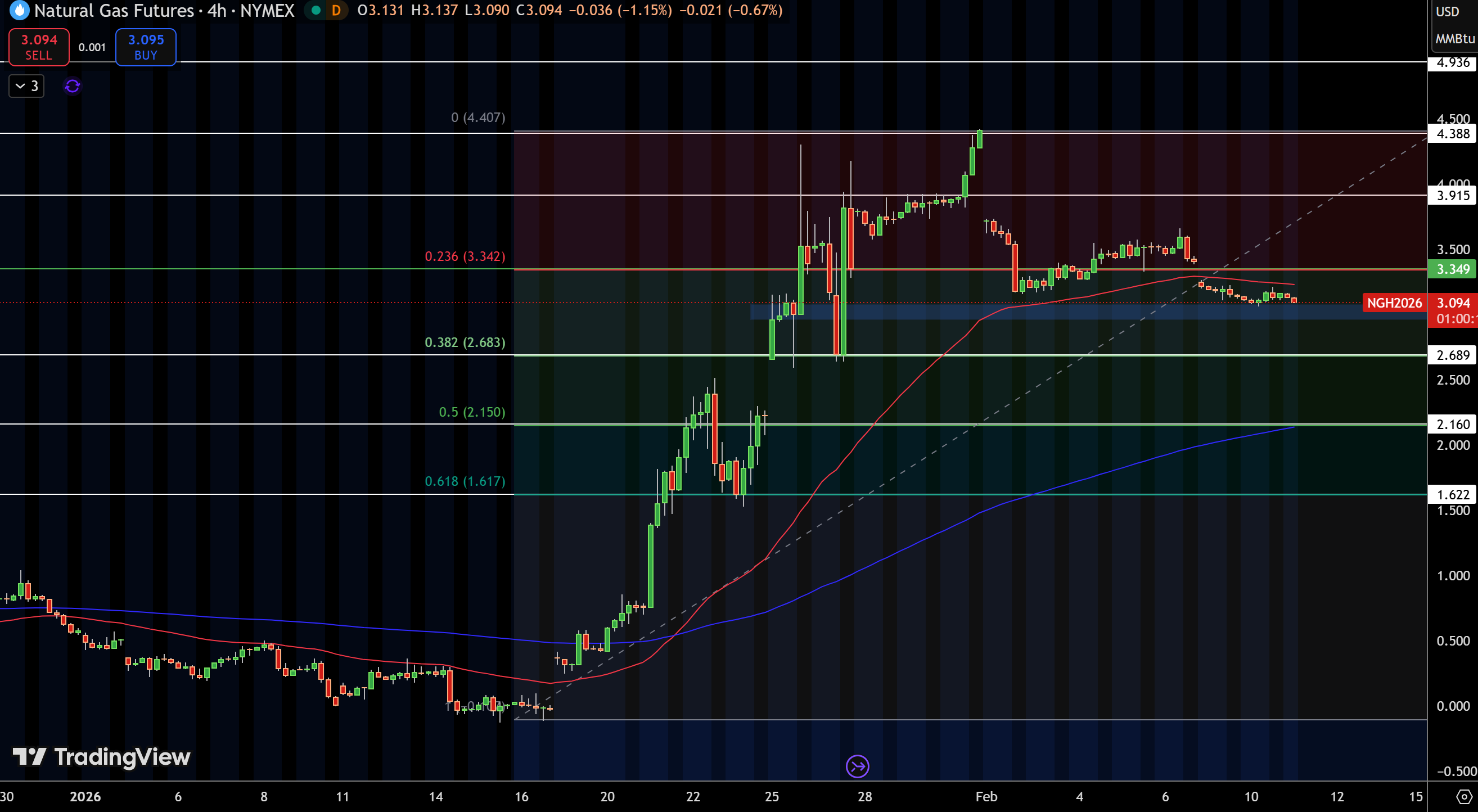
On the technical front, Natural Gas (NG) is trading in a narrow range after a sharp drop from its January highs. Taking a look at the 4-hour timeframe, NG’s price is steady near $3.19. It’s holding a key demand zone between $3.05 and $3.15.d $3.15.
The 50-period moving average, a lagging indicator, is being watched closely. Recent candlesticks show smaller bodies and shorter wicks, which suggests buyers are starting to absorb selling pressure.
With the RSI close to 45, momentum is steady to slow. The medium-term outlook stays guardedly optimistic if prices remain above the $3.05 support. If prices break above the $3.34 Fibonacci resistance at the 23.6% level, a rally toward $3.64 could follow.
Trade idea: Consider going long near $3.05, with a target of $3.64 and a stop loss below $2.90.
Natural Gas Price Forecast
Every new Natural Gas analysis as it publishes, today's technical signal and key levels, live price — on one page.
See all Natural Gas forecastsWTI Crude Oil Price Forecast: Bulls Battle Resistance in the 4H Channel
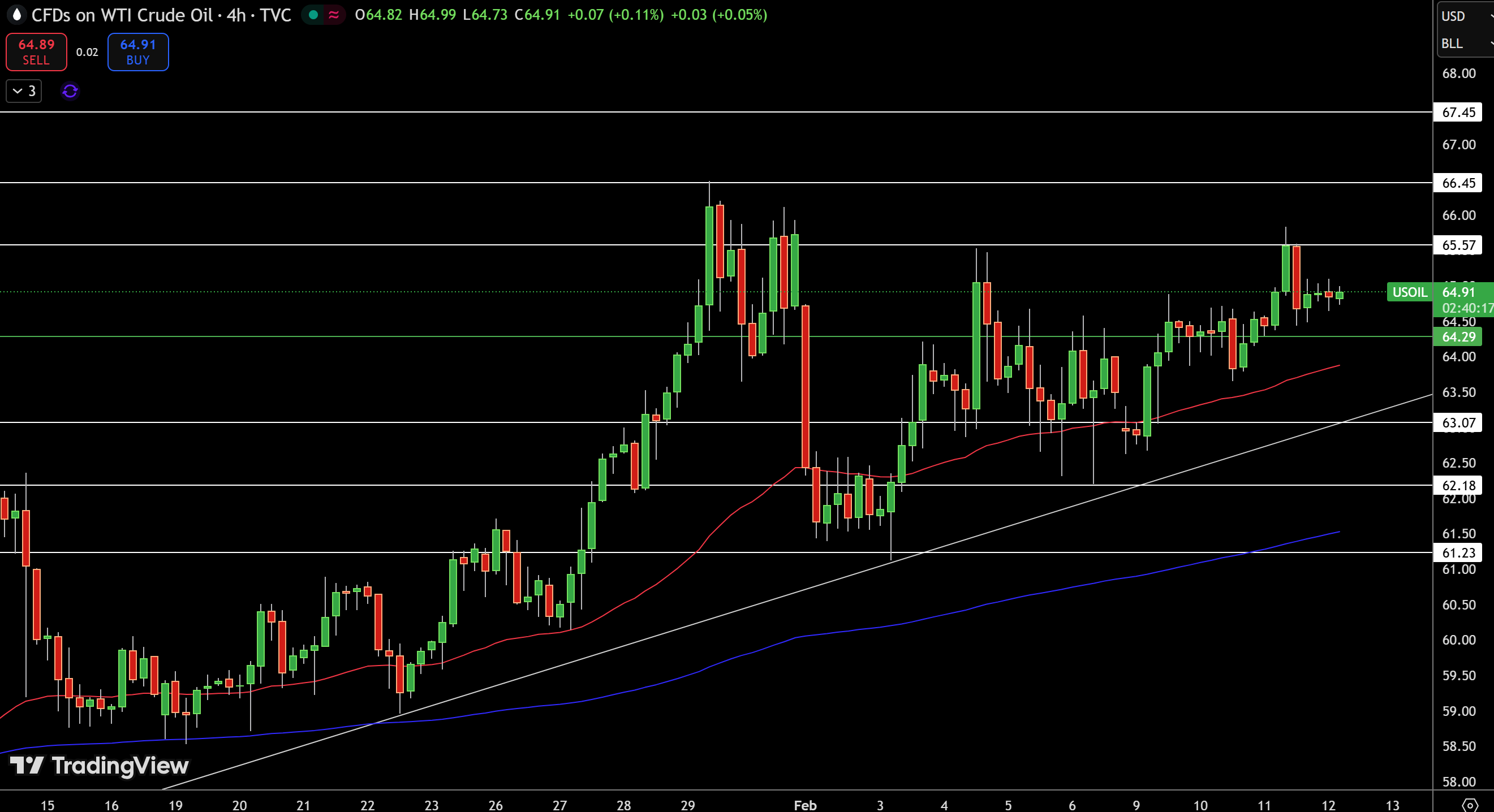
Taking a look at the WTI crude oil, it’s facing major resistance at $65 which is being extended by a key psychological barrier. After rebounding from the $62.20 support, prices have entered a steady upward channel along a clear bullish trendline.
The recent candlestick patterns near the peak show long upper wicks, indicating selling pressure and a possible “double top” near the $65.57 resistance.
Although the price is still above its moving averages, the absence of a clear breakout suggests a short-term consolidation. If support at $64.30 does not hold, prices may pull back toward the $63.00 area to fill the liquidity gap.
Trade idea: It’s worth considering to go long if price closes above $65.60, aiming for $67.45, and set a stop loss at $64.20.
Brent Crude Oil Forecast: UKOIL Holds $68.40 Support as Bulls Target $70.50
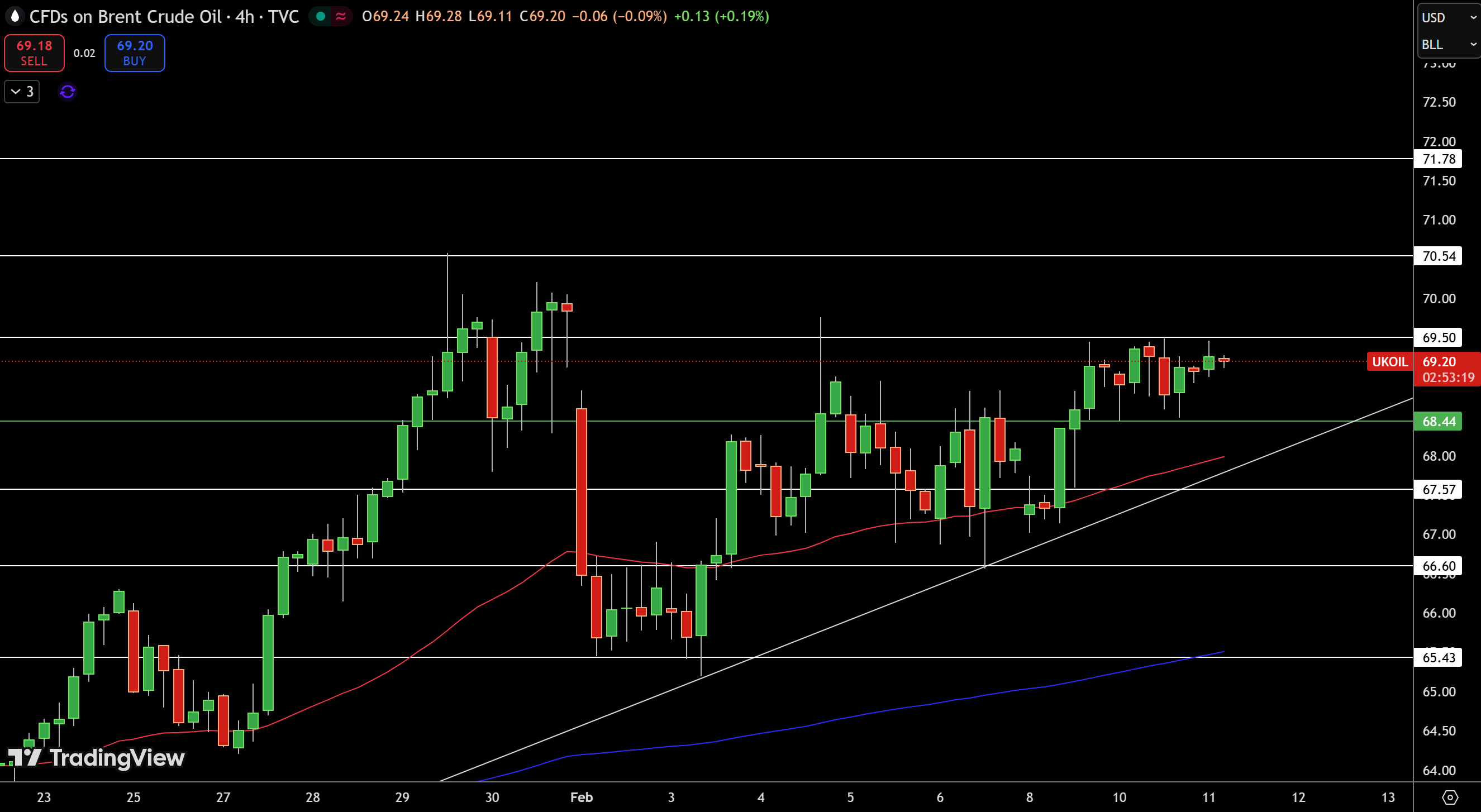
Just like USOIL, the Brent crude (UKOIL) is also facing solid resistance, and $70 is a trading level that is limiting its upside movement. The recent 4-hour candlestick chart is showing that prices failed to hold above $70.54 level. The UKOIL has formed a bearish reversal candle and it’s suggesting a short-term peak. This rejection matches the top of its current upward channel.
The overall price action in UKOIL is supported by a solid trendline from late January. However, with $69.26 acting as a major support, the market seems to be losing some of its bullish momentum. If UKOIL drops below this mark, it could head toward the $68.09 support level. Alternatively, holding above the trendline is important for any move toward the $71.67 resistance mark.
Trade Idea: It’s worth considering to go short if price breaks below $69.20, target $67.04, and set a stop loss at $70.60.