Thursday was another green session for US equities, with investors continuing to look through the fog of the Middle East conflict and pricing in the possibility that a resolution may be in sight. Of course, they could be wrong, and most of this will hinge on how subsequent negotiations unfold.
The US-Iran Conflict: Carefully Optimistic
It is an interesting situation; on one side of the fence, we have President Trump repeatedly saying the US is winning the war. At the same time, the Iranian regime has been equally emphatic in touting similar successes. Neither position lends itself to easy verification, all the while the Strait of Hormuz remains shuttered with oil prices elevated.
Trump also made headlines recently when he declared the war was going ‘swimmingly’ and stated that it should be over soon. Unsurprisingly, he was light on specifics, but the comments carried enough weight for risk assets to catch a bid. Trump’s confirmation that a 10-day ceasefire between Israel and Lebanon provided additional fuel for bulls, aided by his suggestion that a further round of direct US-Iran negotiations is on the table.
Markets: All-time Highs for Equities
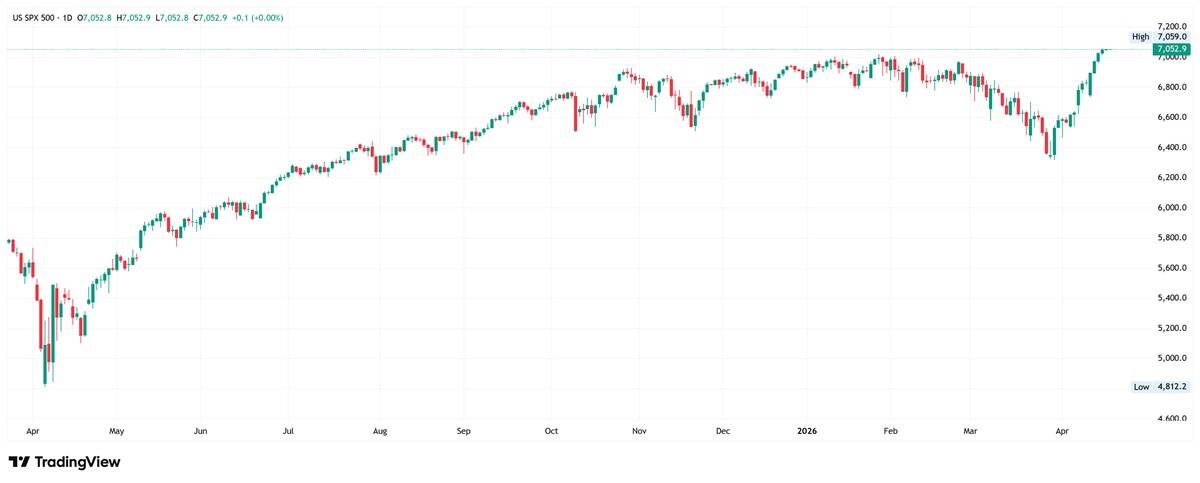
The S&P 500 penciled in its 11th gain out of 12 sessions yesterday, reaching an all-time high of 7,051, along with the Nasdaq 100 printing its 12th consecutive gain to refresh a record high of 26,400 – a run I believe we have not seen in nearly a decade. Netflix (NFLX) earnings also landed yesterday after the closing bell. While headline numbers came in strong, the company’s Q2 26 forward guidance did the damage, sending the stock down nearly 10%.
In the commodities complex, Brent is testing space just south of the widely watched US$100/barrel, following a rebound from a low of US$94 on Wednesday, while WTI has just elbowed south of US$90. Gold, meanwhile, held near record territory at US$4,793, buoyed by expectations that any durable peace deal would open the door to Fed rate cuts further down the line.
Brent Oil Price Forecast
Every new Brent Oil analysis as it publishes, today's technical signal and key levels, live price — on one page.
See all Brent Oil forecastsIn the fixed-income space, US Treasury yields bear steepened, with the benchmark 10-year yield rising for a second consecutive session to 4.317%. I think most of this is down to inflation concerns; however, while price pressures are undoubtedly a key driver, growth fears also remain a worry, which tends to be negative for yields.
Macro: ECB Minutes and Upcoming Fed Speak
The ECB minutes made the airwaves on Thursday, reaffirming pretty much what we already know: despite money markets discounting at least two rate hikes this year, President Lagarde and Co are not in any rush to move just yet. Nevertheless, the minutes did show that the central bank is focused on upside inflation risks, while also closely watching downside risks to growth.
April’s policy meeting has been largely priced for a no-change decision, while June could very well be in play. However, this would be conditional on inflation jumping higher, particularly on the core front. For now, I am still bullish the EUR and bearish the USD.
While economic data is thin today, San Francisco Fed President Mary Daly will take the stage for a moderated discussion on the US economy at UC Berkeley, alongside Richmond Fed’s Thomas Barkin, who will address a business leadership event in Charleston. Governor Christopher Waller will also deliver the Kaserman Memorial Lecture at Auburn University on the economic outlook.
Written by FP Markets Chief Market Analyst Aaron Hill