While major US equity benchmarks chalked up sizeable gains yesterday – sending the S&P 500 up nearly 3% and the Nasdaq around 3.5%, and pulling itself out of correction territory – it was a red month overall.
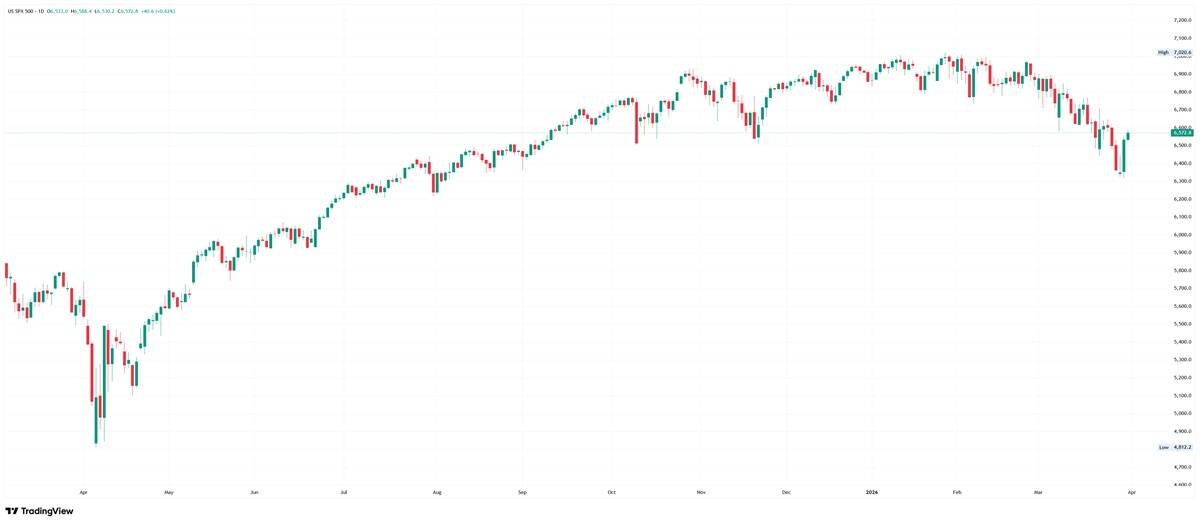
It was a similar picture overnight in Asia, with Japan’s Nikkei 225 jumping over 5% and South Korea’s KOSPI rallying around 9%. European markets are also higher across the board this morning.
One Comment and One Big Rally
The euphoric rally came about on the back of President Trump’s recent comment regarding a two-to-three-week exit from Iran when speaking to reporters at the White House. Importantly, though, he added that reopening the Strait of Hormuz is not the US’s responsibility.
Oil is lower on the news, seemingly catching up this morning, as both Brent and WTI are trading back under US$100/barrel, while spot gold is up around 1%, following a notable 3.5% rally yesterday.
US Treasury yields have continued to fall across the curve, with bonds focused on growth risks, and yields are responding accordingly. The USD index is also printing moves lower, penciling in a textbook bearish engulfing candle yesterday. But overall, we are somewhat muted in the FX space right now.
Off to the Races?
Are the markets too optimistic, or are we simply seeing a short squeeze?
Brent Oil Price Forecast
Every new Brent Oil analysis as it publishes, today's technical signal and key levels, live price — on one page.
See all Brent Oil forecastsFor now, I believe a short squeeze is the case; while optimism is the word of the day, Trump’s comments were spontaneous, and I have yet to see a definite timeline. Nonetheless, the positive aspect is that Iran is openly signaling a willingness to engage in talks, though its demands are still unclear. Time will tell. Personally, I remain sceptical at this stage, as just a few comments could lead to a significant shift in risk sentiment. As a result, we are still very much in a headline-driven market.
For this risk rally to be sustained, credible de-escalation and the reopening of the Strait of Hormuz are needed. Evidently, the longer the Strait is closed, the more damaging this is to growth.
White House Press Secretary Karoline Leavitt took to social media yesterday and wrote that Trump will address the nation to ‘provide an important update on Iran’ at 9:00 pm ET. In the absence of a credible timeline for leaving Iran or information about the Strait, the rally is shaky.
Day Ahead: Data Will Struggle to Compete with Geopolitics
Yesterday’s data added to the picture of an economy under strain. The US March consumer confidence beat expectations at 91.8, but the forward-looking component fell to a level historically associated with recession risk, and inflation expectations surged. The February US JOLTS report also showed that the February hiring rate dropped to 3.1% – the weakest outside the pandemic since 2011 – and predated the full economic impact of the Hormuz closure.
In Europe, the March eurozone CPI jumped to 2.5% from 1.9%, driven almost entirely by the energy shock, complicating the ECB’s calculus ahead of its April meeting.
Today’s calendar will struggle to compete with Trump’s Washington address, but these three releases deserve attention:
- US ADP non-farm employment change for March at 12:15 pm GMT
Expected: 42,000; Previous: 63,000
- US MM retail sales data for February at 12:30 pm GMT
Expected: 0.4%; Previous: -0.2%
- US ISM manufacturing PMI for March at 2:00 pm GMT
Expected: 52.3; Previous: 52.4
Written by FP Markets Chief Market Analyst Aaron Hill