



Gulf Flare-up & Oil Rising
Overnight, the US carried out renewed strikes on Iran, reportedly hitting more than 80 targets. Washington has also withdrawn the waiver that had allowed Iranian oil to enter the global market. As you would expect, Tehran has described the attacks and the revocation of the waivers as breaches of the MoU.
Is it right to call this a ceasefire? Talks are reportedly continuing, though they are on hold this week in observance of the funeral week in Iran for the late supreme leader.
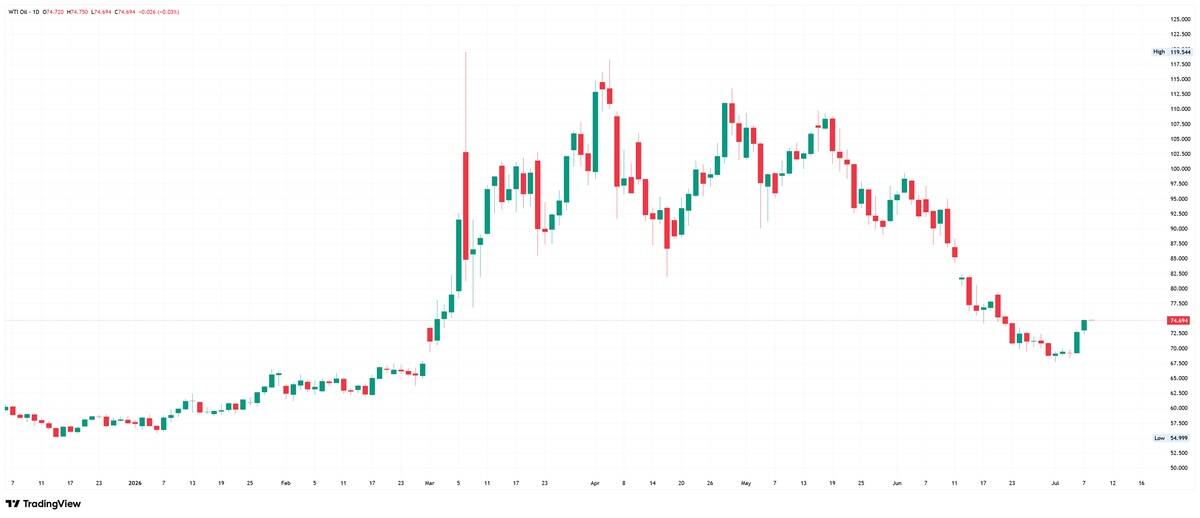
Unsurprisingly, oil benchmarks were heavily bid yesterday. Brent crude rallied 4.5% and is approaching the underside of its 200-day SMA at US$78.63, while WTI added 5.2% and is on the doorstep of its 200-day SMA at US$74.04. Both US 10-year and 5-year breakevens are also rising as markets reprice inflation expectations amid rising energy costs.

Asia Bears the Brunt: KOSPI in Bear Market Territory
In the equities space, Asia-Pac stocks were hit overnight; South Korea’s KOSPI is down more than 5% and now exhibiting a technical bear market (<20% from highs), which, of course, followed Samsung’s solid earnings report that failed to impress investors.
US cash trading on Tuesday saw major benchmarks end in the red, with the Philadelphia semiconductor index (SOX) erasing nearly 5% and closing in on June lows of 11,794. For US equity index futures this morning, we are seeing modest losses, but nothing to write home about.
Yields Rise Amid Inflation Concerns
For bonds, the flare-up in the Middle East was most evident in global yields, which rose as inflation concerns linger, keeping central banks on their toes. US Treasury yields bear flattened, with the 30-year yield crossing above 5%.
NZD Bid Following RBNZ Rate Hike
FX volatility remains relatively low; the USD index was modestly bid on Tuesday, though the greenback has pulled back this morning. Overnight, we also had an update from the RBNZ, which increased the OCR by 25 bps to 2.50%, as widely expected.
Brent Oil Price Forecast
Every new Brent Oil analysis as it publishes, today's technical signal and key levels, live price — on one page.
See all Brent Oil forecastsThe decision lifted the NZD against G10 peers, with the largest gains against the safe-haven CHF and JPY. Markets now imply a 65% chance of another rate hike at September’s meeting (+16 bps).
Fed Minutes on the Radar
With the RBNZ decision in the rear-view mirror, attention will shift to today’s June Fed meeting minutes. Given the Fed’s rate statement – or lack thereof – there could be changes in the minutes’ presentation.
The key will be decoding the hawkish shift at the latest meeting. Although the FFR was left unchanged at 3.50-3.75%, you will recall that we saw several changes. These included dropping forward guidance and shortening the rate statement, and removing its easing bias.
The SEP was also hawkish; 9 out of 18 Fed officials pencilled in at least one rate hike this year – Fed Chairman Kevin Warsh did not submit a dot. You may also recall that at his first press conference, Warsh introduced several task forces examining the Fed’s communication practices, its balance sheet, the collection of official data, and the framing of the inflation target itself.
What to Watch
I think the key today will be what the minutes reveal about internal consensus on further policy tightening and any timeline for Warsh’s recently announced task forces. Warsh has been clear about his approach to forward guidance, even saying that providing guidance is not the business the Fed should be in. As a result, I would not be surprised to see the paragraph that begins: ‘With regard to the outlook for monetary policy’ removed. It is usually around page 10.
The minutes should simply offer us a deeper look at how Warsh intends to run the show. However, if we see a heavy concentration of Fed officials favouring a rate hike – even with Warsh’s silence – this could push front-end yields higher and be positive for the USD.
Written by FP Markets Chief Market Analyst, Aaron Hill


