Equities Notch a Seventh Straight Day of Gains
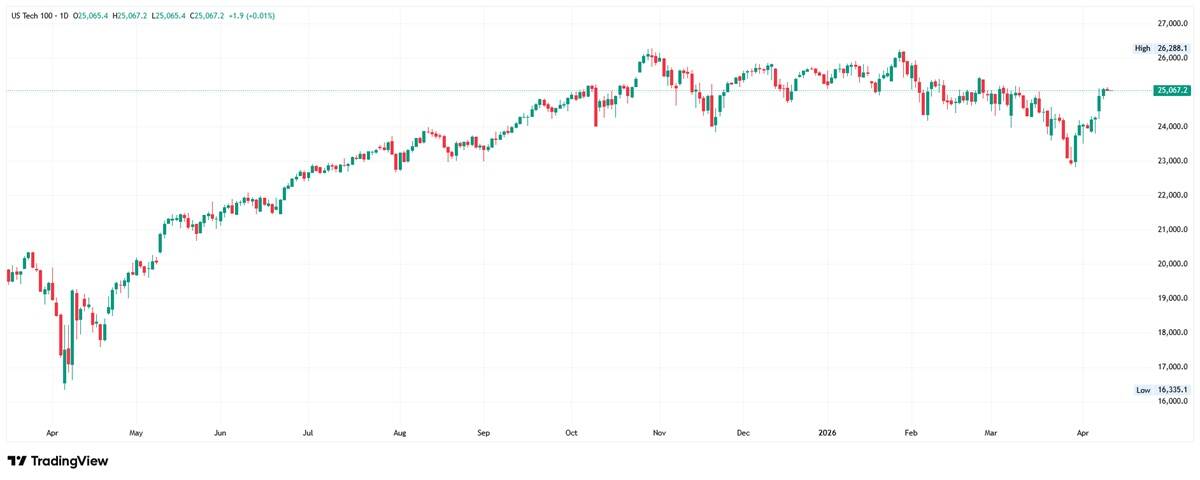
It was a seventh consecutive day of gains for the S&P 500 on Thursday, demonstrating that risk assets are clearly giving the two-week US-Iran ceasefire the benefit of the doubt. The market average added 0.6% to 6,824, with the Nasdaq 100 also up 0.7% to 25,082, and the Dow Jones closed higher by 0.6% to 48,185. Interestingly, all key benchmarks are now trading north of their 50-day SMAs. Asia-Pac markets were tentative, European equity markets opened higher as of writing, and US equity index futures are trading largely flat.
Oil prices remain volatile, swinging within a US$7 range for WTI, with buyers and sellers squaring off just south of US$100/barrel. Brent is in a similar position, tentative below US$100. Meanwhile, spot gold advanced, a move bolstered by USD weakness and ongoing geopolitical uncertainty.
In FX, as noted, the USD finished Thursday modestly lower by 0.2%, weighed down by the unwinding of haven longs. US Treasury yields were also largely unchanged by the close, despite a volatile range.
US-Iran Truce Showing Cracks
While the risk rally remains on track, the US-Iran ceasefire has not been smooth sailing. First and foremost, the Strait of Hormuz remains all but closed. Trump recently said Iran is doing a ‘poor job’ here, but I am not sure what that means, as he offered few specifics. Tehran, however, has insisted that any ship transiting the waterway must obtain prior approval, a demand the US has rejected. Adding to this fragility, Israel continues to strike Lebanon, though it is reportedly seeking direct talks with Beirut.
It is all about this weekend’s peace talks, led by US Vice President JD Vance, Special Envoy Steve Witcoff, and Special Peace Envoy Jared Kushner. Frankly, I think this will be a busy weekend, as the positions of the US and Iran are far apart heading into these talks. The event will likely focus on war reparations, Iranian control of the Strait of Hormuz, and the lifting of US sanctions.
Whether Iran genuinely wants to establish a new protocol for the Strait or is using this as economic leverage in these talks remains unclear at this point. Despite the market’s current optimism, I feel these talks could go either way. I will say this: if the Hormuz does not return to the way it was before and we do not see credible progress from these talks, there is a high chance that conflict could erupt again.
US PCE Inflation Around 3.0%
Yesterday saw the US February PCE inflation numbers land, coming in mostly as expected and essentially reaffirming that price pressures were running hot (and above the Fed’s 2.0% target) before the onset of the Middle East conflict. Headline YY PCE data remained at 2.8%, while YY core PCE modestly decelerated to 3.0% from 3.1% in January.
Brent Oil Price Forecast
Every new Brent Oil analysis as it publishes, today's technical signal and key levels, live price — on one page.
See all Brent Oil forecastsHowever, I found it interesting to hear what JPMorgan’s Bob Michele said on Bloomberg yesterday about the Fed’s 2.0% inflation target – he noted that it is ‘increasingly a myth’ and that the Fed is ‘tactically accepting a higher inflation rate as acceptable’. Michele added that even if inflation remains sticky, he does not see Fed rate hikes on the table.
Nevertheless, you may recall that the March Fed minutes revealed a growing cohort of policymakers who believe rate hikes may be necessary, though Fed funds futures point to no change this year, with only about -7 bps of easing discounted.
One Eye on US CPI Data Today
The US March CPI report makes the airwaves today at 12:30 pm GMT and will be widely watched, as it captures the first full month of war-driven energy price inflation. With energy prices expected to do most of the heavy lifting, economists expect a sizeable jump in both MM and YY measures. Headline MM forecasts point to a rise to 0.9% from 0.3% in February, while YY is anticipated to surge nearly a full percentage point to 3.3% – marking the highest reading since 2024. On the core front, YY is expected to rise to 2.7% from 2.5%, with a slight uptick in MM to 0.3% from 0.2%.
While a hotter CPI reading today could provide the USD with a short-term boost, I think the core measures, particularly over the long term, will be more important, especially for second-round effects. Additionally, it will be important to see how Fed speakers react to the inflation data – we have several officials scheduled to speak next week.
Have a wonderful weekend!
Written by FP Markets Chief Market Analyst Aaron Hill