Even as Tehran publicly rejected the 15-point peace plan, the White House has insisted that peace talks remain ongoing. These mixed messages and contradictions have made trading the markets challenging, to say the least.
On one side of the fence, we have messages of de-escalation, while on the other, military strikes suggest the opposite. Despite Iran’s claims that no talks are underway, President Trump stated that Tehran ‘desperately’ wants a deal. It seems it will be another day of watching the headlines and waiting for something more concrete to work with.
Stocks End in the Green, but Do Not Get Too Comfortable
Despite being off the day’s highs, major US Stock benchmarks were green across the board yesterday. The S&P 500 rejected the lower side of its 200-day SMA at 6,630, but gained 36 points (0.5%) to 6,591. Market breadth was positive, with 322 stocks ending to the upside, 180 to the downside, and 1 unchanged. At the sector level, 9 of the 11 ended on the front foot, with materials and healthcare leading the charge, while energy was the underperformer. The Nasdaq 100 added 160 points (0.7%) to 24,162, with the Dow Jones rising 305 points (0.7%) to 46,429.
We are four weeks into this war – one described as the largest oil disruption ever recorded by the IEA – and the Strait of Hormuz has been almost entirely impassable for most vessels. Gas station prices are rising, and strikes are ongoing, yet stocks rose earlier this week, and Brent Crude fell below US$100 per barrel. This happened because Iran – very briefly, I might add – was said to be reviewing the 15-point ‘ceasefire’ plan, which, as we know, has now been rejected. The US and Iran seem to be operating on different levels; I could be wrong, but it’s becoming increasingly clear that Trump is seeking an off-ramp that would not do too much damage to his ‘winning’ reputation.
Tehran issued its own counter-demands: reparations, a guarantee against further strikes, and, crucially, retention of sovereign control over Hormuz. As far as I am aware, the US has not formally responded to this.
Oil and Gold Are Caught Between Reality and Hope
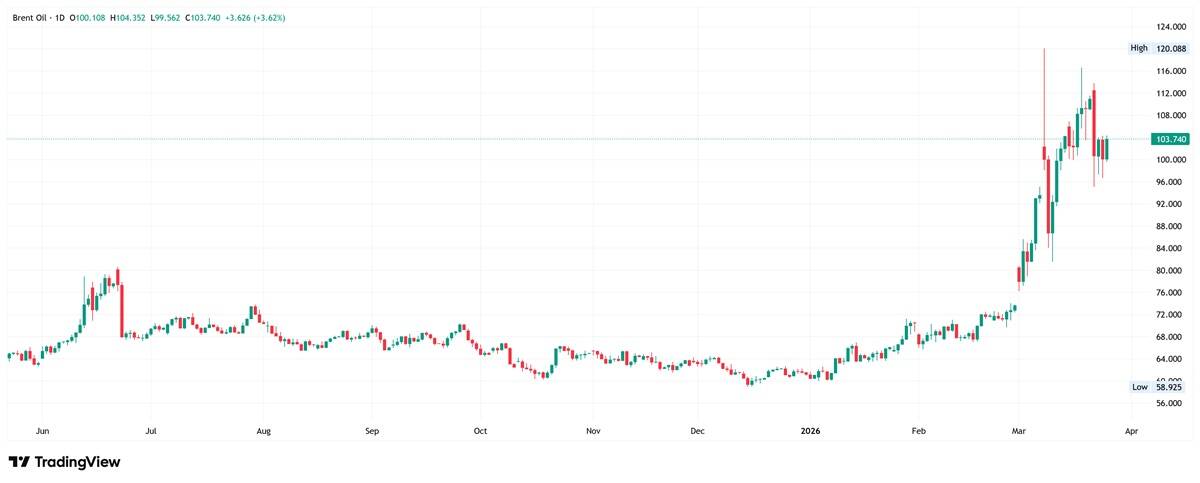
In the oil trade, Brent and WTI are higher this morning by 1.7% and 1.9%, respectively, with the former recently touching the US$100 mark. I believe most of this rise is due to the markets questioning the ‘ongoing talks’ claims from Trump. I know I keep saying this, but time will indeed tell here.
AUD/USD Price Forecast
Every new AUD/USD analysis as it publishes, today's technical signal and key levels, live price — on one page.
See all AUD/USD forecastsGold, considered a traditional safe-haven during times of uncertainty, rose over 1% yesterday, supported by easing inflation expectations amid falling oil prices. However, this morning, the yellow metal has reclaimed these gains, forming what could be a textbook bearish engulfing pattern on the daily chart.
The USD was positive on Wednesday, adding 0.5% and closing at session highs, suggesting scepticism around de-escalation talks. The EUR, GBP and AUD all lost ground, down 0.4%, 0.3%, and 0.7%, respectively.
Day Ahead: Jobless Claims and Fed Speak Eyed
The day ahead is pretty much thin on the macro front, with only US weekly jobless filings on deck at 12:30 pm GMT. Expectations heading into the event suggest a 5,000 increase to 210,000 for the week ending 21 March, from 205,000 the week prior.
Elsewhere, we have a volley of Fed officials taking the stage later today, including Governors Stephen Miran, Michael Barr, Philip Jefferson, Lorie Logan, and Lisa Cook. Traders will be listening for any shift in language around inflation, particularly about whether price pressures are temporary versus persistent.
Written by FP Markets Chief Market Analyst Aaron Hill