Reeves’ Budget: Front-Loaded Spending, Back-Loaded Taxes
As I alluded to in previous posts last week, the problem with the Budget is that the tax increases are back-loaded to the end of their Parliament (2029/30) – convenient. Unless I have missed something, I do not understand how this Budget helps break the UK’s fiscal issues. We not only have back-loaded tax rises but also front-loaded spending, which will naturally increase government borrowing in the short term.
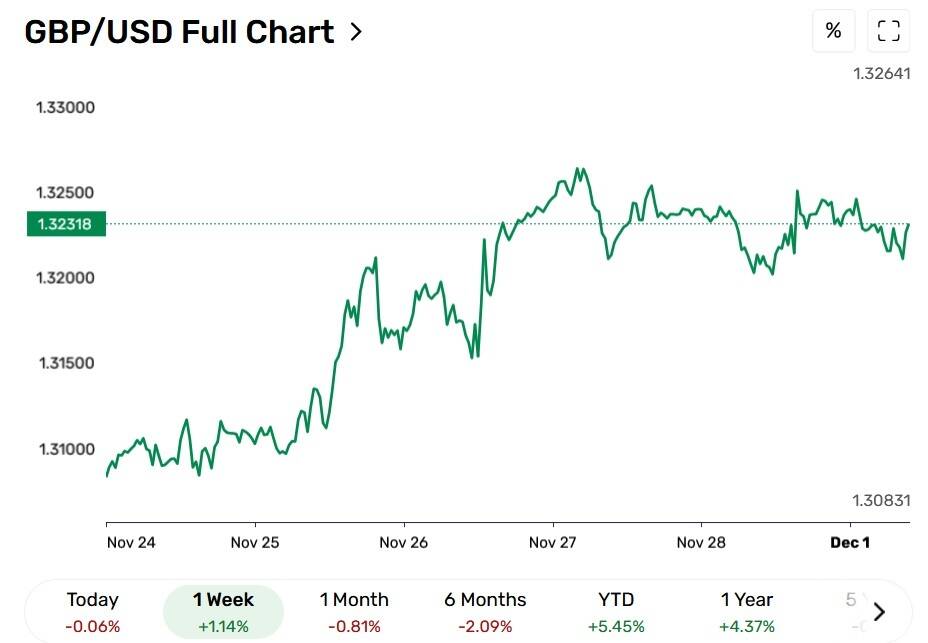
Markets reacted as you would expect. The GBP caught a bid, GILTs rallied, and yields took a dive. Let’s be frank, credibility remains a key theme. I think this Budget was more to do with keeping the Bond market on the government’s side, and the market reaction was more about relief than anything that radiated credibility. This, of course, was not helped by the OBR, which noted that GDP is expected to grow by 1.5% this year (from its previously forecast 1.0%), but downgraded its estimate for subsequent years until 2029.
In terms of where this leaves the BoE, the Budget has done little to change the central bank’s trajectory, in my view. In fact, markets now all but fully price in a 25-bp rate cut on 18 December. I believe this was helped by the Budget’s decision to reduce energy levies, which may ease inflationary pressures.
If you cast your mind back to the BoE rate announcement on 7 November, the MPC voted 5-4 in favour of holding the bank rate at 4.00%, with BoE Governor Andrew Bailey clearly leaning more towards the side of doves.
Regarding what I am watching on the GBP, short positioning is being unwound. However, in the medium term, I expect downside in front-end yields to weigh on demand for the pound, with traders continuing to buy dips in the EUR/GBP cross.

RBNZ Signals End to Easing Cycle with Hawkish Cut
Additionally, the RBNZ update was also an interesting event last week. As expected, the central bank delivered a 25-bp rate cut, bringing the OCR to 2.25% from 2.50%. Nevertheless, this was viewed as a hawkish cut, with the RBNZ essentially calling time on its easing cycle.
According to the accompanying rate statement’s minutes, the central bank’s decision was centred on whether to hold off or cut by 25 bps, not a decision about whether to cut between 25 or 50 bps as market pricing suggested before the announcement.
As I noted in a previous post, ‘optimism surrounding the inflation picture, growth, and the jobs market – as well as the updated rate path – suggests the easing cycle could be done and dusted following 325 bps of cuts since August last year’.
GBP/USD Price Forecast
Every new GBP/USD analysis as it publishes, today's technical signal and key levels, live price — on one page.
See all GBP/USD forecastsWeek Ahead: The USD and the Fed Are in Focus
The first full week of December is upon us.
Where has the year gone?
We have a relatively interesting dynamic playing out in the USD. On one side of the fence, markets are 80% confident that the Fed will pull the trigger on 10 December, cutting the target rate by 25 bps to 3.50% – 3.75%. However, on the other side, there is ongoing speculation about who will be Jerome Powell’s successor as Fed Chair. US Treasury Secretary Scott Bessent made the airwaves last week, announcing that US President Trump could select the new Chair before Christmas.
Candidates on the shortlist include serving Fed Governors Christopher Waller and Michelle Bowman, Kevin Hasset (NEC Director), former Fed Governor Kevin Warsh, and BlackRock’s head of fixed income, Larry Fink. There were speculative reports that Hasset could be in line for the top spot, which would make sense since he shares similar dovish views to Trump, which, once more, raises thorny questions about Fed independence. The news saw yields lower across the curve, and the USD Index closed south of the 200-day SMA.
Markets are not a fan of political meddling and can make investors nervous – the worry is that the Fed may make more politically charged decisions rather than ones based on the economy. An appointment of Hasset would be seen as largely controversial and dovish – so USD and yields may trade lower – while a Trump appointment of Waller or Bowman, who are both already on the Fed, would likely have a minimal market reaction, I believe.
With other major central banks seemingly nearing the end of their easing cycles, and with a new Fed Chair stepping in – one who will likely align with Trump’s desire to lower rates – this creates a notable headwind for the USD in 2026. Does that mean I would sell USD now? No. Personally, I prefer to wait for the data to validate this view and trade out from those events, though I know many traders successfully trade into event risk as well!
Key US Data: ISM, ADP Payrolls, and Delayed PCE in Focus
Monday kicks off with ISM manufacturing for November, expected to remain in contraction territory, followed by the November ADP private payrolls figures on Wednesday. The November ISM services index will also be released on Wednesday, with Thursday’s focus on weekly unemployment claims for the week ending 29 November. Friday brings the long-delayed September PCE inflation numbers, pushed back by the government shutdown.
Traders will be closely watching for signs of labour market softening this week, which would help seal the deal for a Fed rate cut later this month, and potentially open the door to shorting opportunities on the USD. The ISM surveys will be particularly important, as will weekly jobless claims data. Additionally, focus will be on the PCE inflation print, with YY headline expected to rise 2.8% from 2.7% in August, and the YY core measure forecast to remain unchanged at 2.9%. Naturally, an in-line or lower-than-expected outcome here would help solidify rate-cut expectations.
Written by FP Markets Chief Market Analyst Aaron Hill