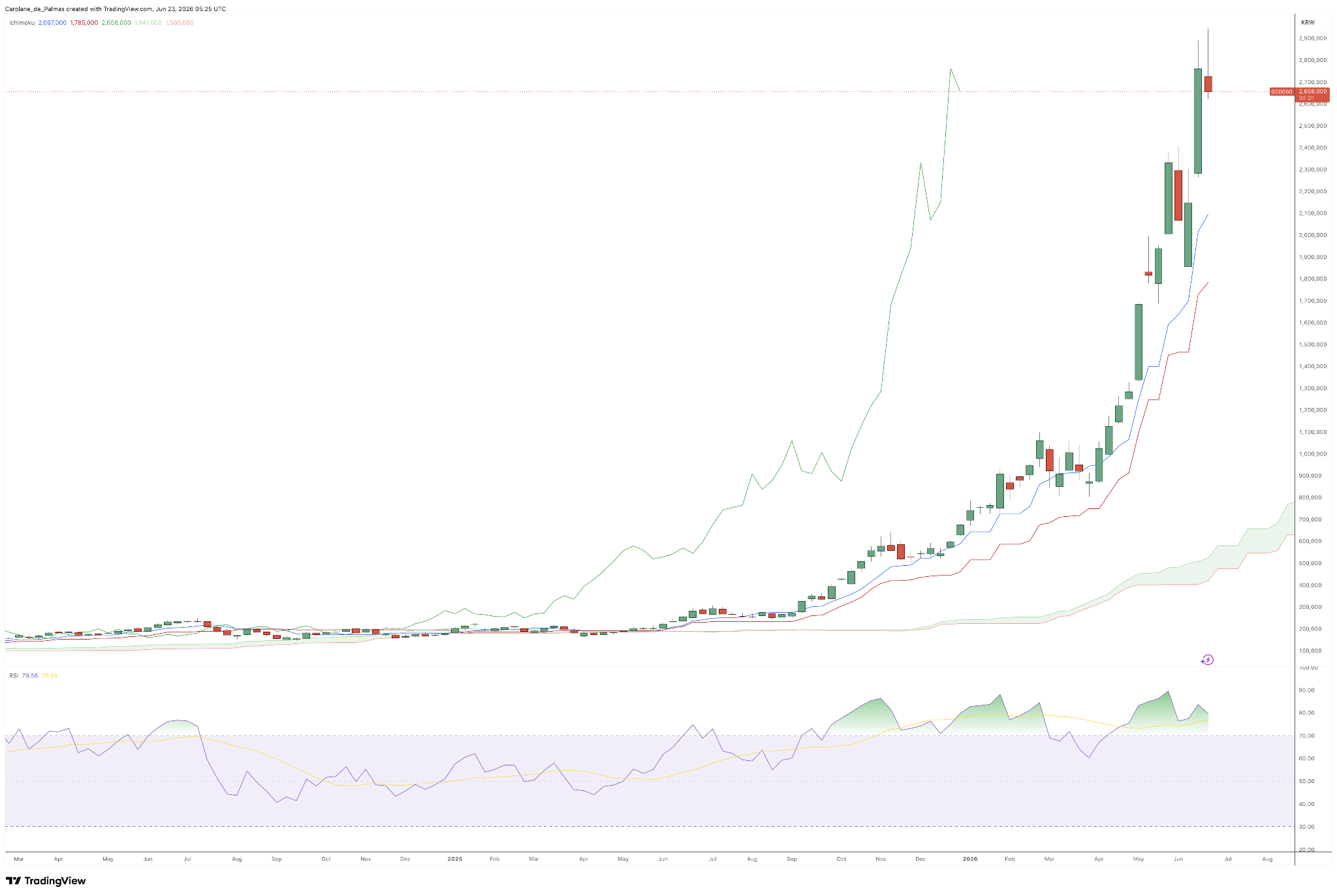
On Monday, SK Hynix surpassed its longtime rival by market capitalisation, closing with a value of 2,080.4 trillion won ($1.35 trillion) against Samsung’s 2,066.7 trillion won in common shares alone. The milestone capped a more than 300% rally in SK Hynix shares this year: a staggering ascent that reflects not just strong earnings, but a wholesale revaluation of what memory chips are worth in the age of artificial intelligence.
Samsung Pushes Back (And Has a Point)
The ranking, however, is not without controversy. Samsung Electronics was quick to dispute the narrative, arguing that any honest comparison must include preferred shares alongside common ones. When those are factored in — adding roughly 183 trillion won to Samsung’s tally — its total market capitalisation climbs to approximately 2,252 trillion won, comfortably ahead of SK Hynix. Preferred shares, while typically non-voting, represent genuine economic claims on the company and are widely included in total market cap calculations elsewhere in the world.
From Penny Stock to AI Powerhouse: A 20-Year Reversal for SK Hynix
To appreciate the magnitude of SK Hynix’s rise, one must go back to 2002, when the company (then known as Hynix Semiconductor) came within a hair’s breadth of ceasing to exist. Crushed under debt from an overambitious expansion drive, it was on the verge of being sold to U.S. rival Micron. That deal fell through, leaving Hynix under creditor control for nearly a decade and its shares trading as low as 135 won in 2003, earning it the Korean nickname “Dongjeon-ju” — penny stock.
What followed was a period defined by the memory industry’s notorious cyclicality. The depth of these swings was on full display in 2023, when a brutal pricing downturn wiped out margins and saddled SK Hynix with a 7.73 trillion won operating loss for the year.
Then the tide turned. AI investment by Microsoft, Google, Meta and others surged, demand for advanced memory exploded, and SK Hynix — which had continued quietly building its high-bandwidth memory (HBM) capabilities even through the downturn — found itself at the centre of the world’s most critical technology supply chain. Its annual operating profit more than doubled in 2025, reaching a record 47.2 trillion won, on revenues of 97.1 trillion won, up nearly 50% from the previous year.
Why SK Hynix Holds the Cards in the AI Memory Race
SK Hynix’s central role in the global AI ecosystem is not accidental. While competitors treated HBM as a niche product during leaner years, SK Hynix doubled down on the technology — a vertically stacked memory architecture that delivers dramatically faster throughput and lower power consumption than conventional DRAM. That early commitment gave it a decisive head start.
SK Hynix led the HBM market in mid-2025 with roughly 62% of global shipments, while Micron held 21% and Samsung trailed at 17%. Because HBM is tightly coupled with AI processors, it avoids the commodity price wars of standard memory. This deep architectural integration locks in customers and gives manufacturers strong pricing power. Counterpoint Research has described SK Hynix as “an outstanding AI winner in Asia,” crediting its lead in HBM supply and quality as having been decisive in the current phase of the AI infrastructure build-out.
That pricing power is already feeding through to the income statement. Memory shortages have pushed hyperscalers to accept significant price increases. With supply constraints unlikely to ease quickly with SK Hynix projecting a 30% annual growth rate for AI-specific memory chips through 2030, the firm’s pricing leverage looks durable.
SK Hynix Shares: Is There Still Room to Run?
For investors questioning whether the historic rally has run its course, the consensus among Wall Street analysts remains bullish.
Bernstein recently tripled its price target for SK Hynix to 3.3 million won from 1.15 million won. The firm notes that skyrocketing High Bandwidth Memory prices will force a major margin redistribution, closing the profitability gap between chip suppliers and the hyperscalers buying them.
Bank of America has crowned SK Hynix its top global memory pick at the beginning of 2026. The bank forecasts a staggering 51% surge in global DRAM revenue, framing the current landscape not as a typical upturn, but as a secular “supercycle” reminiscent of the explosive memory boom of the 1990s—only this time, driven by artificial intelligence rather than the dawn of the personal computer.
This financial optimism is backed by undisputed technological leadership. SK Hynix effectively locked in its first-mover advantage by shipping the world’s first 12-layer HBM4 samples, achieving full mass-production readiness ahead of schedule. This next-generation architecture is a critical piece of the global tech supply chain, specifically engineered to power Nvidia’s highly anticipated next-generation Vera Rubin AI architecture. By securing a near-monopoly on the ultra-premium specs required for tomorrow’s AI accelerators, SK Hynix has built a formidable moat that competitors are struggling to breach.
Beyond fundamentals, investors are also taking into consideration a structural catalys: Reuters reported that following a confidential SEC filing, SK Hynix is preparing for a landmark Nasdaq listing that could debut as early as August. This is a brilliant strategic maneuver. By listing in the U.S., the company steps out of the valuation discount often associated with the Korean exchange, allowing it to trade directly alongside peers like Micron.
More importantly, it re-anchors the stock in a market that values memory chips as scarce, strategic AI infrastructure rather than legacy, cyclical hardware. The listing also triggers a powerful passive liquidity wave: because index funds automatically mirror benchmarks rather than picking individual stocks, a Nasdaq debut will force massive, tech-heavy ETFs to automatically absorb SK Hynix shares into their portfolios.
However, extreme HBM pricing will inevitably squeeze the capital expenditure budgets of tech giants, potentially triggering a buyer pushback. Furthermore, Samsung is aggressively fighting back. Having begun shipments of its own competing HBM4 chips, the tech giant is poised to reclaim market share as its products clear rigorous customer qualifications.
Yet, the core paradigm shift is undeniable. Memory chips have evolved past the days when their fortunes fluctuated solely with smartphone and PC replacement cycles. Today, advanced memory is the literal bottleneck of artificial intelligence infrastructure. And until the laws of physics or computing change, no company in the world commands that bottleneck quite like SK Hynix.
Sources: Reuters, Counterpoint Research, The Wall Street Journal, Seoul Economic Daily, SK Hynix, Yahoo Finance