
Spot Gold Falls as Oil Pushes Inflation Risk Back to the Front
Spot Gold (XAUUSD) is down more than 1% Monday and the selling started the moment Trump called Iran’s latest peace proposal “totally unacceptable.” Spot Brent crude oil pushed back above $103 a barrel on that headline and the inflation trade came roaring back with it. Gold had a window last week when oil dropped and yields backed off. That window closed fast Monday morning.

Technical Outlook
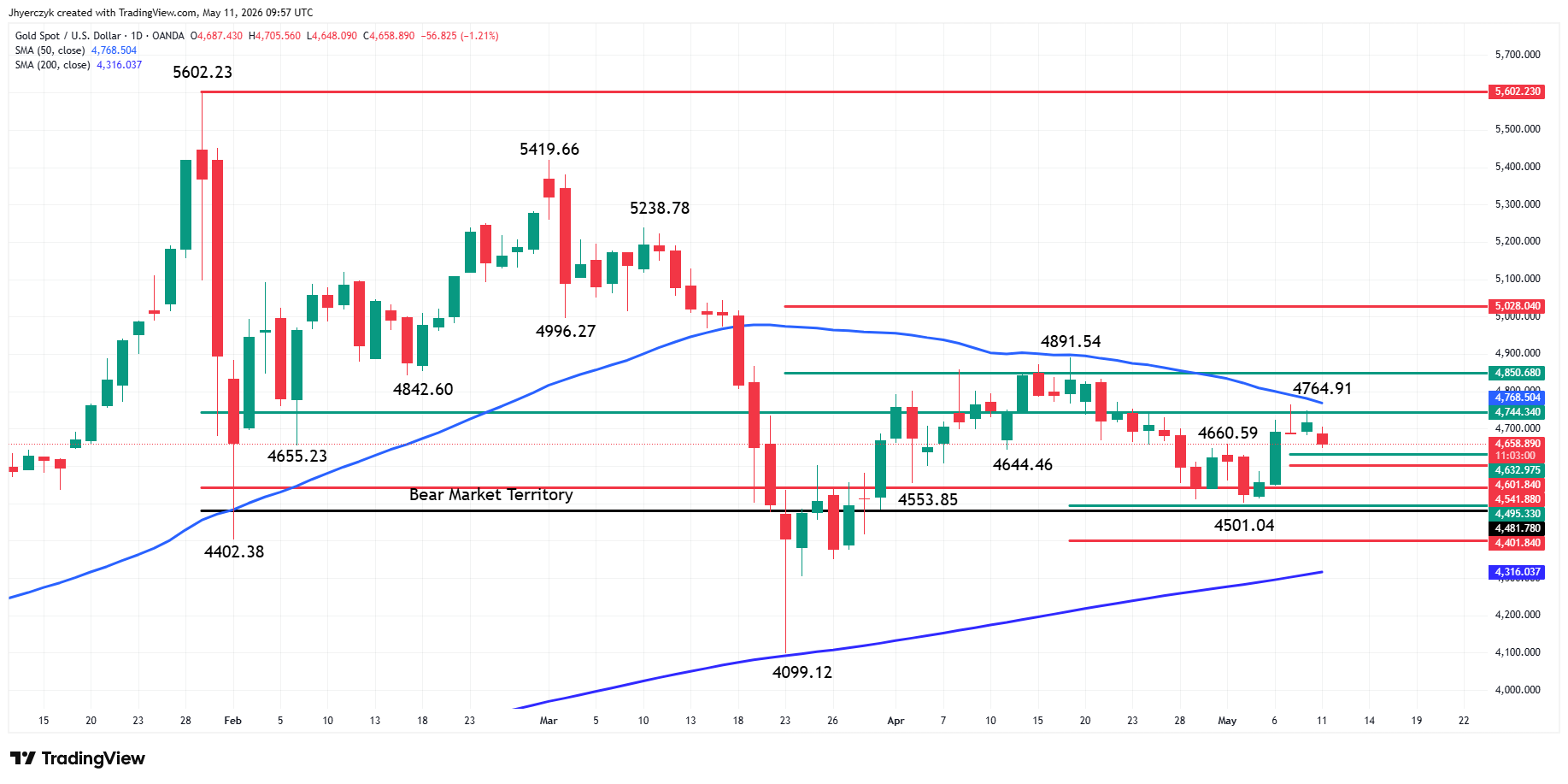
Spot gold is down early Monday, posting its second straight lower-low, making $4,764.91 a new main top. The new short-term range is $4,501.04 to $4,764.91. Its retracement zone at $4,632.97 to $4,601.94 is the first downside target. Bullish traders may try to buy this dip in an effort to form a secondary higher bottom.
If $4,601.94 fails to hold then look for the selling to possibly extend into the longer term 61.8% level at $4,541.88.
The last support zone is $4,495.33 to $4,401.84. Inside this zone is $4,481.78. The level is the Bull Market/Bear Market Territory line that is being watched closely by the major traders. Simply stated, holding above it, we’re still in a bull market. Falling below it, and the market turns bearish.
On the upside, the first resistance is the long-term 50% level at $4,744.34. This is followed by the 50-day moving average at $4,768.63. Additional resistance is the 50% level at $4,850.68 and the 61.8% level at $5,028.04.
With sellers pressing the downside early Monday, we’re going to be watching trader reaction to $4,632.97 to $4,601.94. This should set the tone. A sustained move over $4,632.97 will signal the presence of buyers with $4,744.34 to $4,768.60 the first target area. A sustained move under $4,601.84 will indicate increased selling pressure with potential targets coming in at $4,541.88 to $4,401.84.
If you want to avoid the noise from the cluster of retracement levels then focus on the moving averages. The 50-day MA at $4,768.53 is resistance and the 200-day MA at $4,316.04 is support. The midpoint of the moving averages is $4,542.28. With the market currently trading on the strong side of the midpoint, I’m giving it a slight upside bias. However, overall, I’m still seeing a sell the rally, buy the dip trade. We’re likely to continue to see this type of trade until bullish news encourages traders to take out offers or bearish news influences traders enough to start hitting bids.
Essentially, the market is compressing between overlapping retracement levels and moving averages, creating the kind of tight structure that often precedes a volatile breakout.
Gold Price Forecast
Every new Gold analysis as it publishes, today's technical signal and key levels, live price — on one page.
See all Gold forecastsThe Oil and Inflation Chain Running Against Gold
Trump rejected Iran’s proposal Monday and Spot Brent crude oil responded immediately. That is the chain gold has been fighting all year. Oil goes up. Inflation expectations go up. The Fed stays on hold. Treasury yields rise. Gold loses the argument because investors have a paying alternative and they take it. Last week that chain briefly ran in reverse and gold gained 3.72%. Monday it snapped back.
The 10-Year U.S. Treasury yield climbed toward 4.39% Monday. The 2-Year pushed near 3.92%. Those are not levels that invite buyers into a non-yielding asset. Friday’s nonfarm payrolls number came in stronger than expected and reinforced the view that the Fed is not moving anytime soon. Traders have now largely priced out rate cuts for the year. Some are starting to talk about a rate hike in 2027 if inflation stays sticky. That conversation alone is enough to keep gold from finding aggressive buyers.
The Dollar Is Adding to the Problem
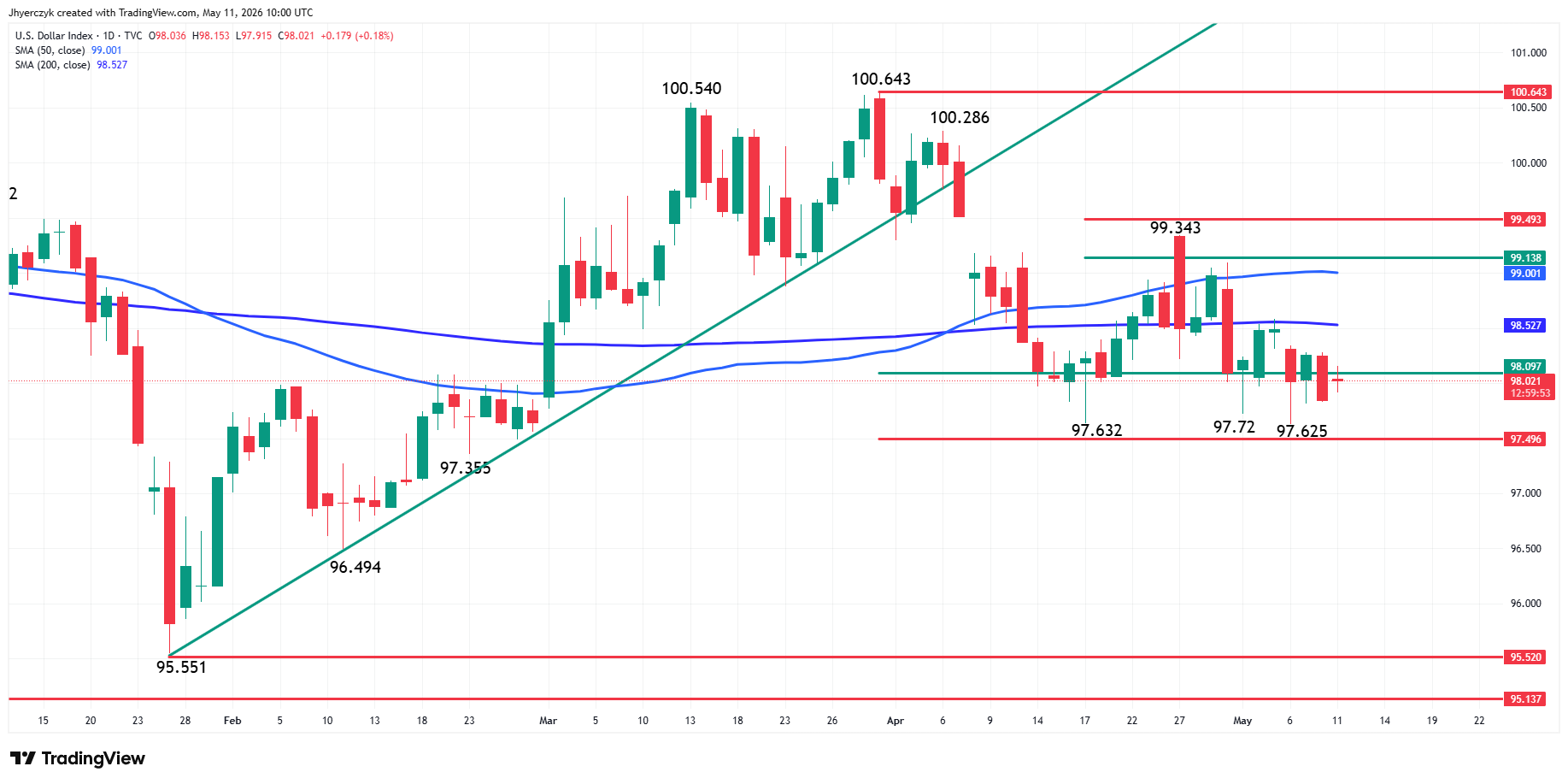
The U.S. Dollar Index climbed back toward 98.00 Monday after the strong jobs report gave the greenback a second wind. The euro, yen and British pound all weakened against the dollar. A stronger U.S. Dollar Index makes Spot Gold (XAUUSD) more expensive for every buyer outside the United States and that demand disappears fast when the dollar is running. Right now gold is fighting rising yields and a strengthening dollar at the same time. That is the same two-front problem that drove the selloff earlier this year and it is back on the table Monday.
CPI Is the Event That Decides This Week
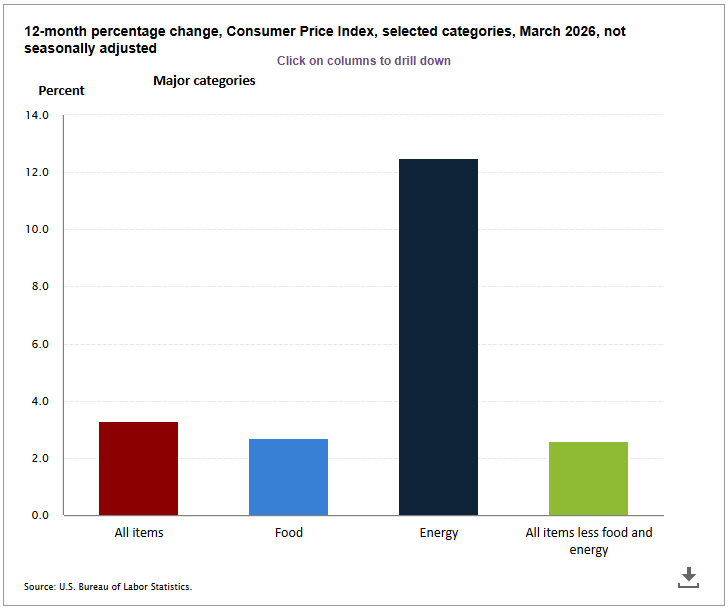
Tuesday’s Consumer Price Index report is where this week gets decided for Spot Gold (XAUUSD). A hot number and the bears are in full control. Treasury yields push higher, the U.S. Dollar Index strengthens, and the technical support cluster at $4,495.33 to $4,401.84 becomes the conversation. That zone contains $4,481.78, the bull market and bear market dividing line. Losing that level changes the entire long-term picture for gold.
A softer reading gives bulls something to work with. Yields pull back, the dollar loses momentum, and the first target on the upside is $4,632.97 to get buyers back in control heading toward the 50-day moving average at $4,768.53.
The Trump and Xi Meeting Is a Wild Card
Trump and Chinese President Xi Jinping are meeting this week with Iran, trade policy, artificial intelligence and Strait of Hormuz shipping disruptions all on the agenda. Any signal of progress on Middle East tensions reduces the geopolitical backdrop and takes oil lower. Lower oil takes inflation pressure down with it and that opens the door for gold buyers. Any breakdown in those talks and the risk premium in crude oil comes back fast and gold pays for it immediately through the yield channel.
What I’m Watching
The $4,632.97 to $4,601.94 retracement zone is the level that sets Monday’s tone. Hold above it and dip buyers are still active. Lose $4,601.94 and the selling extends toward $4,541.88 and then the support cluster at $4,495.33 to $4,401.84. The 50-day MA at $4,768.53 is resistance and the 200-day MA at $4,316.04 is the long-term floor. Everything in between is noise until CPI prints Tuesday morning and the market tells us which direction the breakout goes.
If you’d like to know more about how to trade gold, please visit our educational area.