
Gold Surges to New Record Above $4690 on Tariff Threats and Geopolitical Tensions
Spot Gold opened the new week by gapping above last week’s high. After reaching a new record at $4690.94, the rally has stalled and the market is flattening at $4664.09, up $67.77 or +1.47%. Below-average volume due to a U.S. bank holiday may be the catalyst behind the muted trade.
Last week, XAUUSD settled at $4596.32, up $86.66 or +1.92%.
Reuters said the early rally was fueled by investors flocking to safe-haven assets on intensifying geopolitical tensions, after U.S. President Trump threatened to impose extra tariffs on European countries over the control of Greenland.

Five Key Drivers Behind Last Week’s Record-Setting Performance
To recap last week’s record-setting performance, my work shows that five key events drove the price action.
Central Bank Buying Momentum Continues
The main narrative remained unchanged, with the long-term trend supported by central bank buying momentum. Gold touched multiple highs throughout the week once it cleared $4600 for the first time, driven by continued central bank accumulation as part of a structural de-dollarization strategy, particularly among Eastern economies, according to multiple analysts.
Iran Geopolitical Tensions Create Volatility
While much of the focus lately has been on the pace and amount of Fed rate cuts, geopolitical tensions moved to the forefront last week over Iran. Gold initially rallied on fears of U.S. military intervention in Iran over protest crackdowns, but then pulled back when President Trump signaled a softer stance, saying he’d been told the killings were stopping.
Fed Chair Investigation Sparks Policy Speculation
The Trump administration also made headlines when news emerged of a federal investigation into Fed Chair Jerome Powell, sparking speculation about potential leadership changes that could lead to faster interest rate cuts.
Gold Price Forecast
Every new Gold analysis as it publishes, today's technical signal and key levels, live price — on one page.
See all Gold forecastsTame Inflation Data Supports Rate Cut Expectations
U.S. economic data was also the source of volatility with tame U.S. inflation data supporting market bets on Federal Reserve cuts later in 2026, which typically benefits gold. December CPI came in at 2.7% year-over-year, matching expectations and solidifying the odds of a Fed rate cut.
Strong Jobs Data Shifts Rate Cut Timeline
However, the bullish outlook after the CPI report changed when the U.S. released strong jobless claims, which strengthened the dollar and reduced pressure on the Fed to cut rates soon. The latest rate cut projections from the CME show that traders now expect the Fed to make its first cut in June, rather than March.
Week Ahead: Tariffs, Iran Tensions, and Key Economic Data
This week begins with the gold market underpinned by Trump’s tariff threat on European countries supporting Greenland. Traders will also continue to monitor the events in Iran to watch for a re-escalation of events that prompted Trump to threaten military action on the country. Late last week, reports indicated the U.S. was moving an aircraft carrier into the region.
Traders will also be monitoring economic data on inflation and consumer sentiment ahead of the Fed’s interest rate decision on January 28. On Thursday, the Personal Consumption Expenditures Price Index (PCE) and Core PCE is unlikely to show any major improvement on the inflation front. Friday’s University of Michigan Sentiment Index will be closely watched also.
Technical Outlook Remains Bullish with Key Support Levels
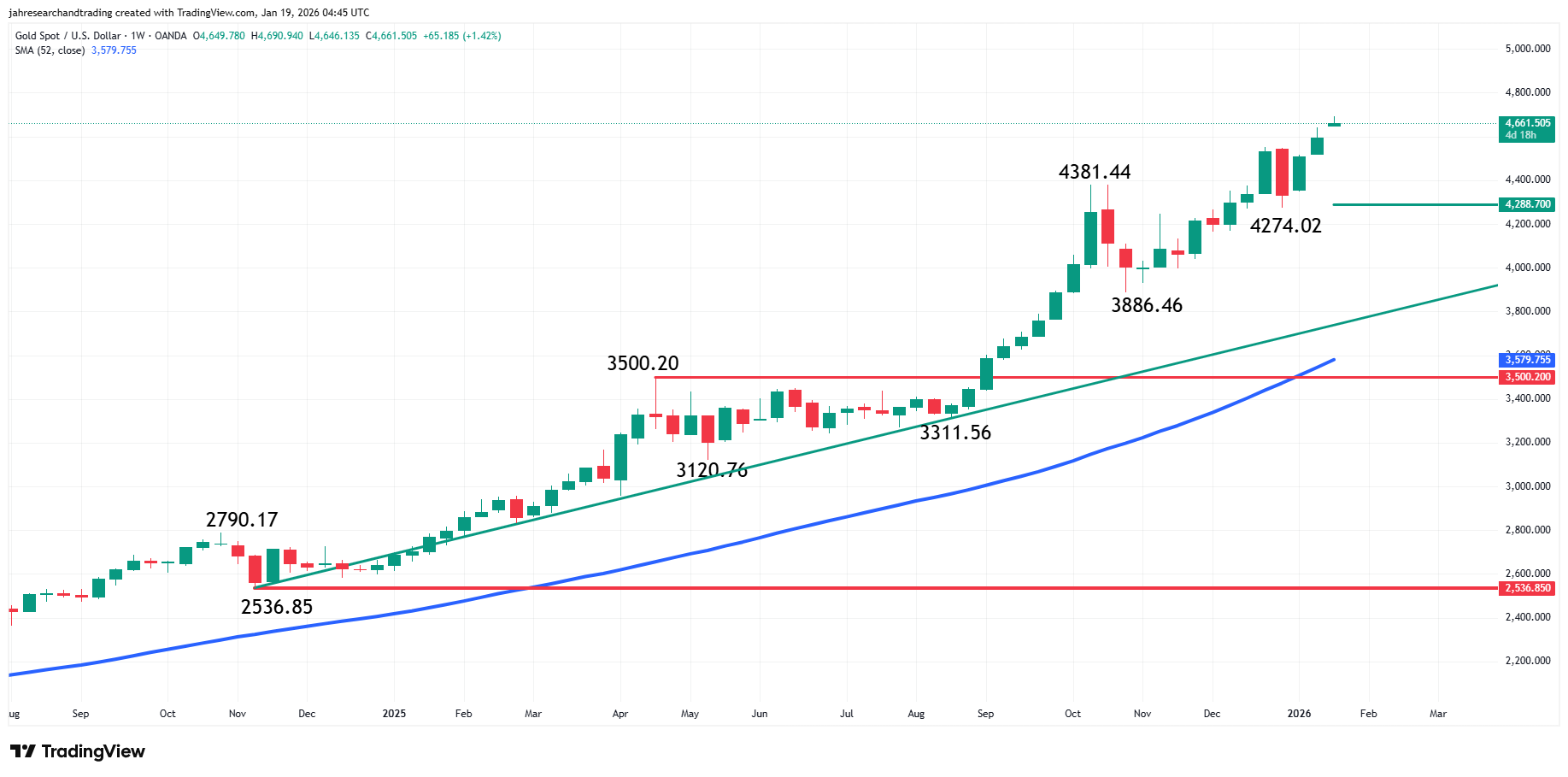
Technically, the main trend is up according to the weekly swing chart, trend line analysis and the 52-week moving average at $3579.91.
The short-term support is a 50% level at $4288.70 and a minor bottom at $4274.02. A trade through the latter will shift momentum to the downside.
More Information in our Economic Calendar.