


Hyperliquid (HYPE) has surged by around 25% in the last 24 hours to reach $47, but its latest rally now faces a technical stress test.
HYPE Rising Wedge Puts 45% Correction In Play
The Hyperliquid token is trading inside a rising wedge, a bearish reversal setup that could trigger a 30%–45% correction if buyers fail to defend key support.
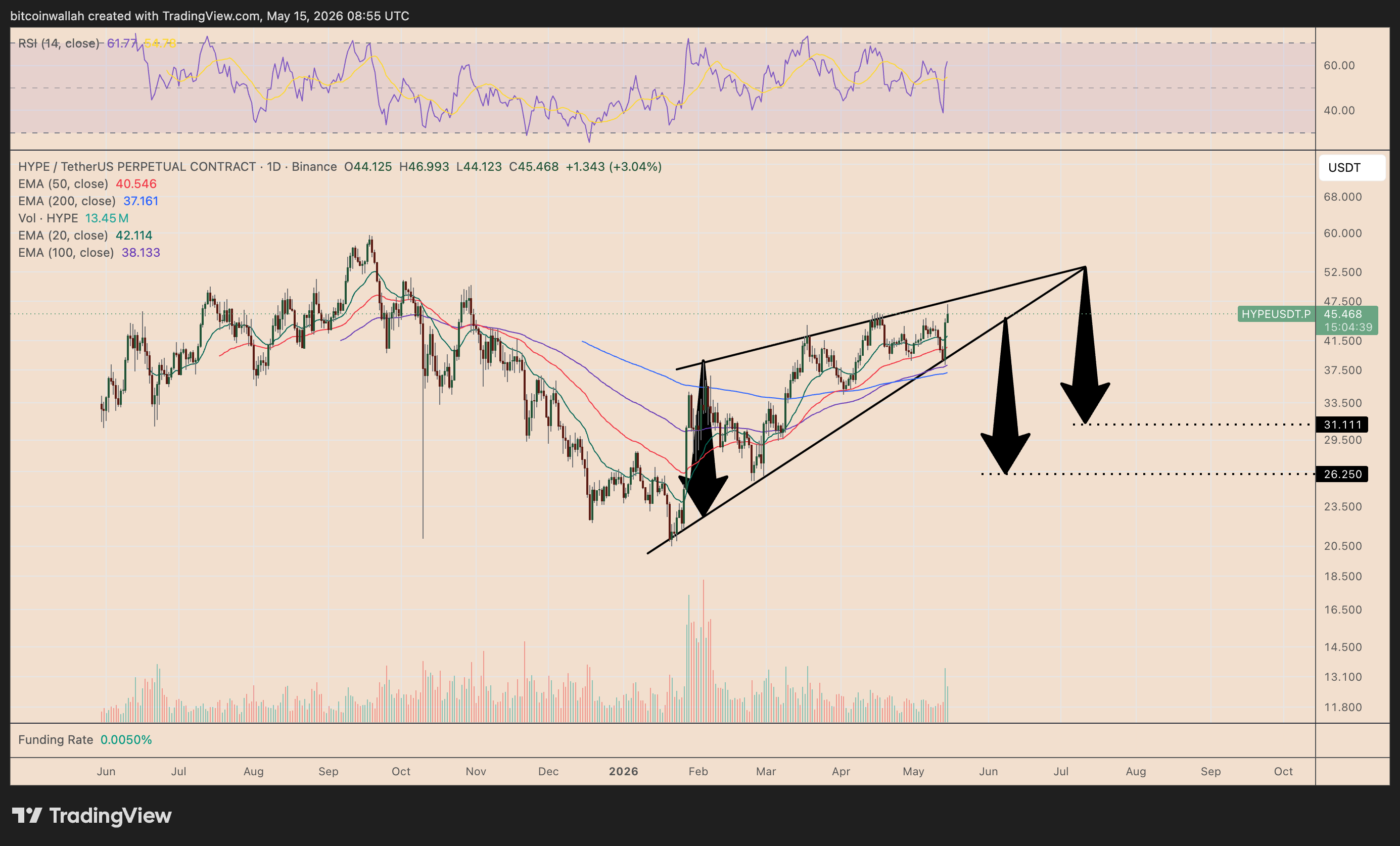
A rising wedge usually reflects weakening upside momentum. Price continues making higher highs and higher lows, but each advance becomes narrower, suggesting buyers are losing control even as the market climbs.
The pattern typically resolves when the price breaks below the lower trendline and falls by as much as the wedge’s maximum height.
Applying that rule to HYPE’s daily chart puts the downside target in the $26.50–$31.20 range, depending on where the breakdown occurs. That implies a potential 30%–45% correction by June or July.
The bearish setup would gain strength if HYPE loses the wedge’s lower boundary with rising volume.
HYPE remains above key short-term support inside the wedge, while its daily relative strength index remains below the overbought threshold of 70. That suggests the token still has room to extend its upside before momentum looks overheated.
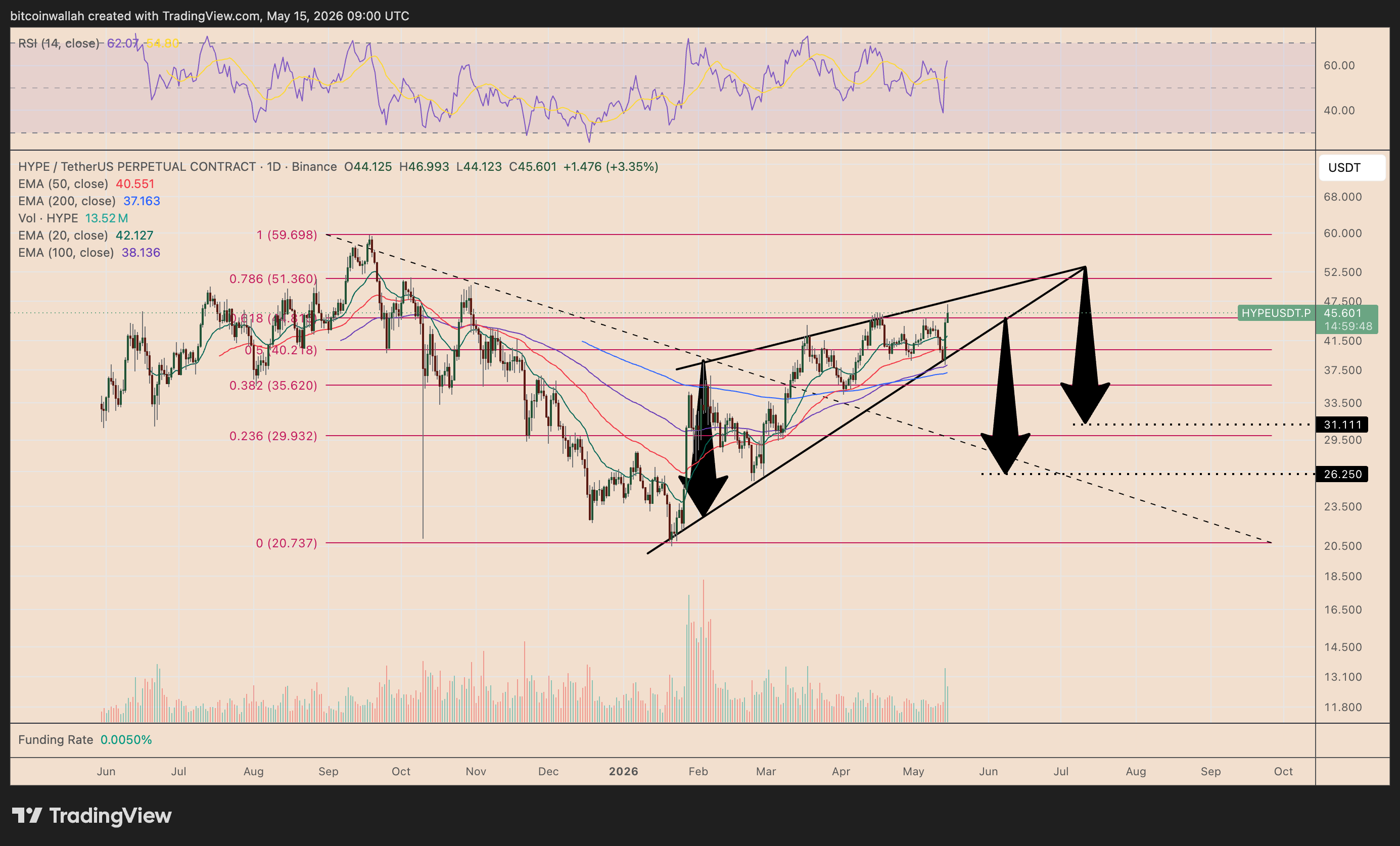
A decisive breakout above the wedge’s upper trendline would invalidate the bearish reversal setup. In that scenario, HYPE could rally toward the $59–$60 area, aligning with the 1.0 Fibonacci retracement level shown on the chart.
HYPE ETF Launches Fueled Rally, But Inflows Must Follow
The biggest immediate catalyst behind HYPE’s rally was the launch of US-listed Hyperliquid ETFs.
Bitwise’s spot Hyperliquid ETF, BHYP, debuted on the NYSE on May 15, following 21Shares’ THYP launch on Nasdaq on May 12. Together, the products strengthened HYPE’s institutional-demand narrative.
Two ETFs in three days!
Two days ago, @21shares_us launched $THYP
Tomorrow, @Bitwise launches $BHYP with 100% direct spot $HYPE exposure, in-house staking, fee waived for the first month$HYPE is the fastest asset in history to receive an ETF and the first to get TWO, all… https://t.co/vr8wtw3n3Y
— SΛGΞWHΛLΞ.HL✦ (@SageWhale) May 14, 2026
Still, ETF launches often trigger short-term “buy the rumor, sell the news” rallies unless inflows continue after debut.
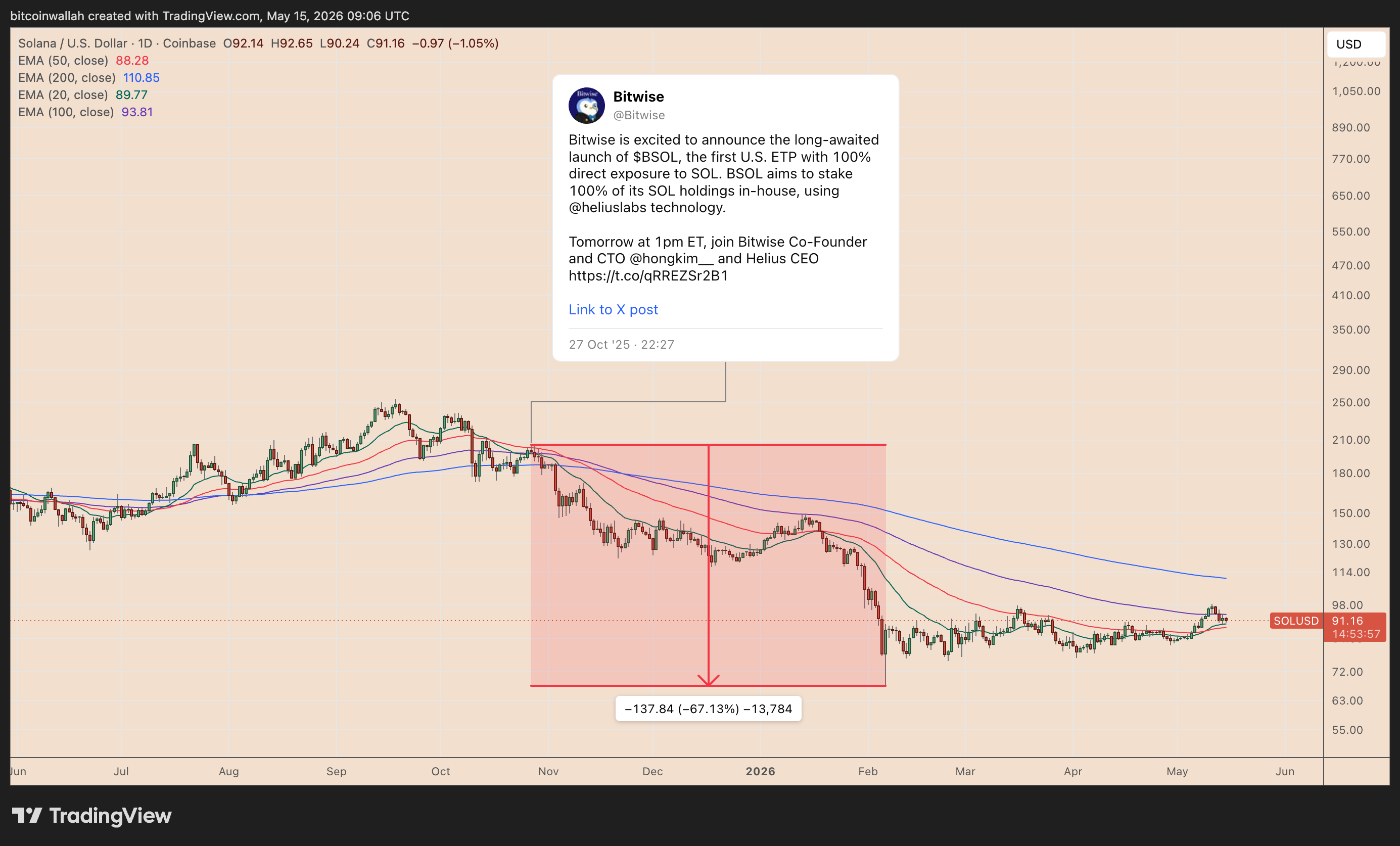
Solana (SOL), for instance, saw weak follow-through after its US spot ETF debut cycle.
Bitwise launched the first US spot Solana ETF in October 2025, and the fund attracted $420 million in its first week, but SOL still tumbled around the launch window, erasing year-over-year gains as ETF demand failed to immediately lift spot price.
Ethereum’s native token, Ether (ETH), saw a similar post-ETF pullback in July 2024 amid heavy Grayscale ETHE outflows, while Dogecoin (DOGE) also struggled to sustain spot-price rallies after its ETF debut.
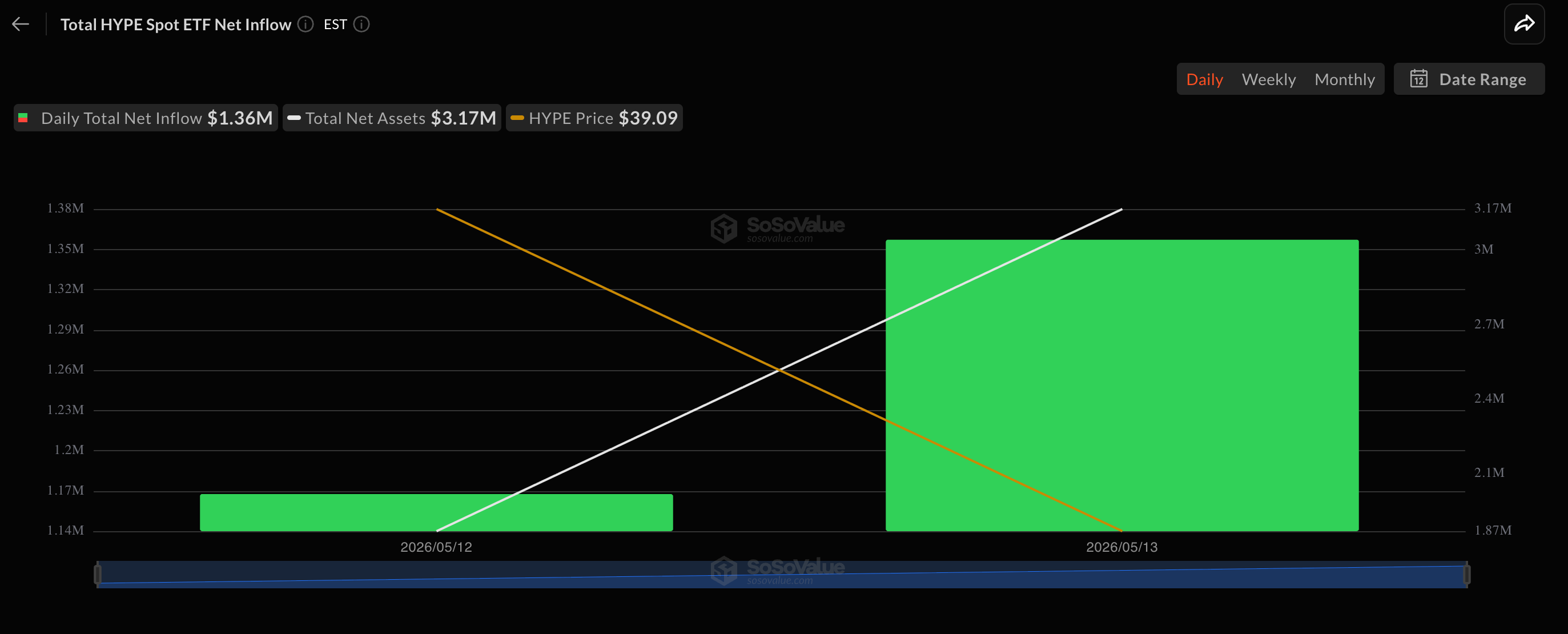
That makes HYPE’s early ETF demand important. As of Friday, the funds managed only about $3.17 million in assets, suggesting the rally still looks more like launch-week speculation than confirmed institutional absorption.
CLARITY Act May Also Serve As Sell-The-News Event
HYPE also rose alongside improving US crypto sentiment.
On May 14, the Senate Banking Committee advanced the CLARITY Act in a 15–9 vote, moving the market-structure bill closer to a full Senate vote. The bill aims to clarify whether digital assets fall under securities or commodities rules.
Still, it is not the law yet. The bill must pass the Senate, be reconciled with the House version, and reach President Donald Trump’s desk.
For now, it remains a sentiment boost for HYPE, not a confirmed fundamental catalyst.
Coinbase and Circle Deal May Lead to Stronger HYPE Demand
HYPE’s bullish case is not limited to ETFs.
The latest Hyperliquid rally also gained support after Coinbase became the official USDC treasury deployer on Hyperliquid, giving it a key role in managing stablecoin liquidity across the decentralized exchange.
Today we’re expanding our support for @HyperliquidX by becoming the platform’s official treasury deployer of USDC.
Onchain markets operate 24/7 and require collateral that is always available, instantly transferable, and deeply liquid – USDC delivers exactly that.
Alongside… pic.twitter.com/ki7QmSJVdH
— Coinbase 🛡️ (@coinbase) May 14, 2026
The deal strengthens USDC’s position as Hyperliquid’s main collateral and quote asset. Under the upgraded AQA framework, most reserve-yield revenue from USDC deployed on Hyperliquid is expected to flow back to the protocol.
Circle will also serve as USDC’s technical deployer on Hyperliquid and stake 500,000 HYPE tokens, adding another layer of ecosystem alignment.
🚨 BREAKING: Coinbase will activate AQAv2 on $USDC on @HyperliquidX.
Coinbase bought and staked the 500K $HYPE ($20M)@coinbase = treasury deployer@circle = technical deployer (CCTP + cross-chain infra)
Both will stake $HYPE to activate AQAv2
Biggest change:$USDC will… https://t.co/xie2HFPIvH pic.twitter.com/EBQfbeMxRM
— Vikingo.hl (@VikingoDigital_) May 14, 2026
That gives HYPE a stronger structural tailwind than ETF speculation alone. Deeper USDC liquidity could increase trading activity, boost protocol revenue and strengthen the token’s buyback narrative.
Analyst Aylo estimates the arrangement could add more than $140 million in annualized revenue, which may be used to buy back HYPE.
Major structural win for Hyperliquid.
A tier 1 CEX and the largest US-regulated stablecoin issuer are both staking HYPE and sharing revenue with the protocol. It’s an admission that Hyperliquid is too dominant in perps to displace, so better to align and capture distribution.… https://t.co/1QQr3wf3uX
— Aylo (@alpha_pls) May 14, 2026