
USD/JPY extended its winning streak to three weeks in the week ending January 16. Strong US economic data sank bets on a March Fed rate cut, increasing demand for the US dollar. Meanwhile, Japanese Prime Minister Sanae Takaichi’s plans for a snap election and fiscal spending weighed on demand for the yen.
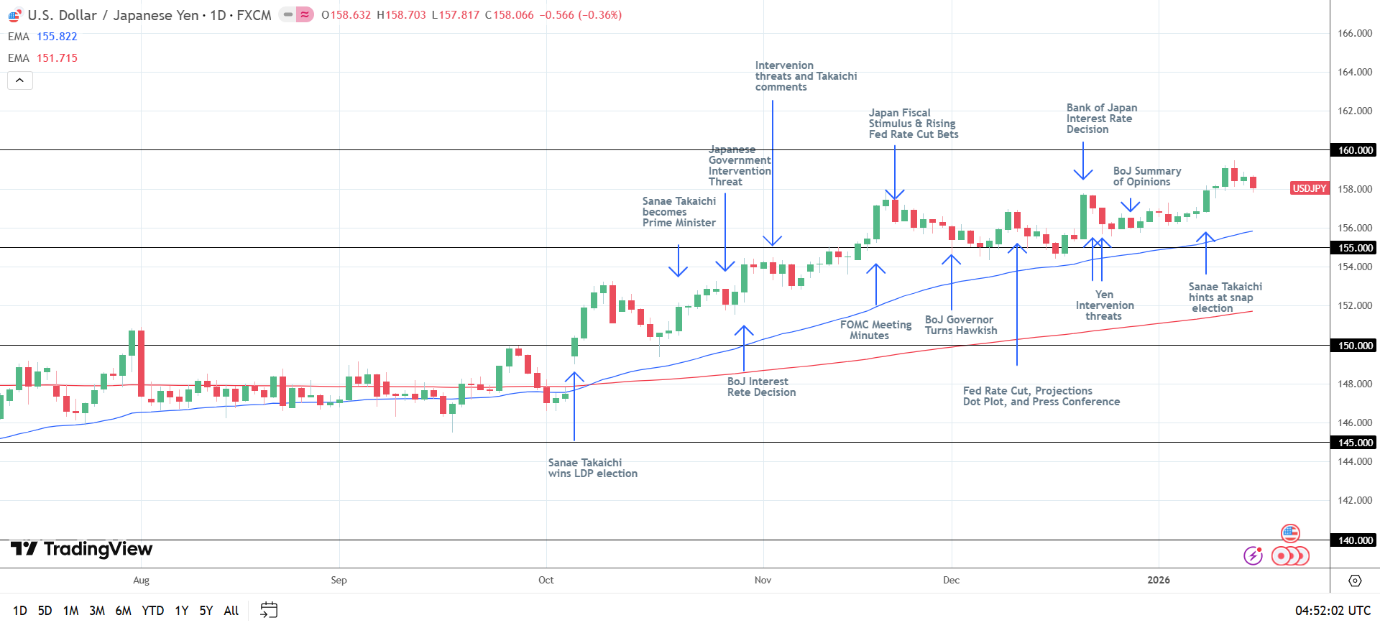
The USD/JPY pair briefly fell to a January 12 low of 157.515 before rising to a January 14 high of 159.453. A pullback from the mid-week high, amid intervention jitters, left USD/JPY up 0.09% to 158.066 at Friday’s close.
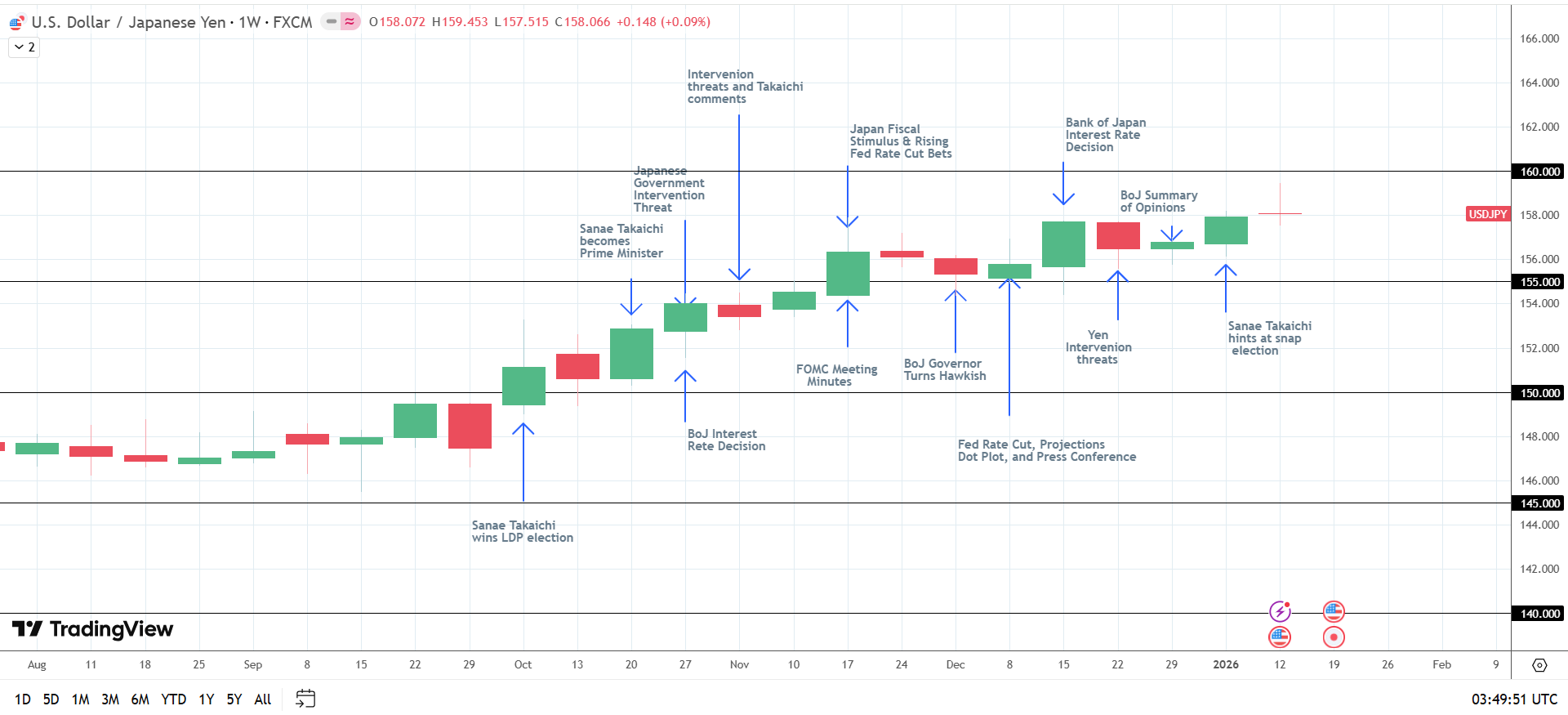
Despite the USD/JPY gains, rising bets on multiple BoJ rate hikes support a bearish short- to medium-term price outlook for USD/JPY.
Below, we examine the upcoming economic calendar, the medium-term catalysts (4-8 weeks), and the technical levels traders should watch.

Key Japanese Economic Indicators to Watch
In the week ahead, several Japanese economic indicators will influence sentiment toward the BoJ policy stance. Key indicators include machinery orders, trade data, inflation figures, and private sector PMIs.
Given the BoJ’s focus on the effect of US tariffs on external demand and price trends, the trade and inflation figures are likely to be key to the bearish price outlook.
Stronger-than-expected inflation and robust demand for Japanese goods would raise expectations of a second-quarter BoJ rate hike.
USD/JPY Price Forecast
Every new USD/JPY analysis as it publishes, today's technical signal and key levels, live price — on one page.
See all USD/JPY forecastsBank of Japan Interest Rate Decision and Quarterly Outlook Report Key to USD/JPY Trends
While the upcoming economic data will influence demand for the yen, the Bank of Japan’s monetary policy decision will be the main event for the week. Economists expect the BoJ to keep interest rates at 0.75% on Friday, January 23. However, the BoJ’s concerns about a weaker yen pushing import prices higher may bring forward plans to tighten monetary policy.
Signals for an April rate hike and a cut to purchases of Japanese Government Bonds (JGBs) would boost demand for the yen. The prospects of narrower US-Japan rate differentials would likely send USD/JPY lower, supporting the bearish outlook.
The BoJ’s Quarterly Outlook Report will give insights into policymakers’ views on the economy and prices. Bank of Japan Governor Kazuo Ueda previously hinted at further rate hikes if the economy and prices aligned with the Bank’s forecasts.
Robin Brooks, Senior Fellow at the Brookings Institution, commented on the yen’s weakness and JGB purchases, stating:
“Japan’s Yen devaluation will get worse before it gets better. Best way to see that is current threats to intervene in the Yen to stop its fall, which illustrates the scale of denial in Japan. Such intervention can’t work as long as BoJ is buying JGBs…”
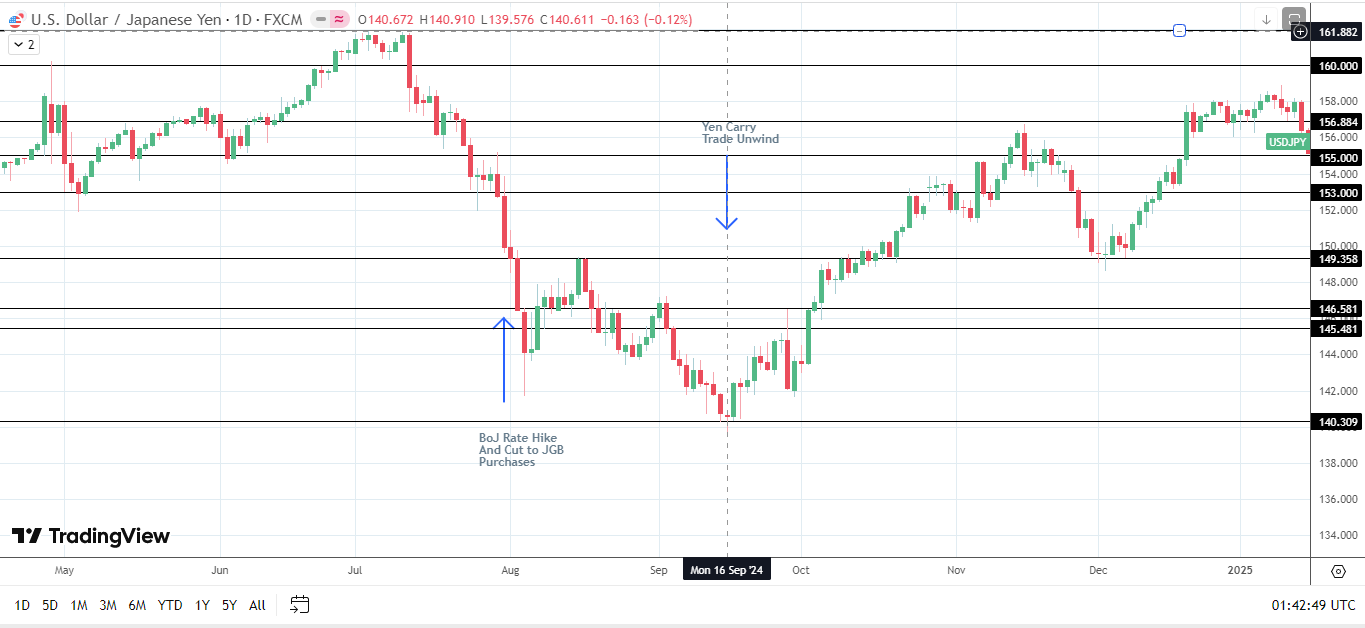
Another key announcement could be the Bank of Japan’s neutral rate, neither accommodative nor restrictive. A hawkish neutral rate (potentially 1.5% – 2%) would signal multiple BoJ rate hikes, sending USD/JPY sharply lower. Importantly, a higher neutral rate and surging Japanese Government Bond (JGB) yields could trigger a yen carry trade unwind. An unwind would mirror price trends in mid-2024, when the BoJ cut JGB purchases and raised rates.
Follow real-time updates to stay ahead of USD/JPY market developments.
Political Drama to Clash with the BoJ
While the BoJ’s policy stance remains key, political developments are likely to continue influencing demand for the yen.
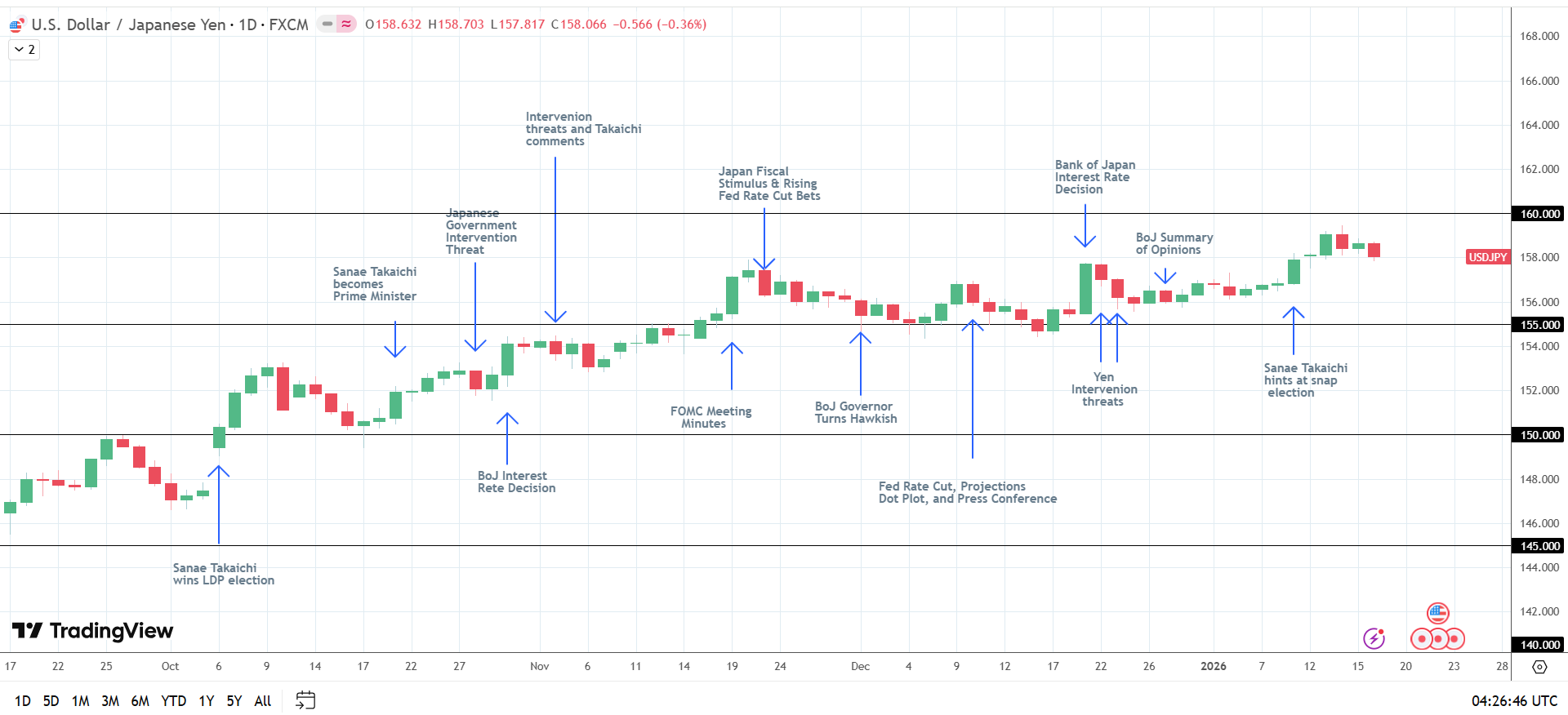
This month, Prime Minister Sanae Takaichi hinted at a snap election, sending USD/JPY to the January 14 high of 159.453. Uncertainty about the election result and concerns about Takaichi’s fiscal spending plans weighed on demand for the yen.
For context, USD/JPY has gained 7.2% since Takaichi won the Liberal Democratic Party (LDP) leadership race. Takaichi’s support for loose monetary policy and fiscal spending weakened the yen.
Despite the political headwinds for the yen, a more hawkish BoJ policy stance would support the cautiously bearish short-term and positive medium-term outlook for USD/JPY.
US Economic Calendar: Inflation and Labor Market Data to Spotlight the Fed
As markets consider the BoJ’s policy outlook and Prime Minister Takaichi’s election plans, US economic data will influence demand for the US dollar.
The weekly ADP employment and jobless claims figures will give insights into the labor market. Rising employment and falling claims would temper bets on a Fed rate cut in H1 2026. However, inflation figures on Thursday, January 22, are likely to be key for near-term USD/JPY trends.
Economists forecast the Core PCE Price Index will rise 2.7% in November after a 2.8% increase in September. October and November figures are due out together. Softer inflation would fuel speculation about a March Fed rate cut, weighing on buying demand for the US dollar. A more dovish Fed rate path would signal a narrower US-Japan rate differential, sending USD/JPY lower.
According to the CME FedWatch Tool, the probability of a March 2026 Fed rate cut stood at 21.1% as of January 16, down from 53.9% as of December 15. Meanwhile, the chances of a June cut stood at 60.7%, down from 84.1% as of December 15. Shifts in the chances of March and June cuts will be key for US dollar trends. There will be no Fed chatter to influence sentiment. The FOMC blackout period started on January 17.
Market View: Medium-Term Yen Strength
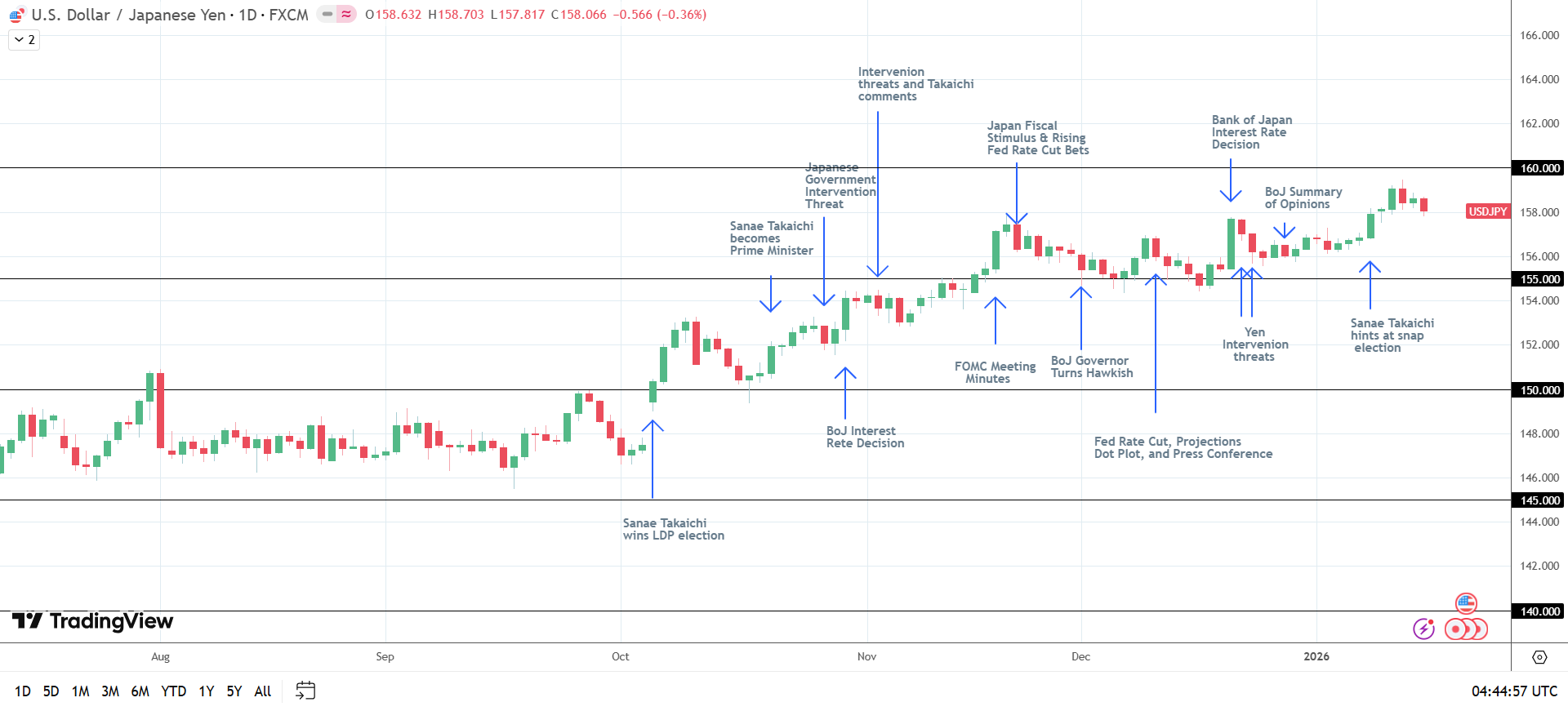
In my opinion, USD/JPY would likely drop toward 150 on a hawkish BoJ policy outlook and expectations of an H1 2026 Fed rate cut. A dovish Fed policy stance and a hawkish BoJ would affirm the bearish medium-term outlook. A drop below 150 would reinforce the medium-term (4-8 weeks) to longer-term (8-16 weeks) 145-140 range.
Counter-Trend Risks: What Could Push USD/JPY Toward 160?
Upside risks include:
- Strong US labor market and inflation data.
- Weaker Japanese inflation and trade data.
- Dovish BoJ policy outlook.
Despite the upside risks, yen intervention warnings are likely cap upside around 160. Given the upside risks, a breakout above the 159.453 January 14 high to 160 would invalidate the medium-term bearish structure.
For context, yen intervention threats and the risk of the Japanese government intervening have continued to hold USD/JPY below 160.
Financial Analysis
Technical Outlook: Bearish Momentum Building
On the daily chart, USD/JPY traded above the 50- and 200-day Exponential Moving Averages (EMAs), indicating a bullish bias. However, positive yen fundamentals are developing, countering the bullish USD/JPY technicals.
A break below the 50-day EMA would signal a near-term bearish trend reversal. Crucially, if breached, the 200-day EMA and the 150 support level would come into play. Importantly, a break below the 50-day EMA would be the next key technical support level. Falls through the EMAs would affirm a bearish trend reversal, supporting the bearish medium-term outlook.
Key Takeaways
The USD/JPY pair has risen 0.77% in 2026, following the previous month’s 0.46% gain. A hawkish BoJ rate path would indicate a narrowing rate differential, supporting a bearish short- to medium-term outlook for USD/JPY.
Yen carry trade unwind risks and the prospect of further policy divergence set up a bearish outlook.
Key levels will include 155, 150, and 140 on the downside, and 160 on the upside.
Consult our economic calendar for historical and upcoming data.