


Warsh Put September Back on the Table and Chips Could Not Hold Thursday’s Bid
Kevin Warsh told Jackson Hole that better summer inflation readings do not prove the fight is over. The September rate-hike trade repriced immediately. Fed funds futures jumped to 57.5% probability of a quarter-point increase from 35.4% Thursday. The 2-year yield rose more than 6 basis points to 4.298%.
Nvidia is giving back more than 3% after rallying nearly 9% the prior session. Marvell is down about 10% on a margin guide that missed. Software is the only reason the Nasdaq is not in worse shape. Salesforce, Workday, ServiceNow and Elastic are all higher.
At 17:19 GMT, the S&P 500 is down 0.26%. The Nasdaq Composite is off 0.48%. The Dow is near unchanged. All three are still heading for weekly gains.
Daily S&P 500 Index (SPX) Technical Analysis
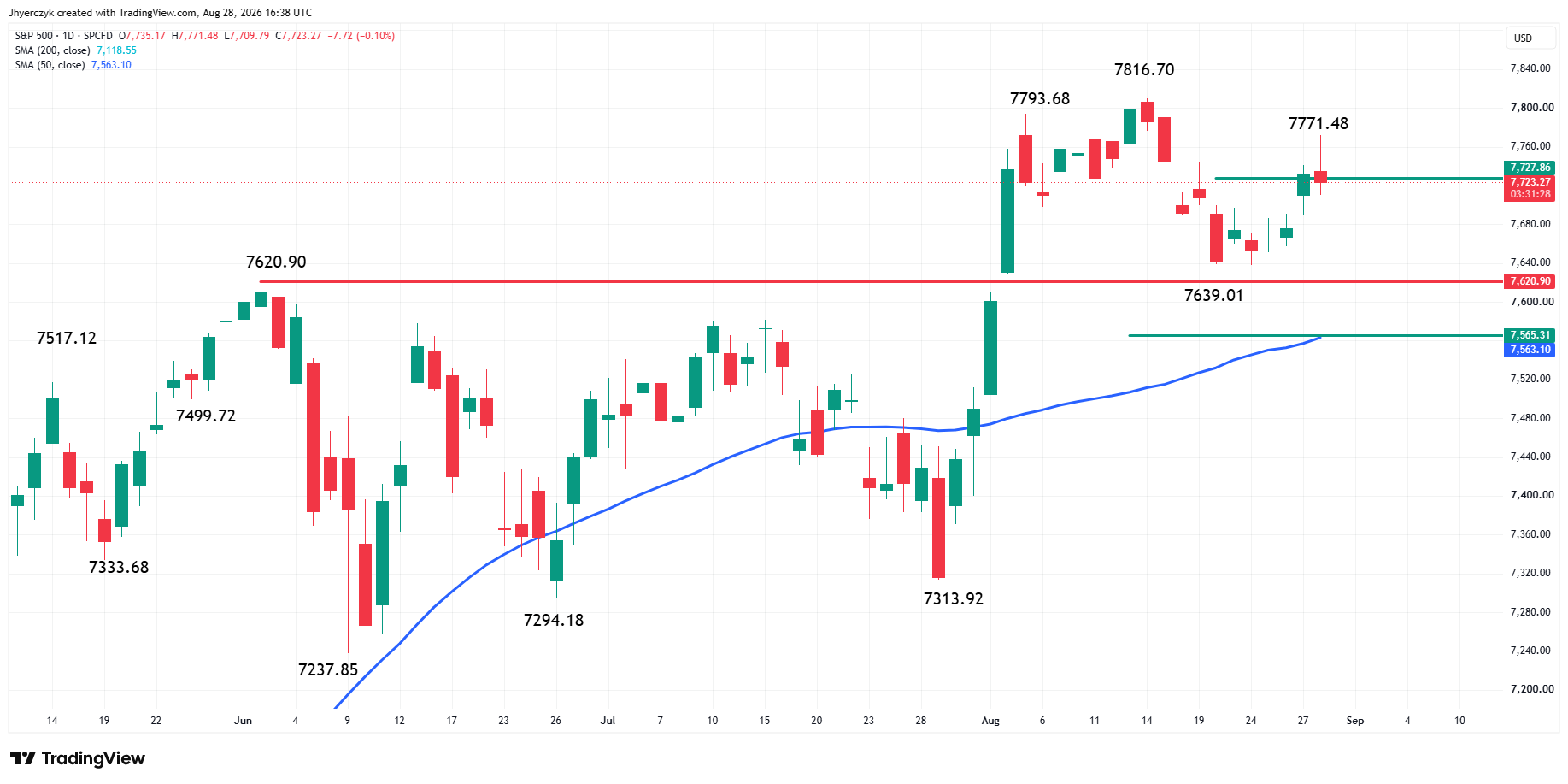
The S&P 500 Index (SPX) is trading lower shortly after mid-session. The benchmark has given up all of its early gains that drove it to 7771.48, its highest level since August 17.
The short-term range is 7816.70 to 7639.01. The index is currently straddling its pivot at 7727.86 as traders search for direction into the close. Trader reaction to this level is likely to determine whether bullish traders regain control and make another late-session run at 7771.48, or whether short-selling and profit-taking drive traders to challenge the intraday low at 7706.11.
The major upside target and current resistance is the all-time high at 7816.70. The support levels are the main swing bottom at 7639.01 and the 50% level/50-day moving average combination at 7565.31 to 7562.79.
Warsh Did Not Promise a Hike but He Made Sure the Market Priced One
Warsh said the Fed needs confidence that inflation is moving toward its objective clearly and fast enough. Otherwise the central bank still has work to do. He did not lay out which data points would trigger a move. He described himself as committed to discipline, not to a decision. That leaves the market with a 57.5% probability of a September hike and no roadmap for what changes it before the September 16 meeting.
Dow Jones Price Forecast
Every new Dow Jones analysis as it publishes, today's technical signal and key levels, live price — on one page.
See all Dow Jones forecastsThe 2-year yield doing the work while long-term yields stayed flat tells you the market read Warsh as a near-term rate threat, not a long-term policy shift. The short end repriced. The long end did not react. That is a market adjusting its September expectations without rethinking the broader trajectory.
Nvidia Gave Back Thursday’s Rally and Marvell Made It Worse
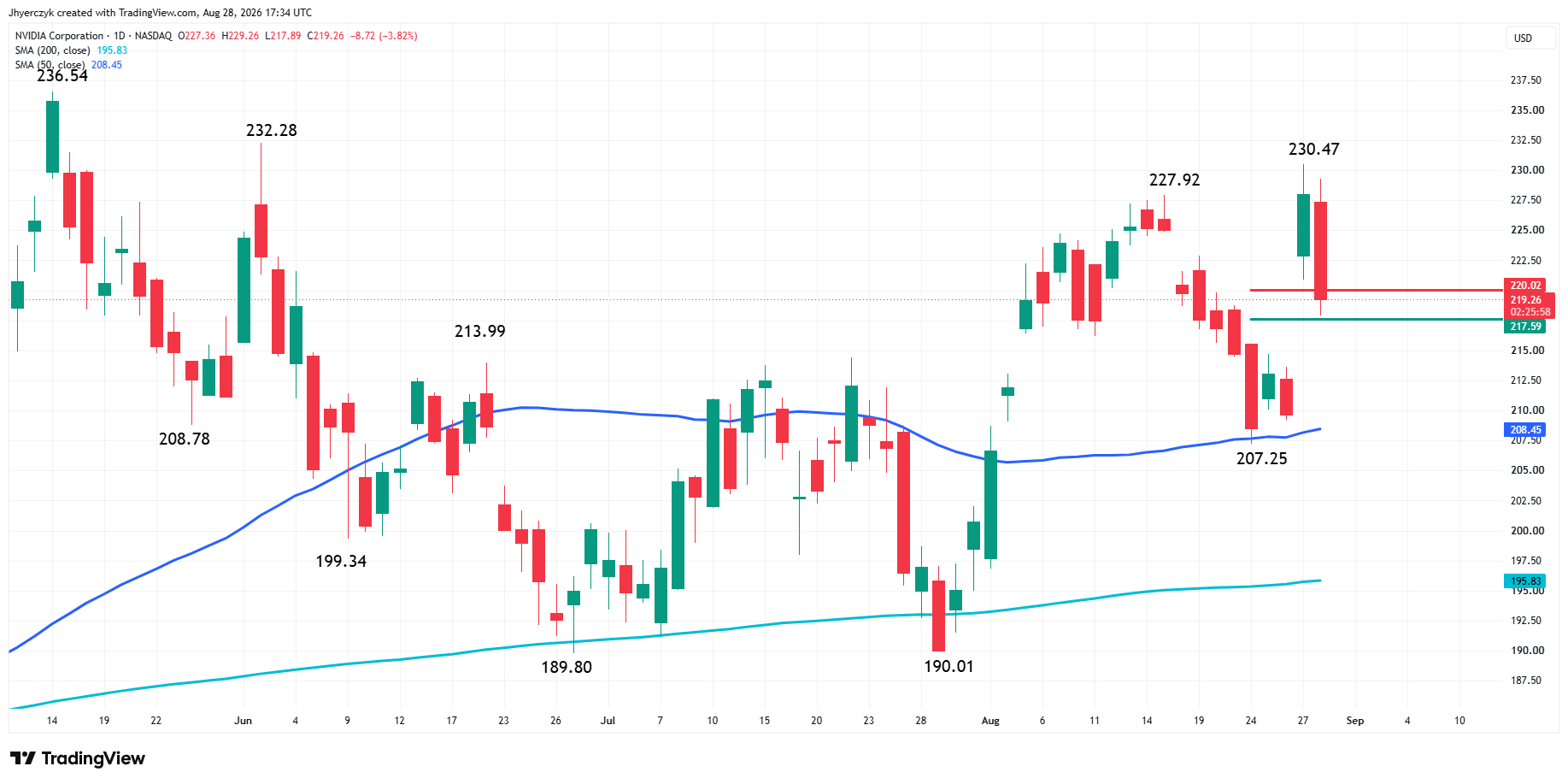
Nvidia dropped more than 3% after Thursday’s 9% surge. The stock rallied on a forward guide that cleared the street’s expectations. Friday’s selling says buyers are not willing to chase it at the higher level with Warsh putting rates back in the conversation. Thursday’s bid was real. Friday’s follow-through is not there.
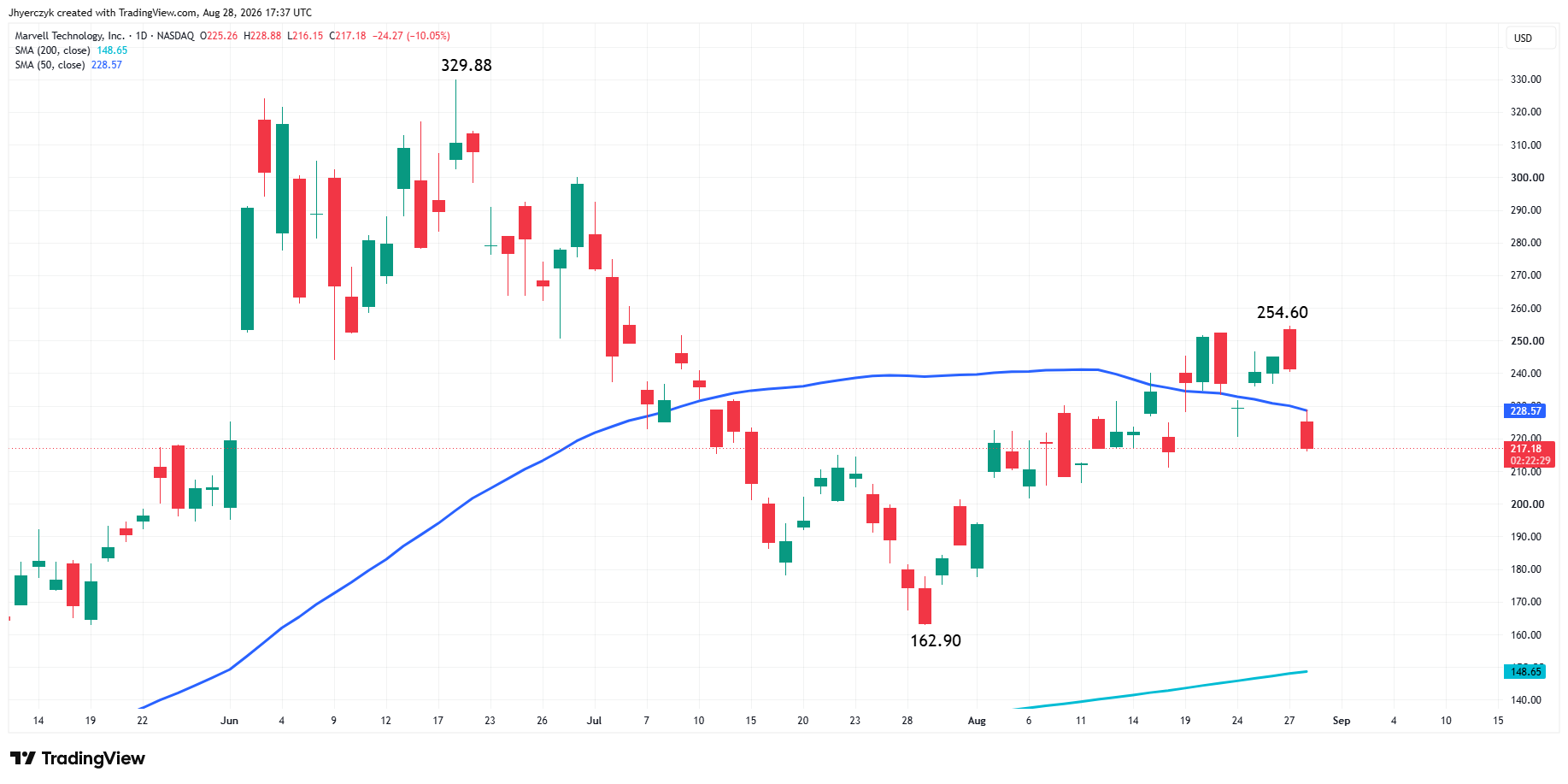
Marvell fell about 10% after guiding current-quarter non-GAAP gross margins to 57.5%-58.5%. The consensus estimate was 58.5%. That is a narrow miss on margins, not a demand collapse, and the stock dropped 10% on it. Nvidia rallied 9% on a strong guide Thursday. Marvell lost 10% on a margin miss one day later. The semiconductor group is trading on the last headline, not on any kind of conviction about the cycle.
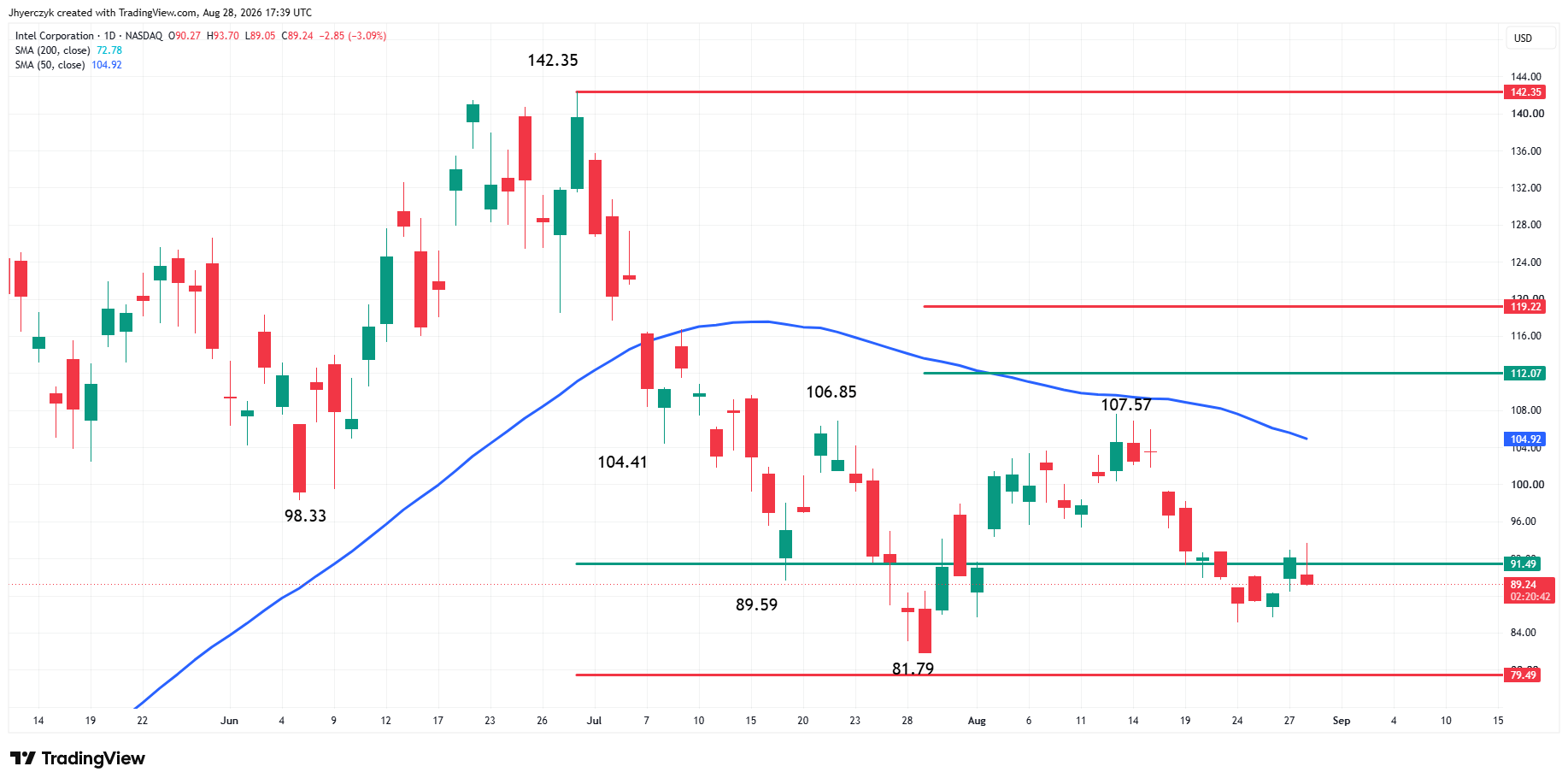
Intel also weighed on the Nasdaq. The semiconductor group that carried Thursday’s rally is the weak point Friday. The VanEck Semiconductor ETF is giving back part of its gains.
Software Is Carrying the Nasdaq Through a Session That Should Be Worse
Workday jumped after second-quarter results beat on earnings and revenue. The company reported adjusted earnings of $2.75 per share and revenue of $2.65 billion against estimates of $2.61 and $2.64 billion.
Salesforce is extending Thursday’s 22% surge with another 3% gain Friday. The company beat second-quarter estimates and reported a $2.6 billion gain on strategic investments including its Anthropic stake. Two consecutive winning sessions after raising guidance. The stock is not acting like a name the market is trying to replace with cheaper AI tools.
ServiceNow rose 3% for a second straight session. Its finance chief said the AI business remains on track for $1.5 billion full-year. Elastic jumped more than 17% after raising full-year guidance above estimates. Amazon added nearly 4% after Evercore ISI raised its price target to $355 citing survey evidence that agentic AI is adding to Amazon Retail.
The software bid is real and it is broadening beyond Thursday’s initial reaction. The Nasdaq losing 0.48% with this many software names higher tells you how much damage chips and the Warsh repricing are doing on the other side.
Crypto Sold Off and PayPal Took a Hit
Strategy fell 7%. Coinbase lost 6%. Bitcoin dropped about 3% to $77,597.90. The rate-hike repricing hit crypto the same way it hit semiconductors. Higher rates raise the cost of holding risk assets that generate no yield.
PayPal plunged nearly 16% after reports that Advent and Stripe decided not to pursue the company.
Affirm rose after fiscal fourth-quarter revenue of $1.17 billion beat the $1.11 billion estimate. Gap jumped nearly 13% after naming a new Old Navy chief executive and beating adjusted second-quarter earnings estimates.
What to Watch
Warsh made September the main risk for stocks heading into the weekend. The 2-year yield at 4.298% is pricing a Fed that is not done. The chip group that carried Thursday’s rally is selling Friday. Software is the only part of the Nasdaq holding together and it is doing it on individual earnings reactions, not a sector-wide bid.
The S&P 500 is straddling its pivot at 7,727.86 and the close relative to that level sets the tone heading into next week. The all-time high at 7,816.70 is resistance. The 50-day moving average near 7,562 is support. Nvidia’s ability to stabilize after giving back Thursday’s move matters. Marvell’s 10% drop on a margin miss tells you how thin the margin for error is in the semiconductor group right now.
More Information in our Economic Calendar.