Chip Selloff Drags Nasdaq Down, Dow Reverses
The Nasdaq Composite is trading at 25,949.60 at 16:35 GMT on Tuesday, down 171.56 or 0.66%. Semiconductor stocks are pulling the index lower for the second straight session while the rest of the market holds together.
The S&P 500 is at 7,516.76, down 20.67 or 0.27%. The Dow is at 52,879.27, down 176.64 or 0.33%, reversing from a fresh all-time high at 53,289.30 earlier in the session. Higher crude prices and the weight of the tech selloff dragged it off the highs. Nine of eleven S&P 500 sectors are trading higher. The weakness is concentrated in one group and the rest of the market is absorbing it.

Daily Nasdaq Composite (IXIC) Technical Analysis
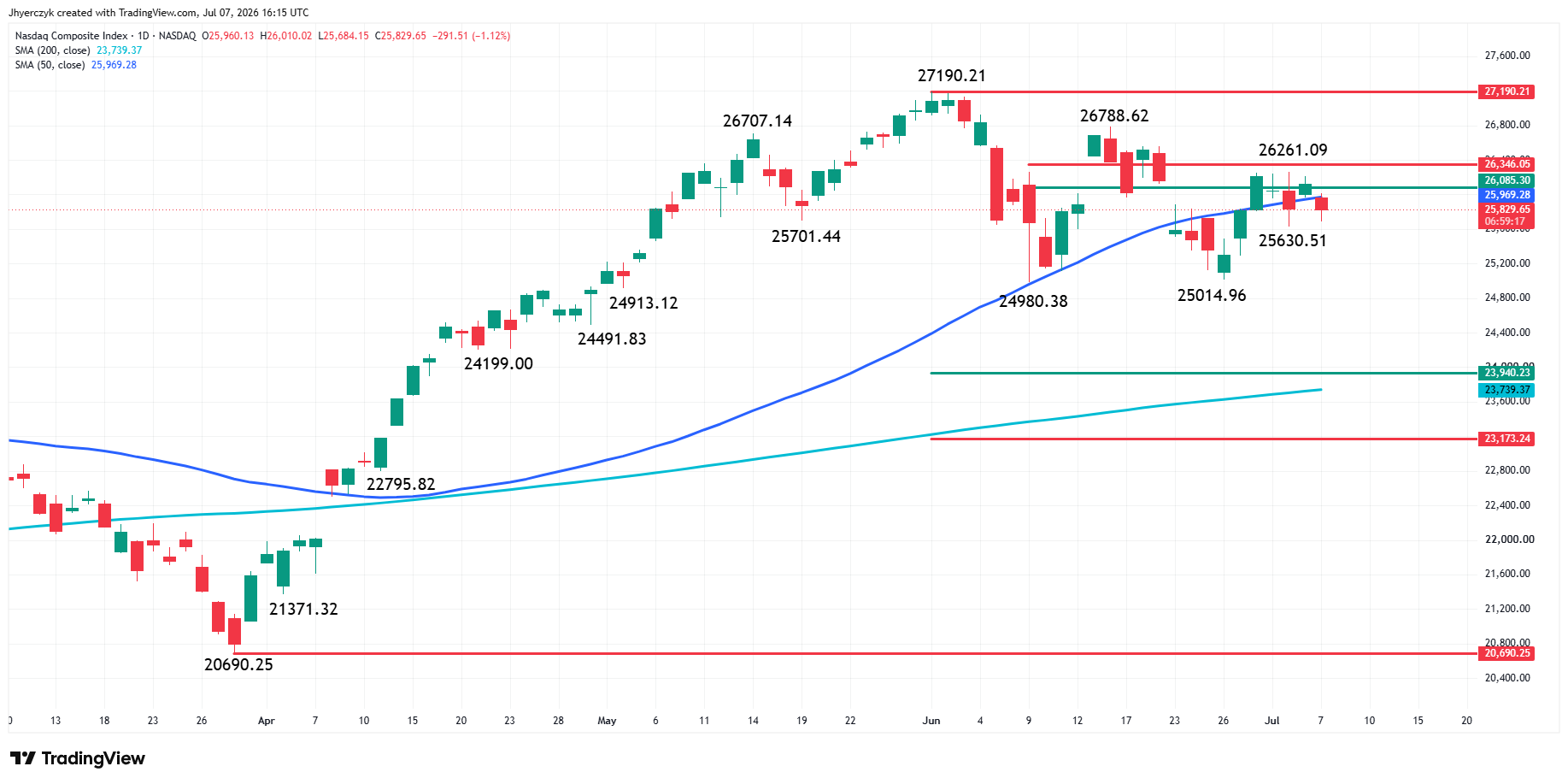
The Nasdaq Composite Index (IXIC) is trading lower and at risk of plunging if sellers sustain the weakness under the 50-day moving average at 25969.61. Additional resistance at 26085.30 to 26346.05 is helping to keep the pressure on the index and form another lower top at 26261.09.
Today, the selling pressure could begin to open up if the minor bottom at 25630.51 fails as support. The could lead bearish sellers to drive the index into the two main bottoms at 25014.96 and 24980.38. The latter is a potential trigger point for an acceleration to the downside with the long-term retracement zone at 23940.23 to 23173.24 and the 200-day moving average at 23739.54 the primary downside targets.
Daily S&P 500 Index (SPX) Technical Analysis
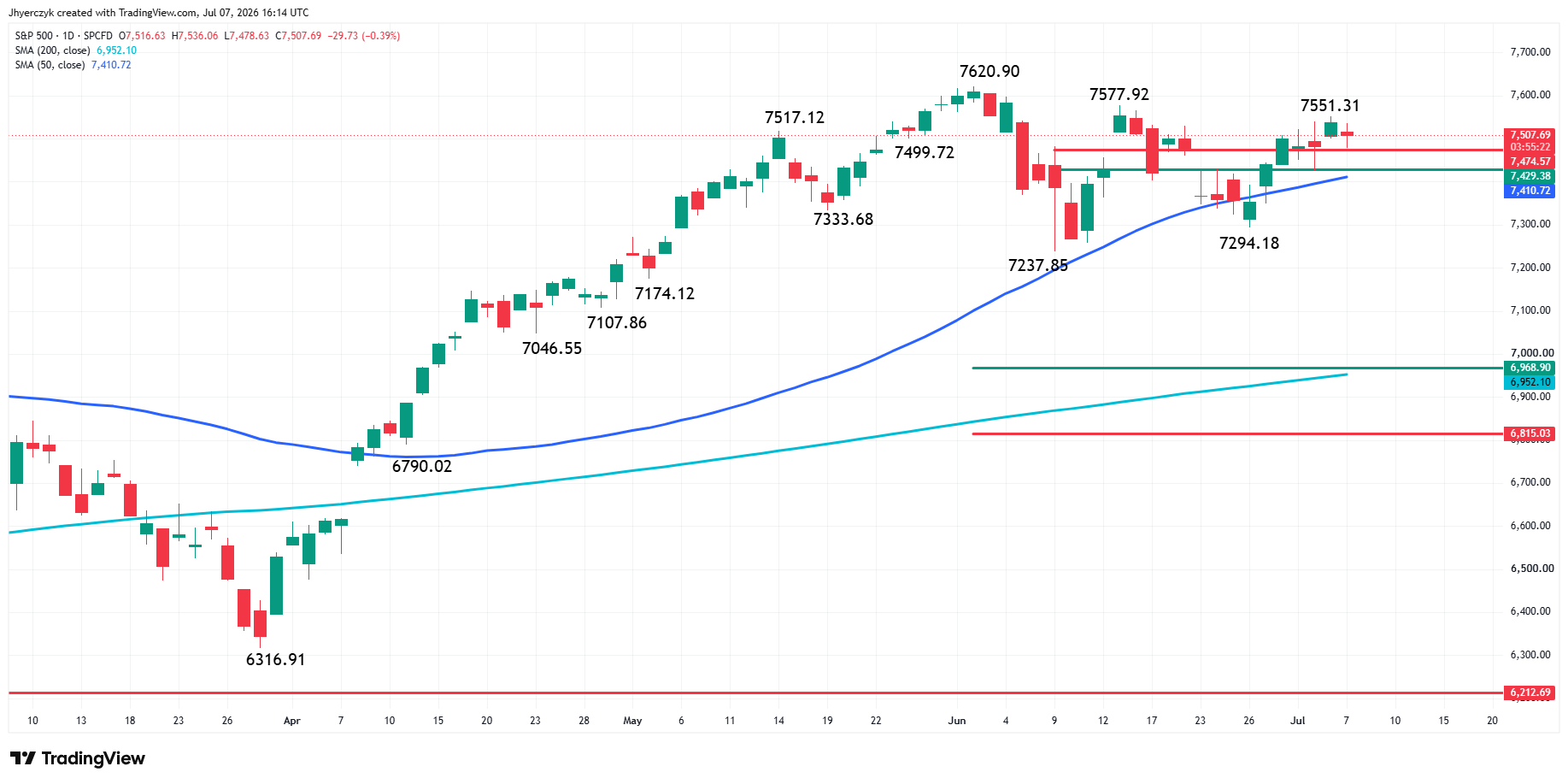
The S&P 500 Index is lower at the mid-session on Tuesday after failing to continue yesterday’s rally. The move stalled at 7551.31, which put it just below the secondary lower top at 7577.92. A third top will be a sign of weakness.
Propping up the market is the short-term retracement zone at 7474.57 to 7429.38 and the 50-day moving average at 7410.62. The collapse of this loose support cluster will send a signal that the selling pressure is increasing. The downside momentum created by the move will put the swing bottoms at 7294.18 and 7237.85 back on the radar.
Dow Jones Price Forecast
Every new Dow Jones analysis as it publishes, today's technical signal and key levels, live price — on one page.
See all Dow Jones forecastsBearish traders are looking to drive the index through 7237.85 and trigger an acceleration into the retracement zone at 6968.90 to 6815.03 along with the 200-day moving average at 6952.09.
Bullish traders want the retracement zone at 7474.57 to 7429.38 to hold, but more importantly, the 50-day moving average at 7410.73.
Daily Dow Jones Industrial Average (DJI) Technical Analysis
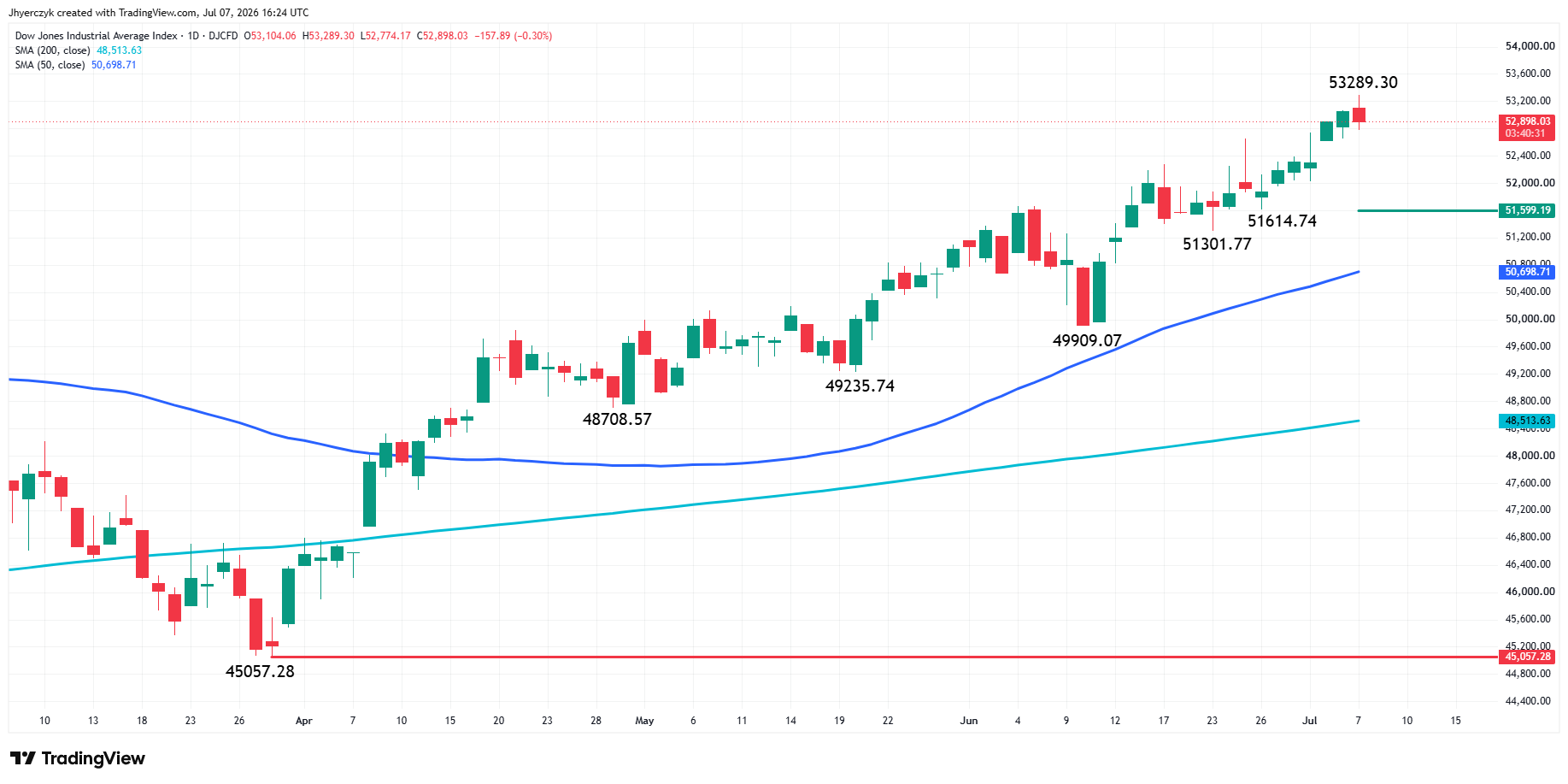
The Dow Jones Industrial Average is edging lower at the mid-session after reversing down from an earlier all-time high at 53289.30. The chart pattern suggests a potentially bearish closing price reversal top may be forming. This pattern won’t change the main trend to down, but if confirmed, it could lead to a pullback into the 50% level at 51599.19.
With the main trend up and the Dow still holding the 50-day moving average at 50698.94, buyers are likely to remain active on pullbacks into support like 51599.19.
The Chip Trade Is Breaking Down
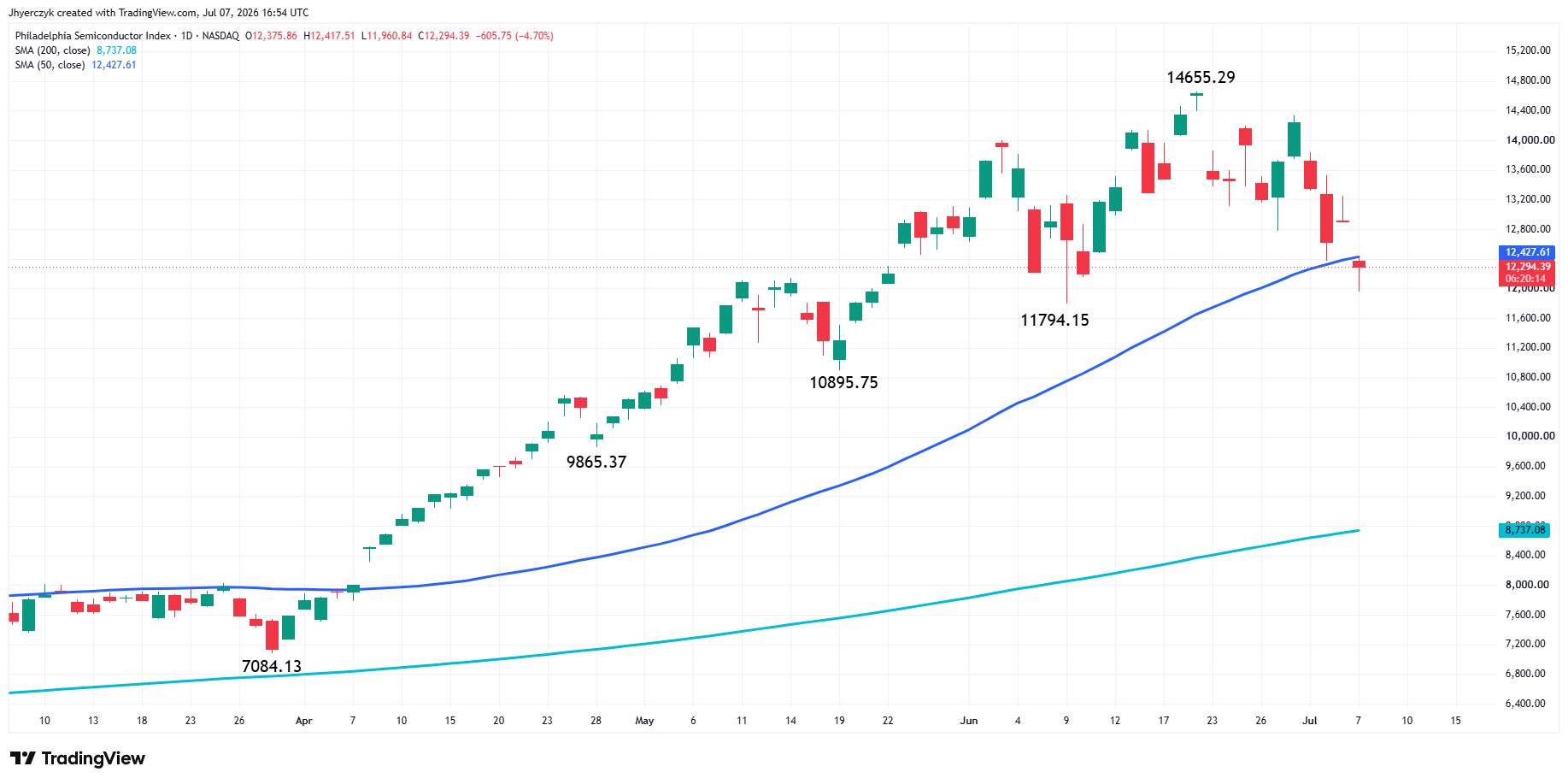
The Philadelphia Semiconductor Index dropped 5.5% on Tuesday to its lowest level in four weeks. Intel plunged 8.2% and Micron Technology fell 7.3%, while KLA, Marvell Technology, Broadcom and AMD all traded sharply lower. The VanEck Semiconductor ETF lost more than 5%. This is not one name dragging the group. Every major chipmaker on the board is red.
Nvidia slipped 1.8% after reports that Chinese AI startup DeepSeek is developing its own AI chip. That is a direct shot at the company carrying the AI hardware trade. One startup building one chip is not a business threat today. But the market is repricing the assumption that Nvidia owns the entire AI pipeline, and it is not waiting for DeepSeek to ship product before taking money off the table.
Samsung Beat by 19x and Still Got Sold
Samsung Electronics reported an operating profit that rose 19-fold in the second quarter and the stock sold off nearly 7% in Seoul. The numbers were strong on their own. The reaction tells you the expectations bar has moved past what even a blowout quarter can clear.
South Korea’s Kospi gave back nearly 5% on the Samsung session before the pressure carried into Europe and across Wall Street. One earnings report pulling global chip stocks lower tells you how stretched the positioning has become. Q2 results are going to be solid when they come in. The problem is the expectations going into this reporting season are running well above where they were for Q1, and Tuesday proved the market will sell strong numbers that do not clear the new bar.
SK Hynix begins trading on the Nasdaq later this week. That listing is the next test of whether money is willing to come back into chip stocks at current prices or whether the rotation has further to run.
Buyers Moved Into Healthcare and Staples
The money leaving chips is not leaving equities. Healthcare and consumer staples led the session. Eli Lilly rose about 3%. Walmart advanced after announcing price cuts on products including ground beef and Coca-Cola. JPMorgan Chase and Microsoft also picked up buyers.
The rotation has been building for sessions and Tuesday’s semiconductor selloff gave it more fuel. Financials attracted money alongside healthcare and staples. The trade is not about getting out of the market. It is about lowering exposure to the sector where the valuation risk is highest and moving into names where the earnings bar is easier to clear.
Stocks in the News
Fiserv climbed 3.5% after reports the payments company held discussions with JPMorgan Chase, Bank of America and other large U.S. banks about selling its debit card payments infrastructure business.
SpaceX gave back 4.5% in its first session as a Nasdaq-100 component despite several bullish analyst initiations after the quiet period expired.
Rivian tumbled 13.3% after announcing plans to sell 75 million shares, overshadowing guidance that projected second-quarter revenue above estimates.
Brent crude traded above $73 and West Texas Intermediate pushed above $70 after reports of attacks on vessels near the Strait of Hormuz.
What to Watch
The chip selloff is running the market and earnings season is about to test whether it accelerates or stalls. Samsung’s blowout quarter got sold. SK Hynix lists on the Nasdaq this week. Every semiconductor report from here walks into expectations that Q1 set too low and Q2 hype raised too high. The rotation into healthcare, staples and financials keeps building as long as chip stocks give money a reason to leave. The Dow posted a record high and reversed in the same session, which tells you even the broadest index cannot hold gains while tech is getting repriced.
Wednesday’s release of the June FOMC minutes gives traders their first detailed read on how Chair Kevin Warsh is approaching monetary policy. The Nasdaq is pressing the 50-day moving average and the S&P 500 is sitting on a retracement zone above its own 50-day. If the chip selling carries into Wednesday, those levels determine whether this stays a sector rotation or turns into something the rest of the market has to deal with.
More Information in our Economic Calendar.