


Natural Gas Edges Lower Sunday as Domestic Bears Outweigh Middle East Bullish Factors
U.S. natural gas prices are edging lower on Sunday. My work suggests traders are more focused on bearish domestic issues rather than the potentially bullish conditions due to the closure of the Strait of Hormuz.
At 02:34 GMT, April Natural Gas futures are trading $3.121, down $0.010 or -0.32%.
Warm Weather Eroding Late Season Demand
One of the biggest factors weighing on U.S. natural gas prices is warmer weather forecasts. At this time, Spring warmth is eroding late season demand. The country is currently divided with frosty temperatures east of the Mississippi River, and warmer temperatures west. Some areas in the west are seeing near record warm temperatures, while talk of a blizzard dominates portions of the east.
According to NatGasWeather from March 13 to March 19, we’re expected to look for light demand through the weekend then stronger Monday-Wednesday.
Record Production and Storage Flipping to Surplus
High production levels are another major reason prices are struggling to gain ground. U.S. natural gas output is currently hovering near record levels, especially from the shale regions like the Permian Basin, Appalachia, and Haynesville. In my opinion, even with the global energy markets facing disruptions, the U.S. still has plenty of domestic gas available. Additionally, storage is getting close to flipping from deficit to surplus against the 5-year average. This large supply is what’s keeping traders cautiously bearish over the short-term.
I Was Right About Europe but Wrong About Prices
At the start of the war between the United States and Iran, I was bullish for natural gas because I thought supply disruptions in the Middle East, would drive up prices in Europe, forcing the region to turn to the U.S. to make up the shortage. I was right about the developments, but I haven’t seen a big jump in gas prices, just a normal underpinning of prices.
Natural Gas Price Forecast
Every new Natural Gas analysis as it publishes, today's technical signal and key levels, live price — on one page.
See all Natural Gas forecastsLNG Terminals Running at Full Capacity
Normally, global energy tensions push U.S. prices higher, but according to reports, export limits are capping gains. I have found out that U.S. LNG terminals are already running near full capacity, so the U.S. cannot export LNG fast enough even with the jump in international demand.
Reports show that the extra domestic supply is staying in the U.S. instead of moving to Europe, for example where prices are higher. This is what’s keeping futures prices stable as we start shoulder season.
The Technical Picture
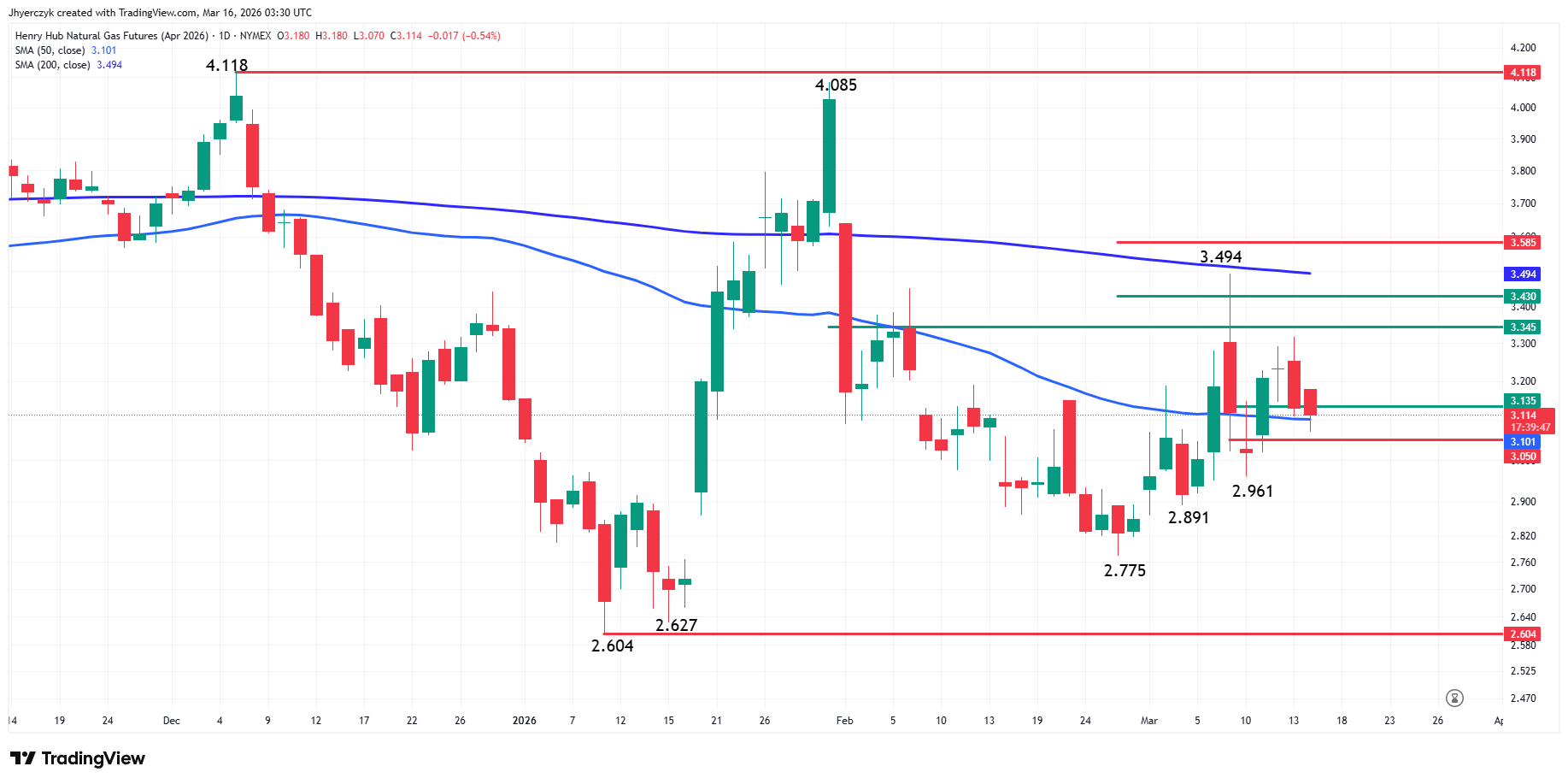
Technically, the swing chart and the 50-day moving average show that April Natural Gas futures are in a weak uptrend. The daily chart also indicates that it is going to take a sustained move over the next swing top and the 200-day moving average at $3.494 to really shake up the market.
On the downside, a sustained break under the 50-day MA at $3.101 will signal the presence of sellers. Crossing to the weak side of the 61.8% level at $3.050 will indicate the selling is getting stronger, while a break under the swing bottom at $2.961 will shift momentum to the downside.
No Cold Weather Catalyst in Sight
Looking at the fundamentals again, the biggest factor that I see that could quickly change the cautiously bearish outlook is a colder-than-expected weather pattern, and I don’t see one at this time.
More Information in our Economic Calendar.


