Natural Gas Holds Gains Ahead of EIA Report as European Supply Fears Linger
U.S. natural gas futures are slightly higher early Thursday as traders await the release of the latest weekly government storage report. The market is up for the week, but down from its weekly high at $3.188. The hint of volatility this week is being fueled by concerns over European supply. It is being impacted by the war between the United States and Iran, which is preventing the transportation of LNG from the Middle East.
At 10:13 GMT, April Natural Gas is trading $2.963, up $0.046 or +1.58%.

NYT Iran Report Sparks Selloff — Then Iran Calls It Fiction
After a price surge on Tuesday took the market to its highest level since February 26, the market fell hard after the New York Times reported that Iran was ready to negotiate the end to the conflict. The news eased concerns that a prolonged war could disrupt Middle Eastern gas supplies. Prices stabilized late yesterday after Iran’s semi-official Tasnim news agency implied the NYT report was a work of fiction, calling it “pure falsehood and psychological warfare.”
Trump’s Hormuz Pledge and Qatar Shutdown Add to the Mix
Natural gas was also impacted negatively by comments from President Trump, who said earlier in the week the U.S. will protect energy shipments through the Strait of Hormuz and even issue insurance guarantees by promising naval escorts. The shutdown of energy flow in the region has had a major impact on European natural gas prices, sending its benchmark price to a 3-year high on Tuesday. According to reports, Qatar’s Ras Laffan plant, which accounts for about 20% of global LNG supply, has been shutdown since Monday. A prolonged disruption of LNG to Europe could boost U.S. energy exports, and consequently domestic natural gas prices.
Weather Turns Warmer as EIA Report Looms
Moving on to the weather, the Commodity Weather Group is predicting a shift to slightly warmer, with above-average temperatures expected across high demand areas on the East Coast through March 13.
Today’s key report is from the U.S. Energy Information Administration (EIA). It is expected to show natural gas inventories fell by 124 Bcf for the week ending February 27. A consensus of analysts is calling for a 122 Bcf decline.
Natural Gas Price Forecast
Every new Natural Gas analysis as it publishes, today's technical signal and key levels, live price — on one page.
See all Natural Gas forecastsBullish Secondary Bottom Forming Inside $2.775 to $3.188 Range
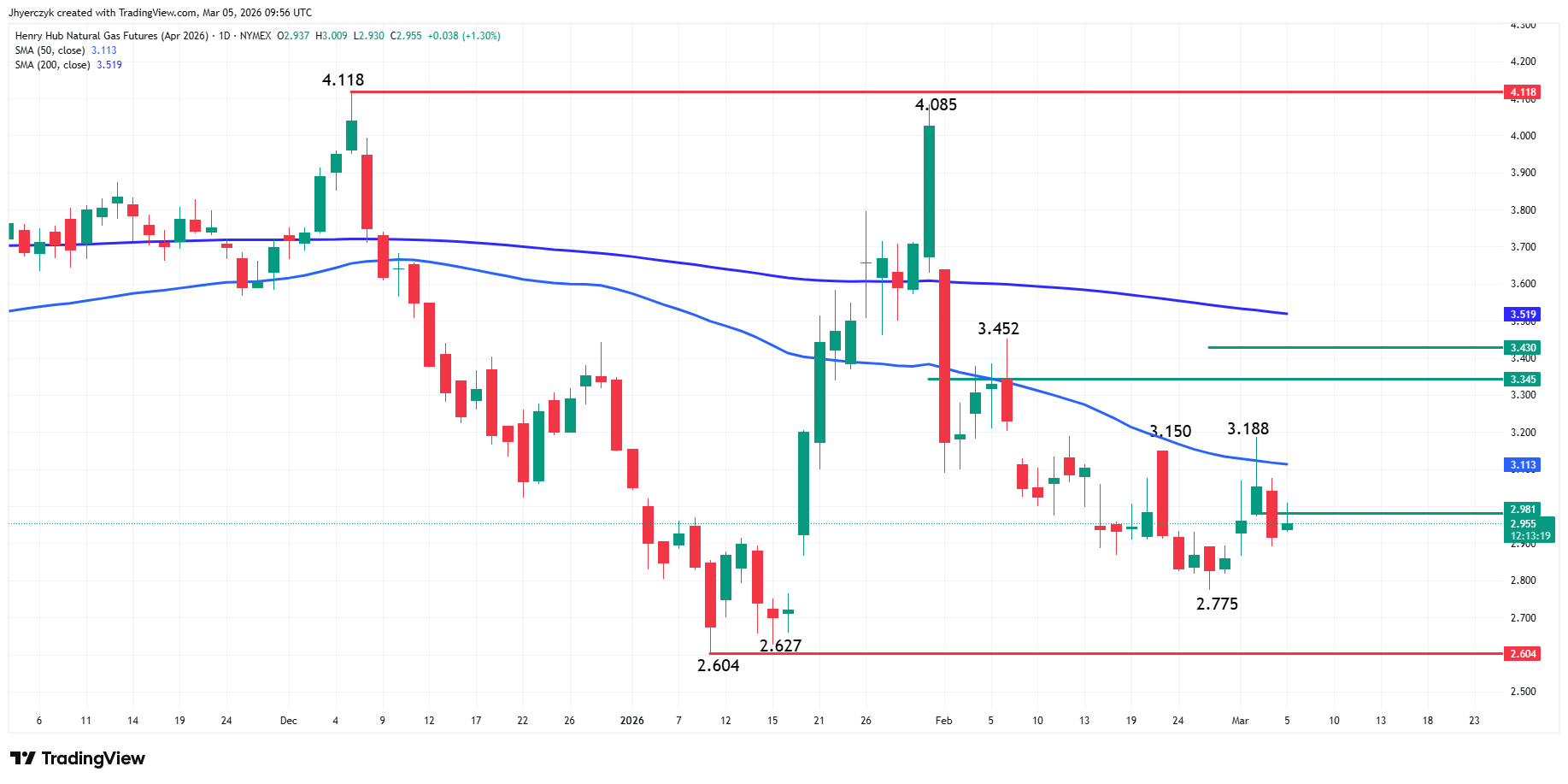
Technically, the trend is down according to the 50-day moving average at $3.113. A sustained move under this level could generate the downside momentum to challenge last week’s low at $2.775. If this price fails to hold then pencil in $2.627 to $2.604 as the next two targets. Overcoming the 50-day MA with conviction, however, could launch a rally into a pair of pivots at $3.345 and $3.430. The 200-day MA at $3.519 could also come into play.
According to the swing chart, April natural gas is trying to form a potentially bullish secondary higher bottom. The longer it consolidates inside the $2.775 to $3.188 price range the greater the chances of an upside breakout if more natural gas facilities in the Middle East are damaged from Iranian bombs and Europe has to turn to the United States for LNG.
More Information in our Economic Calendar.